Arkansas’ big man is a master at taking charges. What can Kentucky do about it?
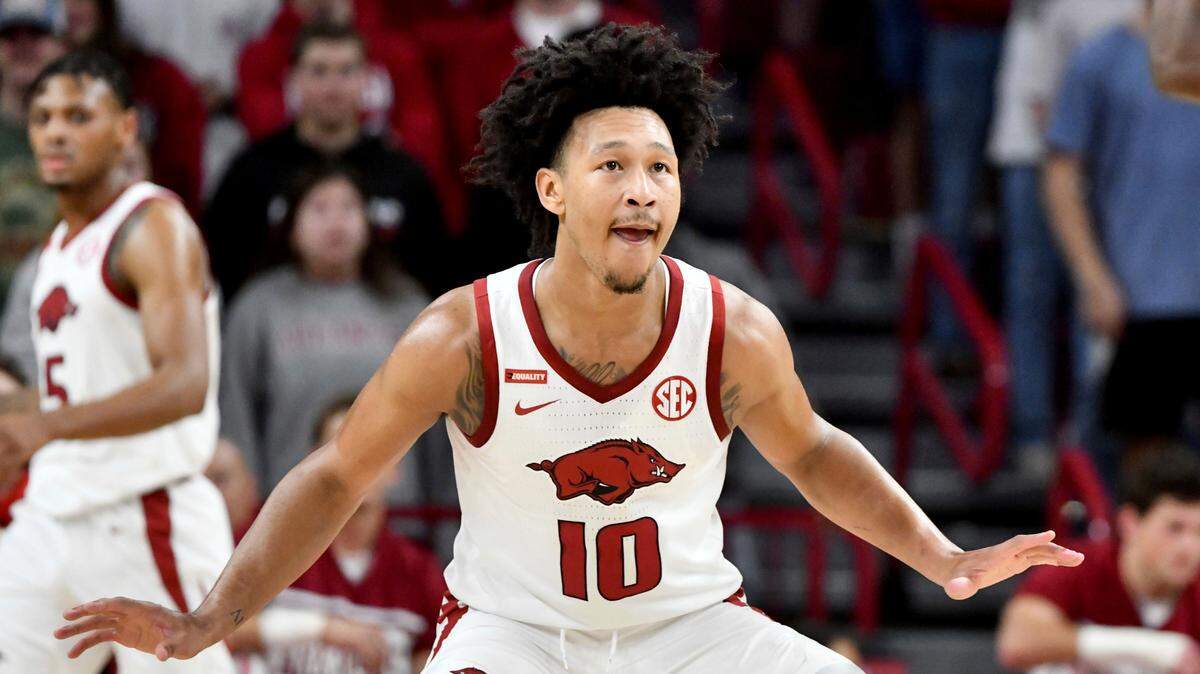
If Kentucky wonders how Saturday’s game at Arkansas is going, a glance at the scoreboards in Bud Walton Arena will provide a clue.
But the score of the game will not be the only indicator. There’s also the “charge counter” to consider.
Much as UK students keep an updated total of Oscar Tshiebwe’s rebounds in home games, so Arkansas counts charges taken by Jaylin Williams.
So far this season, Williams has taken 44 charges, which is more than the Razorbacks have taken as a team in two of the five previous seasons in which the program has counted this statistic.
The Williams-Tshiebwe matchup has the makings of an intriguing strength-against-strength competition. But Arkansas Coach Eric Musselman tried to downplay the notion of a one-on-one showdown.
“This is not a one-positional matchup,” he said Wednesday. “It’s gonna be a five-man committee on the glass and a five-man committee guarding not just Kentucky’s star players but every night that we play.”
After Kentucky beat LSU on Wednesday, Tshiebwe voiced confidence that John Calipari and his staff would prepare him to face a charge-taker like Williams. The coaches consider ways to avoid foul trouble, Tshiebwe said, “especially me because I think my team really needs me because I help my teammates a lot.”
Earlier this week, associate coach Orlando Antigua said such preparation would have to consider the player trying to take charges.
“Is it a guard who likes to slide under you?” he asked. “Is it a big man who likes to flop when you drop your shoulder?”
Williams is a 6-foot-10 sophomore.
Of course, being called for a charge can cause frustration.
“The frustration will come when you’re not prepared and being mature about how you respond to things,” Antigua said. “We talk to our guys about emotional intelligence and being mature about how you respond to things. Those calls are things that are never overturned with an emotional reaction.
“You let the coaches deal with that. Don’t talk to referees. You just keep playing.”
After his team lost 58-48 at Arkansas last weekend, Tennessee Coach Rick Barnes vented on his postgame radio show.
“The guys not gun shy because every time they went in there, there was a charge called . . . ,” Barnes said. “I’ve got issues with the way I thought it was officiated. . . . Did some frustration set in with our guys on some of the calls? Absolutely. . . . They felt they had gotten airborne and weren’t allowed to finish with guys sliding in.”
Barnes added that prior to the game he had advised his players of Arkansas’ willingness to take charges.
“They’re not a real shot-blocking team,” the Tennessee coach said. “They’re going to try to slide in and take charges. It changed the entire game from our end.”
On a Zoom call Wednesday, Williams said he had been trying to take charges “my whole life.” His father worked with him to be a help defender, he said.
Williams attended Fort Smith (Ark.) Northside High School. Incidentally, that’s the school that produced former Arkansas guard Isaiah Joe, who led the team in charges taken in the 2018-19 and 2019-20 seasons.
“You’re talking about two guys in Isaiah and Jaylin that have a high IQ for the game of basketball. . . . ,” Northside High School Coach Eric Burnett told the Arkansas Democrat Gazette last year. “You can tell both of them have studied the game really well.
“They know if a guy’s out of control coming to the hole. ‘I’m going to just slide over there and take this charge.’
“To me, that’s just being in the right place at the right time and knowing how you can make an impact on the game.”
Most big men do not look to take changes, Burnett said, adding, “They want to jump up there and block everything. And sometimes Jaylin will rotate over to get a block. But sometimes he takes guys out and out-smarts them and says, ‘OK, c’mon. I’m just going to take a charge.’”
Williams said he studies film to try to learn an opponent’s tendencies. He called Tshiebwe “one of the best rebounders ever” and a player who has posted “crazy” statistics this season.
Vanderbilt Coach Jerry Stackhouse saluted Williams’ sense of anticipation.
“He’s super smart . . . ,” Stackhouse said. “He just sees the next play a little bit quicker than a lot of guys his size. He’s more of a guard, almost from a point guard standpoint where he sees the next play ahead.”
Of course, pain can be a price to pay for taking charges. Williams said he wears a pad around his waist to soften the blow.
Williams acknowledged being surprised at times when opponents challenge him on drives.
“Yeah, sometimes I’m thinking what are these guys doing?” he said. “But there’s also times when some guy will see me down there and they will completely stop their drive mid-dribble.
“I just try to get in position. It’s just something I go into a game thinking about.”
Williams’ in-game contribution extends beyond taking charges. He is averaging 10.4 points and 9.6 rebounds.
Williams also averages 2.75 assists. His assist-to-turnover ratio of 1.54-to-1 would rank 10th among Southeastern Conference players if he met the standard of 3.0 or better assists per game to be included in that statistical category.
“He’s our best facilitator,” Musselman said. “I can’t play him at the point, but we need his passing. He’s a willing passer. He’s got great vision. . . . He does a great job of reading the defense. He doesn’t try to make any outlandish passes. He reads it. He delivers it. He throws two-handed chest passes.”
Like Tshiebwe, Williams brings an upbeat presence to basketball. It’s not unusual to see him break into a smile during a game.
“He brings joy to the game,” Musselman said. “He brings joy to practice every day. He’s such an upbeat personality, and that rubs off on other people from a personality standpoint.”