Nobody seems to like college basketball’s goaltending review rule. Are changes coming?
If you’ve been watching a college basketball game this season, found yourself outraged by the sport’s new goaltending review rule, and gone looking for affirmation online, you probably haven’t had to search long to find it.
Social media has been abuzz with complaints. And it’s not just enraged fans upset at a call that didn’t go their way. College basketball pundits have been talking and posting about the rule on a regular basis, and TV announcers have brought it up on national broadcasts.
College basketball coaches — not exactly known as the most patient and understanding of human beings — have often voiced their displeasure, especially in the heat of the game.
In case you’ve somehow missed it to this point in the 2023-24 campaign, here’s the rule in question:
Referees can now use instant replay to determine if a goaltending call is correct only when a call has been made on the floor. If the violation occurs in the final four minutes or at any point in overtime — or if the officials are already at the monitor for another reason — it’s reviewed immediately. In pretty much all other cases, it’s not reviewed until the next TV timeout.
Pretty simple, right? It’s been anything but for much of this season.
There have been a number of complaints related to the new rule, but it stemmed from the wishes of some of those who have been complaining the loudest (in the moment, at least).
Chris Rastatter, the NCAA’s national coordinator of men’s basketball officiating and a former college basketball referee who has worked 19 NCAA Tournaments, spoke with the Herald-Leader about the origin of the rule, some of this season’s criticisms, and what might be done about it moving forward.
Why was it implemented in the first place? To get the calls right, of course.
“Coaches wanted to be able to review it,” Rastatter said. “I was in the room when the discussion first came up.”
The NCAA rules committee always invites an officiating coordinator and an active referee to sit in on its meetings regarding possible changes to make the game better, and Rastatter was around in that capacity when the discussion began.
“We had a really good conversation,” he said. “And I told all the coaches and everybody in the room: ‘Here’s what’s going to happen. You’re going to review it, and it’s not going to be (goaltending). And it’s a free ball, no team control, so you’re going to go (alternate possession). So you’re going to lose the ball when you should’ve gotten it, because of the (alternate possession).
“And the coaches said, ‘We don’t care. We want to get it right.’ And they still stand with that now. It’s more important to get it right and get the points on or off the board based on the play.”
If a goaltending call is reviewed right away and determined to be wrong, the officials must determine if either team gained clear possession when the call was made. If so, that team gets the ball. If not, it’s determined by the alternating possession arrow.
If the goaltending call is reviewed at the next TV timeout and reversed, two points are taken away from the team that benefited from the bad call, and the play is counted as a blocked shot.
A common complaint so far: When a call is later reversed, it obviously changes what would have happened in the moment if it was never called in the first place. But to get it correct — unless every referee is perfect, which isn’t the case — sacrifices must be made. You can’t go back and replay the game from that point. And reviewing every call as soon as it’s made still wouldn’t completely fix that issue (but it would prolong the time of the game, which no one wants).
“For the most part, I think it’s pretty good,” Rastatter said. “It’s certainly an improvement. And we’re getting more of them correct, which, ultimately, is what we’re trying to do. There are those plays where possession consequence will come into play because we blew the whistle and there’s no team control. But again, we talked about that. We talked about that as a group with the referees, but we also talked about it with the coaches.
“And they understand it. We want to get it right.”
The Kentucky effect
For Kentucky, this rule has come into play several times over the course of the season.
At least a couple have had potentially major impacts on the result of the game.
In one — at Texas A&M in January — the Aggies were called for a goaltend on a D.J. Wagner fast-break layup. The call was reversed at the next TV timeout, and UK’s two points came off the board. But, had that play stayed live, the offensive rebound fell right into the hands of Ugonna Onyenso, who started to go back up at the time when the whistle blew. (He missed the putback, but the call was made before his attempt.) If no call had been made, UK still might have scored. If it had been reviewed right away, the rule would have given the ball back to Kentucky, since Onyenso secured the rebound. (The Cats also had the possession arrow at the time.) Instead, they ultimately lost two points, and Texas A&M got the ball. The Aggies scored on that possession.
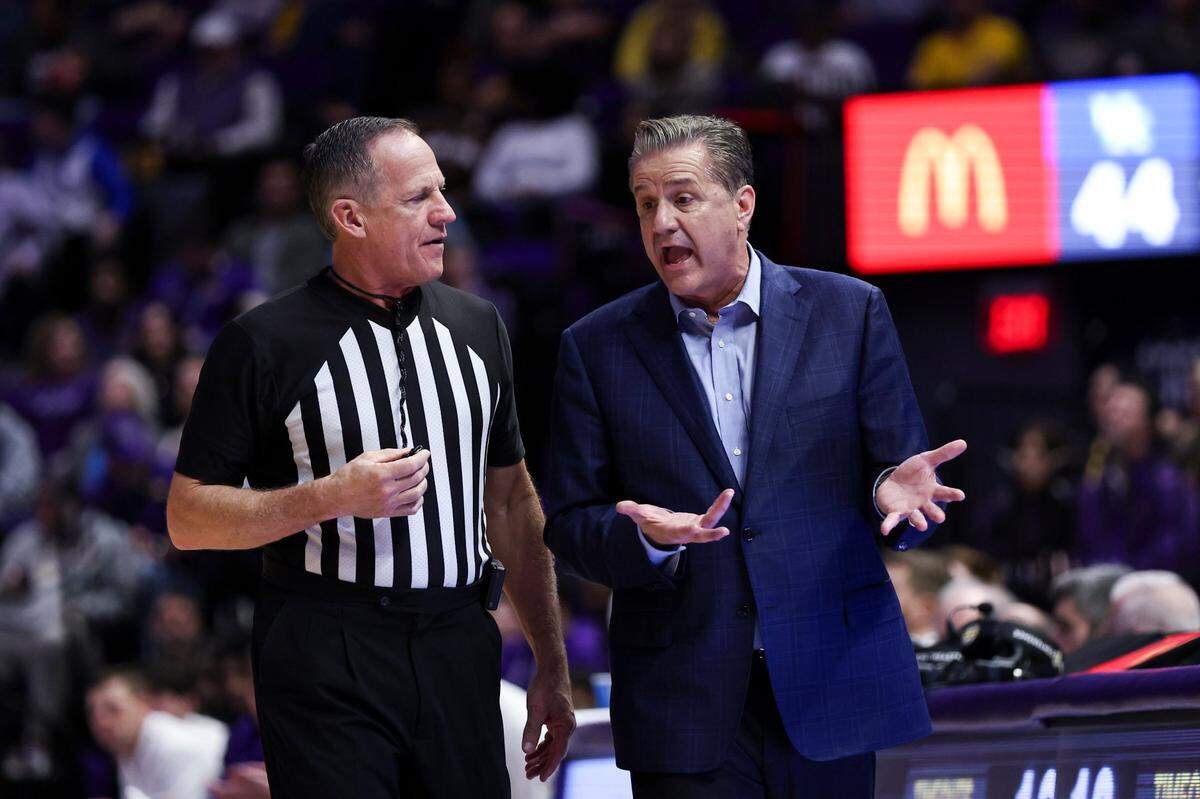
More recently, Adou Thiero came out of nowhere to block a shot in the second half of a game at LSU, but it was whistled as a goaltend. The ESPN announcers questioned the call before even seeing the replay. Thiero immediately motioned that it needed to be reviewed. John Calipari was upset on the sideline. The officials ensured Kentucky’s side that they would look at it at the next TV timeout. But the damage was done.
At the point of that play, LSU led 56-54 with 9:18 left. The call was later reversed — and two LSU points were taken off the board — but it could have been a bigger swing for the Cats if the call was never made in the first place. Thiero’s block landed in the hands of Rob Dillingham, and the lightning-quick freshman took off down the court with the ball, no one between him and the basket. Instead of two Kentucky points on the fast break, the Cats got none. On the ensuing possession, Thiero missed a 3-pointer, and LSU got the rebound. So, no points on that trip.
LSU beat Kentucky 75-74 on a buzzer-beater.
Even though both games were close, it obviously doesn’t mean Kentucky would have won either of them if neither call had been made. But, in both instances, the Wildcats surely would have welcomed the extra points.
For the sake of alternate history, if UK had won both games, the Cats would’ve gone into their finale at Tennessee on Saturday with a seven-game winning streak, a 14-3 record in the SEC, a chance to win the league title outright and a double-bye in next week’s conference tournament secured. Their NCAA Tournament résumé would also look a lot better.
Calipari didn’t blame either call for either loss. But he voiced his displeasure both times.
He wasn’t alone.
“Goaltending replay is one of the worst rules ever passed in college hoops,” Hall of Fame college basketball writer Mike DeCourcy posted on X the night of the UK-LSU game. “Just tonight I’ve seen three atrocious goaltend calls that were obviously wrong. All were changed. ‘Oh, we’ll just fix it when we review.’ Not that simple. The crummy call changed the game flow. It’s a mess.”
And that brings us to another major complaint regarding the new rule.
‘Trust your gut’
Whether it’s truth or perception, there’s a narrative out there that referees have been erring on the side of caution and calling goaltending if there’s any question at all on a play, knowing they’ll just be able to go back and review it at the next TV timeout. (If no call is made on the floor, the play cannot be reviewed, according to the rule.)
If refs are indeed doing that, they shouldn’t be.
“My preference would be we referee the play for what it is, and trust your gut,” Rastatter said. “Referee the play. Because if you start thinking, ‘Oh hey, I’m going to beat the system here. I’m going to play the odds and referee to the video,’ you’re going to lose. It’s kind of like the shot-clock violation. ‘Oh, I’m not going to call it unless it goes in, because I know I can review it.’ If your gut says, ‘Hey, that’s a violation.’ Then call it.”
When Thiero’s play at LSU was described to the head of NCAA officiating, he made clear that — if it was an instance of an official leaving his options open — that was not the intent of the rule or the correct approach.
“I don’t want that to be the norm,” Rastatter said. “And we’re pretty good at it, even though it’s a really, really hard play. Our referees are good. We get most of those right anyway. So just trust your gut. And if it’s not, don’t (call) it. And we teach how to referee, who should be blowing (the whistle) on what particular type of play it is — where it comes from, where you are on the floor, what kind of angle you have on the play. We talk about all that stuff.”
Rastatter, who was an active NCAA referee for nearly three decades, did say that goaltending was one of the two most difficult plays to call when he was on the court, along with out-of-bounds plays.
“These plays are so hard,” he said of goaltending. “Because on some of them, it’s like, ‘Where did he come from?!’ And all of a sudden they get to the ball. Like, ‘Holy crap.’ So it’s such a hard play to referee to begin with, and that was the other aspect. You’ve gotta get it right. Because you’re talking about points.”
When guys like Thiero — an incredibly athletic, quick-twitch player who can cover a lot of ground in an instant — are on the court, they can fly in out of nowhere and make a play on the ball, doing it so fast that referees’ eyes can’t track it all at once. That, obviously, makes arriving at the correct call a huge challenge.
The NCAA doesn’t keep stats on it, but Rastatter did say that it seemed to him like there have been more basket interference and goaltending plays recently. He said that could be because so many teams have shifted their style of play to a more free-flowing approach, which lends itself to a faster pace and more shots, in general. The tweaking of the block-charge rule — a change that has been met with widespread acclaim — has also helped open up the game.
“Especially in the SEC, it’s very up and down,” he said. “It’s very free-flowing, and there are a lot of good athletes. So it just seems like there are a lot of plays at the rim. And I think that was part of the impetus behind the rule. Because there are so many of those plays.”
.JPG "LEX_20231216_UKvUNC_2391 (1).JPG")
Changes to the rule?
The rule is clearly not perfect, but it’s probably not going anywhere. As Rastatter said, officials are getting the calls right in the end, and when actual points hang in the balance, that’s going to be paramount.
Can anything be done to make it better?
Some March Madness soothsayers on social media have already predicted that one of these calls could change the dynamic of an NCAA Tournament game, possibly affecting the ultimate outcome of one of those all-important matchups as a result. Rastatter made it clear that nothing regarding the rule would be changing between now and the start of the tournament.
That isn’t to say it will stay exactly the same long-term.
One possible change: opening up the review process even further to be able to take a look at plays that don’t get called on the court. This was Calipari’s only postgame complaint following the loss at Texas A&M. When asked by the Herald-Leader about the sequence that went against the Cats, he said there was another Aggies block that he asked the officials to review, but — since that play was not whistled on the court — the refs (correctly) told Calipari they couldn’t look at it.
“If you’re gonna do that call, then do the other one,” he said. “It’s the difference in a game.”
There, Calipari might get his wish.
Rastatter told the Herald-Leader that he expects there to be a discussion among the NCAA rules committee — after the Final Four — that would allow officials to review goaltending plays that don’t get called on the floor.
“I’m sure that will come up,” he said.
These reviews would probably follow the current rule, meaning any play in question could be looked at during the next TV timeout, unless it came in the final four minutes of the game or in overtime. (And the difference with late-game situations, as Rastatter confirmed, is that players and coaches in those scenarios need to know the actual score. Decisions made in the final minute of a game, for instance, will be different depending on the score. Teams don’t usually change the way they play based on a two-point difference with 16 minutes left, for example.)
One benefit of allowing non-calls to be reviewed at the next TV timeout would be — if referees are indeed currently whistling anything close as a goaltend, since they know they can review it later — letting play continue so the natural result of a legal blocked shot could play out.
Whether the rule gets tweaked or not, it’s likely to be a topic of discussion among referees and officiating coordinators this offseason. Rastatter said plays like these will always be a “teaching point” for referees, and the principles behind such calls can be emphasized in offseason meetings.
“You want to keep the flow,” he said. “And when the game’s going up and down and it’s really good — a lot of rhythm — and everybody’s on the same page, referees and players, it’s a blast. And when you break that rhythm and you chop it up, well then it’s difficult for everybody. We walk that line every night.
“To me, it’s a level of concentration. Don’t get taken by surprise. Be ready for the play. And don’t guess. If you’re not certain, let it go. Don’t referee to try and beat the rule, though. That’s one of my things that I preach a lot. You’ve just got to referee the play.”
This story was originally published March 9, 2024 at 7:00 AM.