How referees could help Mark Pope’s offense become even more explosive this season
Whatever side of the game you’re on, Mark Pope’s offense is fun to watch.
There’s plenty of pace. Lots of 3-pointers. It’s an entertaining style that Kentucky plays.
But much of that beauty can be found away from the basketball. And while the Wildcats will get plenty of attention for their fast breaks and quick triggers this season, it’s those plays that begin away from the perceived action that will be the foundation for their offense.
If things go according to plan, they might even get a little help from the guys in stripes.
When the NCAA released its rule book for the 2024-25 season, one of the points of emphasis for referees related to “freedom of movement” and the need to focus more attention on that area.
“Our game is one of movement, screening action and cutters,” reads the directive. “Be diligent in calling fouls that inhibit both offensive and defensive players’ ability to move freely around the court with or without the basketball.”
That emphasis — if the officials actually follow through in games — could be a boon for Pope’s offense, which is predicated on players cutting away from the ball to space the floor, disorient the defense and open scoring opportunities for themselves and their teammates.
Chris Rastatter, the NCAA’s national coordinator of men’s basketball officiating, stressed that nothing has changed in the rules. He simply wants to see the proper calls made on the court.
“I just wanted to make sure it happens,” Rastatter said, when asked by the Herald-Leader for further explanation. “I just want to get us back to — look, our game is movement. It’s different than years ago, when I started refereeing. They ran their triangle and dumped the ball into the post from the wing, and that’s how we played. Now it’s five wide. There’s movement and athleticism.”
Rastatter said he was talking in the offseason with Georgetown head coach Ed Cooley, who noted how much more quick and athletic college basketball players are these days. Often, the only way to stop movement off the ball is to reach out and grab a cutter or run through a screener.
That, the NCAA’s top ref says, is what he wants his officials to be watching for this season.
“The freedom of movement is more off ball than it is on ball,” he said. “It’s allowing players to just run the floor and go wherever they want to go without impeding them illegally. Contact, that’s the feel and the art, right? We could put a whistle on so much more than we do. So it’s looking at that contact and judging it. ‘Is that marginal, incidental?’ You know, you’ve got 10 big athletes running, there’s going to be contact versus, ‘That’s illegal. That clearly affected that player’s balance and speed and rhythm.’ OK? Well, that play needs a whistle.”
That could play right into Pope’s hands.
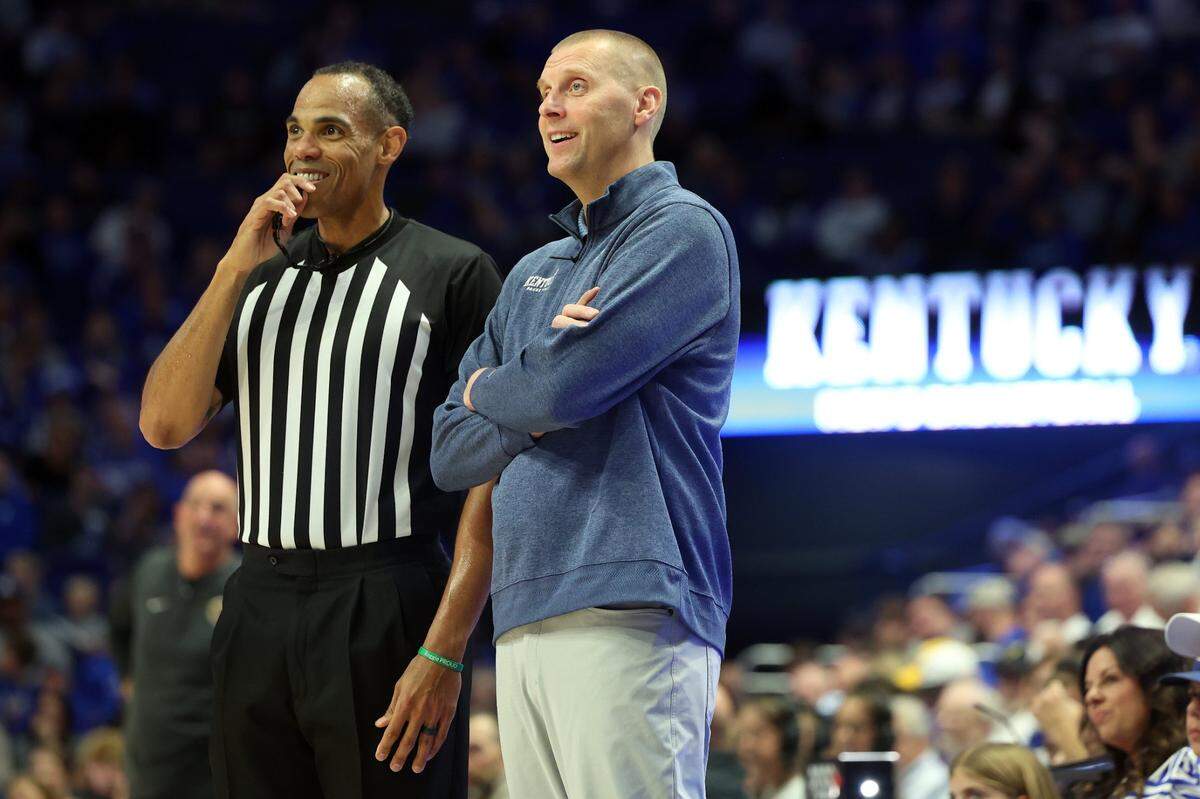
The new Kentucky coach found success with his offensive style featuring cutters, willing passers at all positions and a deep roster of 3-point shooters at BYU last season, and Pope has the personnel to take it up a notch in his first year with the Wildcats.
UK guard Jaxson Robinson — the leading scorer at BYU last season and the only Wildcat who had ever played for Pope coming into this one — said recently that his Kentucky teammates were “way ahead” of where Pope’s Cougars were at this stage, when it came to getting the finer points of cutting.
“It’s huge,” Robinson said. “Cutting opens everything up. He emphasizes playing off two feet. And then, just whenever your man loses sight of the ball, make sure that you’re cutting. It gets all of your teammates open. So, it’s a huge part of our offense.”
UK assistant coach Jason Hart, who spent a decade as a point guard in the NBA, works with the Wildcats’ point guards and helps fellow assistant Cody Fueger — known as the offensive coordinator for Pope’s teams — with the offense.
Hart called Pope’s approach an “NBA style” offense.
“So in the old NBA, guys would just have to sit in the corner, and you just watched Charles Barkley dribble, dribble, dribble,” he said. “When you’re cutting, it allows guys to make them feel like a part of the offense. So you cut hard enough, you may get your backdoor dunk or layup or something. So it’s an offense to where everybody on defense has to have a responsibility in guarding. And it takes pressure and stress off you, sitting there waiting for the ball.
“So that’s a great thing. A lot of movement.”
UK’s starting point guard, Lamont Butler, summed up his teammates’ approach simply: “We cut for each other.”
It’s contagious, and it’s celebrated.
Freshman guard Collin Chandler said Pope and the other coaches will call attention to cutting in practice and film sessions.
“We don’t want guys to feel like their cuts — or their things that aren’t on the stat sheet — that they don’t go unnoticed. They’re all important,” he said. “So I think the coaching staff has done a great job at highlighting that and helping everybody to understand that. …
“I know it’s not listed as an assist, but a cut down the lane to bring another defender — getting somebody a wide-open shot — is just as much of an assist as the pass is. So, it’s very important.”
Last season, BYU was second in the country in 3-point attempts, and Fueger said his goal this season is to have the Wildcats average 35 long-range shots per game. That got a lot of attention during the offseason, but what often goes unmentioned is that the Cougars also led the Big 12 in 2-point percentage last season.
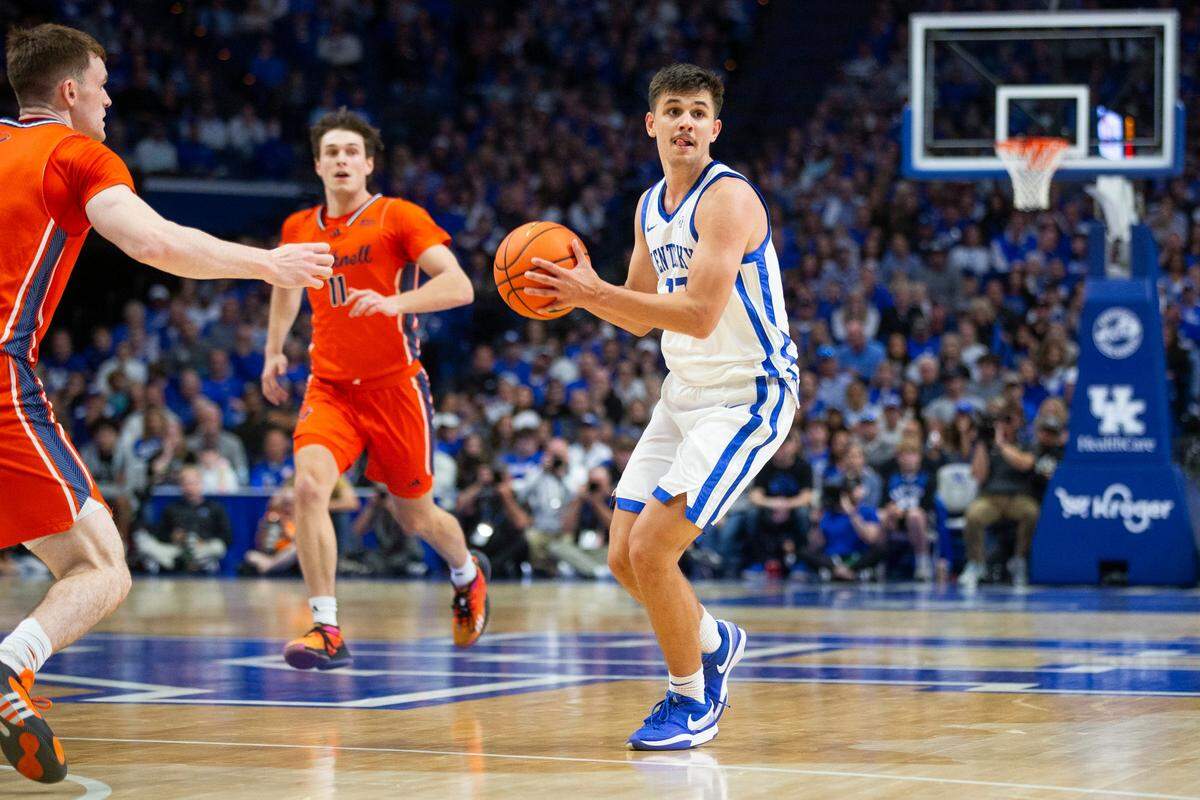
A major reason for that is all of that action off the ball. But it can’t just be action for the sake of action. When these Wildcats cut, they have to be all in, and the movement isn’t simply to open up possible 3-point attempts. The cutters have to be ready to score themselves.
“Everything that you do has to have some meaning behind it. We cut hard. We screen hard,” said starting guard Otega Oweh. “It’s not all just about the shooting. It’s about setting up the shooting and then the next moves after that. …
“If you don’t cut hard, they don’t really have to guard that cut, because they don’t see you as a scoring threat. So when you cut hard, it causes confusion between the defense. Like, ‘Oh, do I have to take him? Do I have to stay on the 3-point shooter?’ Someone’s gonna be open.”
Even when defenders play the Cats perfectly, all that movement can lead to scoring opportunities.
“It’s what makes us different,” said starting power forward Andrew Carr. “The pace we have in transition is one thing, but for us this year, we need to win games in the halfcourt, and the best way to be able to do that is by cutting as hard as you possibly can. We always talk about, in practice, ‘Cut harder than you can.’ And see what happens. Just cut as hard as you possibly can. And you know that’s gonna get either you open or create a shot for someone else by getting two people to help on you or something like that.”
Carr — a 6-foot-11 forward — is one of a few talented passers with lots of size on Pope’s roster. Starting center Amari Williams is known as an exceptional facilitator for a big man. Backup center Brandon Garrison is skilled in that area, too.
All will play away from the basket — and be looking for cutters — in Pope’s offense.
“It really helps the bigs who are out there at the 3-point line trying to read the defense,” Carr said. “If he doesn’t know whether you’re gonna finish your cut or not, he’s like, ‘Eh, I don’t know if I want to throw it or not.’ But if we always finish our cuts, we give the big the trust to throw the passes.”
Oweh noted that Kentucky’s players got an early feel for what is supposed to be called this season. During the summer, UK brought NCAA referees in to officiate scrimmages. Some of their whistles off the ball were a little different than what the returning college players were used to in the past.
“And they explained it, broke it down to us,” Oweh said on the point of emphasis this season. “I feel like that’s the benefit in cutting hard. You’re gonna get some foul calls. If not, someone’s gonna be open. … If you just cut hard, something good’s gonna happen.”
If the refs consistently call such fouls throughout the season, a lot of good could come the Cats’ way.
“If there was one common theme from the feedback I got last year from coaches during the season — and even in the postseason — was the game, at times, gets too physical,” Rastatter said. “We allow too much contact that impedes players illegally. So I take that to heart. I didn’t disagree with them. So, that’s the conversation going into the season.”
Next game
Lipscomb at No. 19 Kentucky
What: BBN Invitational
When: 7 p.m.
TV: SEC Network+
Radio: WLAP-AM 630, WBUL-FM 98.1
Records: Lipscomb 2-2, Kentucky 3-0
Series: Kentucky leads 2-0
Last meeting: Kentucky won 88-50 on Dec. 15, 2012, in Lexington