Travis Perry is getting a chance for Kentucky basketball. How can he make the most of it?
Lamont Butler can’t play every single minute of every single game. Kerr Kriisa can’t play at all, the foot injury he suffered a month ago still relegating him to crutches, with no clear timetable for a return to the basketball court.
That means Kentucky needs some help at the point guard spot. And that’s led to an earlier-than-expected opportunity for Travis Perry to play some meaningful minutes against formidable foes.
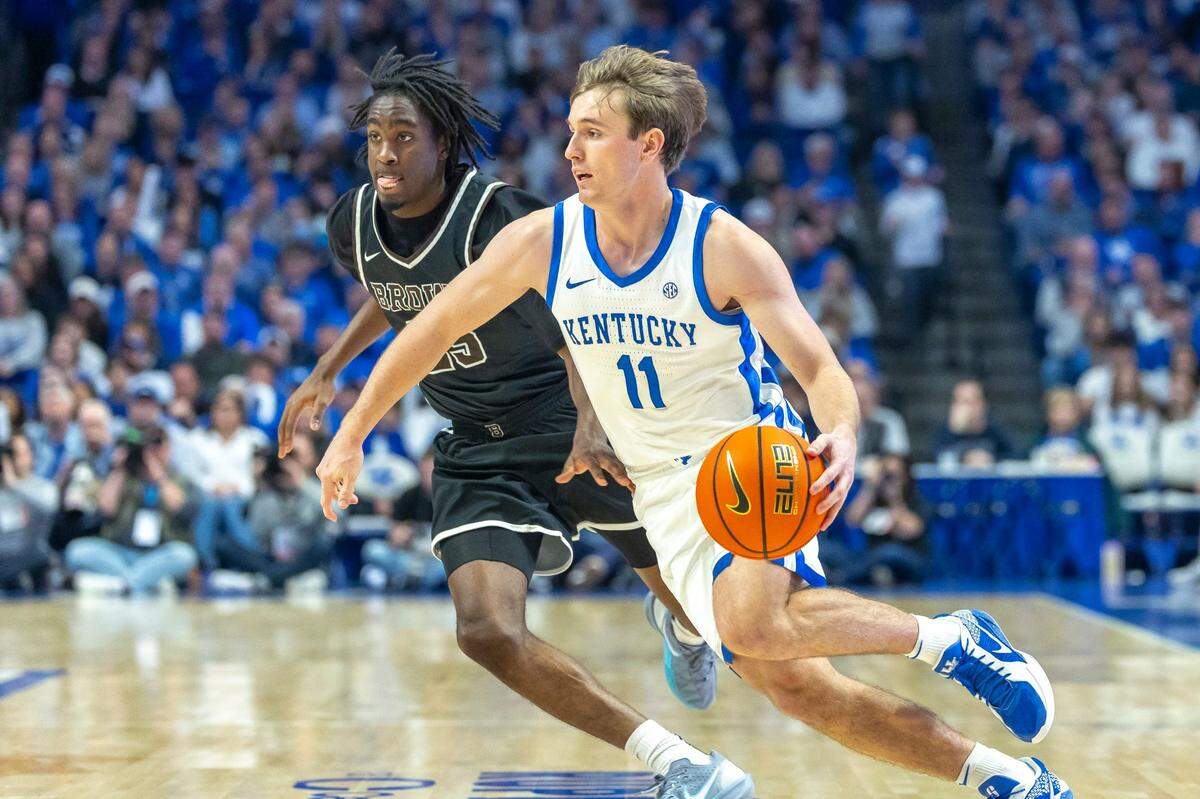
Perry — a 6-foot-1 freshman from Eddyville, near the western edge of the commonwealth — played a season-high 14 minutes in last week’s 88-54 victory over Brown, knocking down his second 3-pointer of the season, grabbing two rebounds and picking up a steal in the process.
“TP looked the most comfortable he’s looked out there, against real pressure,” UK coach Mark Pope said afterward. “I mean, full-court press every single possession, and he looked really comfortable. And, you know, he just looked like he felt it. I was really pleased with — sometimes he broke the pressure and stayed on attack. …
“And so you can tell he’s feeling more and more comfortable.”
That’s been a challenging part of the process for Kentucky’s reigning Mr. Basketball.
Perry was a scoring sensation from the start of his high school career. He averaged 20.6 points per game as a seventh grader. He broke the state’s all-time scoring record when he was still a junior, while playing in the state tournament on the Rupp Arena court.
His team, Lyon County, lost in the quarterfinals that season. The Lyons returned to Rupp the following year and won the whole thing, Perry earning Sweet 16 MVP honors to go with his Mr. Basketball trophy and status as the only player in Kentucky history to score more than 5,000 points.
He averaged 28.8 points per game and shot 41.7% from 3-point range as a senior, taking 799 shots over 39 games. When he got to UK in the summer, his new teammates — almost all of them a few years older than the freshman — raved about his outside shooting ability. Koby Brea — the top returning 3-point shooter in college basketball — used the word “incredible” to describe it.
But, even in the early blowouts, Perry didn’t get much opportunity to show it in real games, to be expected on a team so loaded with veteran talent. He didn’t play more than seven minutes in any game over the first month of the season. He didn’t play at all in the win against Duke or the loss to Clemson.
For a guy who’s been a star his entire life, that was one change. When was the last time Perry didn’t start for his team? Had it ever even happened? He paused to think about it.
“It’s been a while, for sure. Yeah, yeah, maybe ever,” Perry conceded. “So, yeah, it’s definitely a different environment, for sure.”
Even when Butler was sidelined for the Gonzaga game — and Kriisa went down with his injury in the second half — Perry played just three minutes in an eventual UK victory that went to overtime, veteran Pope player Jaxson Robinson taking over the bulk of the point guard duties down the stretch.
But Robinson running the show isn’t the ideal solution as Kentucky waits for Kriisa’s return. A versatile offensive threat, the 6-6 guard is better utilized elsewhere. In UK’s next game, Perry played nine minutes — at that point his season high — in a win against Colgate. He played seven minutes in the win over Louisville, then just three in the lopsided loss to Ohio State.
He didn’t score or dish out an assist in any of those games. At times, especially against U of L and OSU, he looked a little out of place. And that’s part of the second big change.
A UK basketball learning process
On one hand, Perry is having to mentally adjust to no longer being the star on his team and play accordingly, when he gets a chance on the court. At the same time, he’s having to transition to the speed of the college game and the length and athleticism of the players he’s now seeing on an everyday basis.
It’s all a balancing act, and the adjustment has been a constant battle.
“I think there’s a lot of differences,” Perry said of the jump from the 2nd Region to the SEC. “I think just trying to make the right play — not do too much — but also be aggressive. I think something I was struggling with — or had been struggling with — was not being aggressive enough. So I’m coming in and maybe giving the defense a little bit too much of an easy path, or giving them a break. So something I’m trying to do is just come and be aggressive, play my game, make plays for myself and for teammates to keep the defense honest when I’m in there.”
Do enough, but not too much. Don’t hold back, but don’t force it either. Easier said than done.
Perry said he’s been relying on his teammates every day in practice. Kriisa being sidelined means he goes one-on-one with Butler — one of the best perimeter defenders in college basketball — much more these days.
“It makes me such a better player. Anybody going against Lamont Butler makes them a great player,” Perry said. “But just to be able to go against him and learn from him. Like, you’re playing, and obviously he might beat you on a couple plays, rip you, but just getting better, trying to minimize those, and then just asking him questions, figuring out what he knows about the game. I mean, he’s played five years of college basketball, played in the national championship game. He knows a lot about the game of basketball and college basketball.”
Even when he’s struggled — or not played at all — Perry has received praise from his teammates. He came to Lexington with a reputation as someone who couldn’t be outworked, and that’s stuck so far. His demeanor doesn’t change. No matter the circumstances, he doesn’t get too up or too down.
“He’s been awesome. He’s such a great teammate,” fifth-year forward Andrew Carr said. “He comes ready to go every day. I think, for him, he’s trying to adjust to being able to play super hard defensively and then also be able to play offensively as well. I think when anybody gets to college, that’s one of the biggest adjustments, is just how much mental and physical … how much energy that requires. So I think he’s been doing a great job of trying to continue to get better, get his feet under himself. He’s a big part of this team, and he helps us a lot.”
Two days after Perry logged 14 minutes against Brown, his coach said he was making strides. Pope has acknowledged the difficult situation Perry is in, especially as play begins in the SEC, the best league in college basketball and one stacked with talented, veteran guards.
For Perry, keeping up will be a challenge. It all starts in a simple place.
“It’s just growing into the game,” Pope said. “It’s not actually ‘growing into,’ because he’s fully capable. It’s just getting comfortable. It’s just that comfort level.”
As Perry gets more reps, especially against elite competition, the game should start to slow down. He said that process has already begun.
On Saturday against Florida — the SEC opener against the No. 6-ranked team in the country — Perry played a little more than seven minutes. Kentucky won 106-100, and Pope started the game by expertly managing his subs to maximize Butler’s time on the court. He’d send Perry in either immediately before or after a TV timeout, giving Butler — still not 100% recovered from the ankle injury he suffered last month — that time when Perry was on the court to rest, plus the entirety of the timeout.
At the start of the second half, it looked like Pope was doing the same thing. Perry entered for Butler at the 16:15 mark, but when the TV timeout came less than a minute later, the freshman broke the huddle to stay out on the court. On UK’s next possession, he banged a 3-pointer to give the Cats a 63-55 lead. Perry finished with those three points, an assist and no turnovers in seven minutes against one of the best defenses in the country.
“It’s just getting used to the cadence of the game, and kind of understanding — at this level — what you need to be super aware of, and what you gotta let go, what you don’t need to be distracted by. And that’s just a learning process,” Pope said. “The great thing about TP is he’s pretty unflappable. He just is like, ‘Yep.’ I mean, he’s very even-keeled. And he’s incredibly talented. And he picks up information so fast. And so mostly it’s just more minutes on the floor, where he can kind of show what he already is bringing to the table, because he’s already bringing so much to the table.
“He’s already like a guy like, go pressure him. He’s going to handle the pressure fine. Try and trick up the way you’re guarding, he’s going to read it really, really well in the halfcourt. Try and take advantage of him defensively. And you’ll be like, ‘Wow. Man, this guy’s way better than I think he is.’ And so he’s already got those tools. It’s just a matter of becoming more comfortable.”