This Kentucky basketball team is doing something that’s never been done in program history
Mark Pope’s first Kentucky basketball team was billed from the beginning as a group with no true stars — possibly a roster relatively short on NBA talent, as a whole — but one that should be deep with ability at the college level.
The latter half of that projection has certainly panned out so far.
Going into Kentucky’s 22nd game of the 2024-25 season Tuesday night — a road trip at No. 25-ranked Ole Miss — the Wildcats’ stat sheet featured six different players averaging double digits in the point column.
Otega Oweh leads the way with 15.6 points per game. Going down the list from there, it’s Jaxson Robinson (13.4), Lamont Butler (13.2), Koby Brea (10.9), Amari Williams (10.3) and Andrew Carr at exactly 10.0, with 200 points in his first 20 games as a Wildcat.
How does that number — six Cats in double figures — stack up in the UK basketball history books? Well, there’s no previous record of such a thing. It’s never happened before.
If the current points distribution holds through the end of the season — and there’s still lots of basketball to be played, obviously — it would be the first time that a Kentucky team has ever had six players average at least 10 points per game.
There have been some close calls in the past.
The closest came courtesy of John Calipari’s best UK team. The 2011-12 national championship squad had five players in double figures: Anthony Davis (14.2), Doron Lamb (13.7), Terrence Jones (12.3), Michael Kidd-Gilchrist (11.9) and Marquis Teague (10.0).
A sixth Wildcat, senior Darius Miller, averaged 9.9 points for Kentucky, finishing three points shy of hitting the 10.0 mark.
In the past 50 years, there have been only four other UK teams with five players scoring in double figures for the season:
▪ Joe B. Hall’s 1978 national championship team, with Jack Givens leading the way at 18.1 points per game, and Rick Robey, Kyle Macy, James Lee and Mike Phillips joining him in double figures. Truman Claytor was sixth in scoring at 6.9 points per game.
▪ Rick Pitino’s second team, the 1990-91 Wildcats, were led by John Pelphrey’s 14.4 points per game, followed by Reggie Hanson, a freshman Jamal Mashburn, Deron Feldhaus and Richie Farmer. That one was close to six, too, with Sean Woods averaging 9.7 per game.
▪ Tubby Smith’s 2003-04 squad was led by Gerald Fitch (16.2) and featured Erik Daniels, Kelenna Azubuike, Chuck Hayes and Cliff Hawkins in double digits. But the Cats’ sixth scorer that season, Anwain Barbour, averaged only 5.0 points per game.
▪ And Calipari’s 2021-22 squad was led by national player of the year Oscar Tshiebwe (17.4) but also included TyTy Washington, Kellan Grady, Keion Brooks and Sahvir Wheeler averaging double figures. Davion Mintz was next at 8.5 points per game.
Six of Adolph Rupp’s final eight teams as head coach of the Wildcats had five players average at least 10.0 points per game, but none of them had a sixth score that much.
Of course, one common trait shared by those five teams that have done it in the past 50 years is that they were all really good.
Hall’s 1978 team won the title. Pitino’s 1991 squad finished first in the SEC standings and was ranked No. 9 in the final AP poll, but those Cats were ineligible for postseason play. Smith’s 2004 team was the No. 1 overall seed in that year’s NCAA Tournament. And though Calipari’s 2022 Cats will be remembered for their first-round loss to Saint Peter’s, they were ranked No. 5 nationally going into the postseason despite dealing with multiple injuries down the stretch.
And, obviously, the 2012 Cats that came the closest were one of the best UK teams ever.
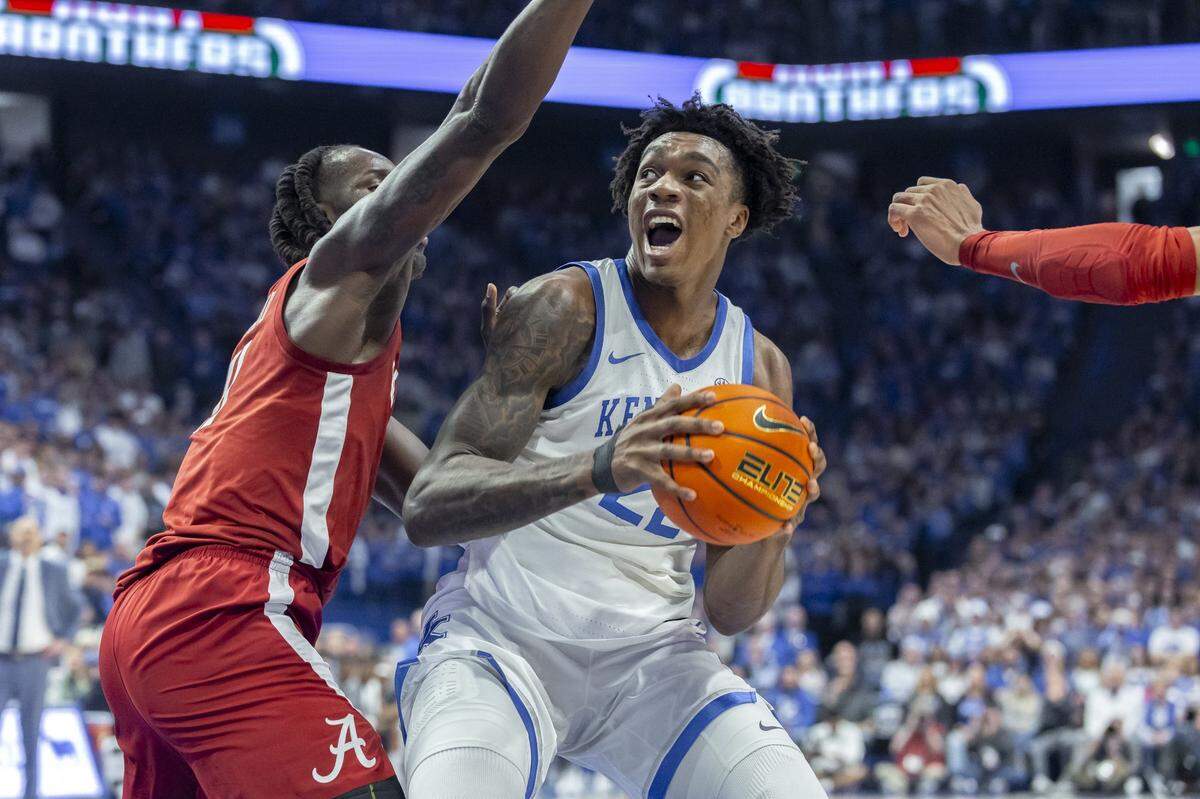
Kentucky basketball scoring record?
Pope’s team is in this conversation for several reasons.
There are no true stars, with Oweh leading the scoring through his amazing consistency. He hit double figures in every game going into Tuesday night.
These Cats have taken to Pope’s team-first, create-opportunities-for-others approach. Kentucky started the week at No. 11 nationally in assists per game and was even higher before this recent stretch of distribution struggles, with Butler playing injured and then joining backup point guard Kerr Kriisa on the sidelines.
Heading into Tuesday night, the Cats had averaged just 12 assists over their previous three games, more than six below their average to that point and the team’s worst three-game stretch of the season.
It also helps that UK is simply one of the top scoring teams in all of college basketball. Coming into the week, the Cats ranked third nationally in points per game (87.2) and third nationally in offensive efficiency (behind only Auburn and Alabama).
The KenPom numbers date back to 1997 — Pitino’s final season at Kentucky — and this is the most efficient offense the Wildcats have ever had in that span.
As of now, Pope’s team ranks 12th in school history in points per game and seventh since Rupp retired in 1972. Rupp’s 1969-70 team holds the school record with 96.8 points per game, helped along by Dan Issel’s 33.9 scoring average that season.
The highest scoring among those post-Rupp teams was Hall’s 1974-95 national runner-up squad, which averaged 92.2 points per game (but had just three players in double figures).
Pope’s final season as a player — with Pitino’s 1995-96 title squad — was next at 91.4 points per game. Only three Wildcats on that ’96 roster averaged in double figures in scoring, however, and Pope was sixth at 7.6 points per game.
Obviously, wins and losses — and deep postseason runs — are the most important things to the players on Pope’s current UK team, but these Cats might be able to make a little statistical history in the process.
Oweh, Robinson and Butler should have no trouble staying in double digits. Brea is close to the cutline at the moment, but his big-game ability makes him a pretty safe bet to remain above 10 points per game.
The biggest question marks are Carr and Williams.
Assuming Carr is getting closer to regular minutes after missing time with a back injury — and he said Monday that he’s feeling “a whole lot better” — he should be a double-digit scorer, too. He was at 11.4 points per game before playing through major pain against Alabama (four points), getting pulled after less than 90 seconds at Tennessee (zero points) and then playing limited minutes in Saturday’s loss to Arkansas (three points).
Williams has been the one dancing around the 10.0-point line the most this season, finally pushing above it for the first time in weeks with his 22-point performance against the Razorbacks over the weekend.
“I think he’s been a difference-maker for us in so many ways,” Pope said recently when asked to assess Williams’ scoring approach, specifically. “He’s come up with really big, timely buckets. Really big, timely and-ones.”
Pope has also singled out Williams’ improvement as a decision-maker with the ball in his hands. The 7-footer often quarterbacks the UK offense, and — while he’s had some back-and-forth issues with turnovers — Pope mentioned him first when assessing how the Cats beat Tennessee last week with both of their veteran point guards out due to injury.
The Kentucky coach has also lauded Williams’ for learning how to more effectively and forcefully use his physicality against SEC opponents.
That’s been most apparent on the boards — Williams has more than 10 rebounds in five of his last six games after hitting that number just four times in his first 15 games as a Wildcat — but it’s also shown itself in his approach as a scorer.
Williams was 9-for-13 from the floor against Arkansas. He’s shooting 57.7% this season, and his numbers have been even better (59.3%) against SEC competition heading into Tuesday night.
“He’s always been super, super strong,” Carr said Monday. “He does a great job — especially the last couple of weeks, I think — kind of taking his time more when he gets down low and really getting to spots where he knows that he’s able to be dangerous.
“And then I feel like he’s done a great job of making sure he’s finishing through the basket and to the basket and not going (with) a hook or something away — kind of like leaning and going away from the basket. And that’s all the stuff that we’ve talked about all summer, and things that we try to work on. And I feel like he’s gotten a little bit more comfortable and really stepped up and been super aggressive and forceful when we needed him to be.”
If Williams can keep it up — and the rest of his teammates can keep spreading the points around — the Wildcats might be able to make a fun little bit of history this season.