Mark Pope is shaking up his defensive approach. It might mean even more scoring
AI-generated summary reviewed by our newsroom.
- Pope shifts Kentucky to aggressive, pressure defense to force turnovers.
- Staff rebuilt roster with length, athleticism and physicality for defense.
- Defense-driven turnovers aim to fuel transition offense and more 3s.
Last year, the Kentucky basketball preseason was all about offense.
That’s what had UK fans excited. The more they learned about Mark Pope’s coaching style, the more they salivated over the idea of watching an innovative scoring attack in action.
That’s how Pope’s first roster was primarily constructed — a group with some defensive upside, for sure, but one that was heavy on proven offensive ability, especially from 3-point range.
And that’s what the Kentucky coaching staff hammered home throughout the summer and fall, prioritizing the teaching of Pope’s offensive philosophies in those early days — getting guys on the same page as far as cutting, spacing the floor and putting up perimeter shots in large numbers — while the principles of actually stopping the ball were secondary.
When the season started, the Cats were indeed elite — and often incredibly fun to watch — on offense. The defense, however, left much to be desired. As the season wore on, the Wildcats fell out of the top 100 nationally in defensive efficiency — a no man’s land for any team with hopes of a deep NCAA Tournament run — and Pope’s squad needed a late surge to finish 51st in the country in that stat.
For season two, Pope had a different idea. He built his roster to be more effective defensively — more athleticism, more physicality, more guys willing and capable of mucking up an opponent’s offense. And once the UK coach got them all on the floor together, he changed his approach there, too.
Those who have been in the Joe Craft Center regularly this fall say Kentucky is spending a lot more time on defense at this stage of the preseason than last year. And Pope plans to play it differently when the games begin.
“We’d like to find a way to be way more aggressive,” he said. “We want to force teams to be more uncomfortable. And you can do that a bunch of different ways. So we’re really trying. We’re trying to push up the boards more. We’re going to take shots to extend the floor more.”
Aggressive is not how anyone would have described Pope’s team defense last season.
That group finished 338th nationally in turnover percentage, according to the KenPom ratings. That’s out of 364 teams. The Cats were last in the SEC with an average of 10.3 turnovers forced per game. Not good. And that’s been pretty much the norm for Pope’s head coaching career.
In 10 seasons in charge, Pope has had just one team finish in the top 200 nationally in defensive turnover percentage — his 2022-23 BYU squad was 138th — and that’s something the Kentucky coaches are hoping to change this time around.
“We’re going to try to make a massive jump there,” said Cody Fueger, who has been an assistant on Pope’s staff for all 10 of those seasons and is back on the UK bench for an 11th run with the head coach.
Fueger, a coach who delves into the analytics, knows the numbers history of Pope’s teams over the past decade. There have been discussions about trying to be more disruptive in previous years.
“We’ve talked about it — trying to amp it up a little bit more,” he said. “I just think this is going to be probably our best roster with that. We’ve always kind of talked about getting deflections and steals and things like that. I just think this is our best-built roster for that type of defense.”
That was by design, Fueger confirmed.
While the first Kentucky roster of the Pope era was offensively accomplished coming in, the Cats found that life in the SEC would necessitate a little more grit than they showed last season. So, for year two, the UK coaches went out and found some.
Mouhamed Dioubate — a 6-foot-7, 220-pound physical force — will be a key to that approach. Brandon Garrison is back, and he showed last season that he’s not afraid to mix it up. Fellow returnees Otega Oweh and Collin Chandler have been praised for their perimeter defense this preseason. Incoming transfers Denzel Aberdeen and Kam Williams bring length and athleticism, and — when he returns from injury — 6-10 center Jayden Quaintance should be a defensive game-changer.
Much of this fall has been spent teaching defense.
“And guys are getting better and better,” Fueger said.
Kentucky’s new-look defense
“We’re all a little bit lemmings,” Pope said on the team’s media day, when asked about the possible next big trends in college basketball.
Emphasis on the 3-point shot has been the most visible recent fad to trickle down to college from the NBA, and Pope — always on the lookout for new wrinkles — called out the Oklahoma City Thunder and their NBA Finals series with the Indiana Pacers as a source for the next one.
“I think watching this OKC-Indiana series has got everybody kind of on edge about extending the floor and seeing what impact that has,” he said.
Oklahoma City, which won that series 4-3, has led the NBA in forced turnovers per game in each of the past three seasons. That defensive excellence has corresponded with the Thunder going from a non-playoff team to their first championship in franchise history. Indiana wasn’t known for playing that type of game during the 2024-25 season, but the Pacers implemented it during the Finals series, trying to beat OKC at its own game and nearly pulling off the series upset.
The rest of the basketball world has been watching.
Pope’s plan for this UK team is to emulate the OKC style, which includes more pressure on the ball, applying that pressure more quickly in possessions and trying to extend the other team’s ball-handlers farther away from the basket.
This season, Kentucky will attempt to prolong defensive possessions, force opponents into more bad shots and, ideally, create more turnovers in the process.
“I think having an impact on the ball — we’ve focused a lot on jamming, which means like picking up full court, one-on-one type of thing,” Chandler said. “Getting the offense to feel rushed and to just put more pressure on the ball. I think that’s going to be big for us.”
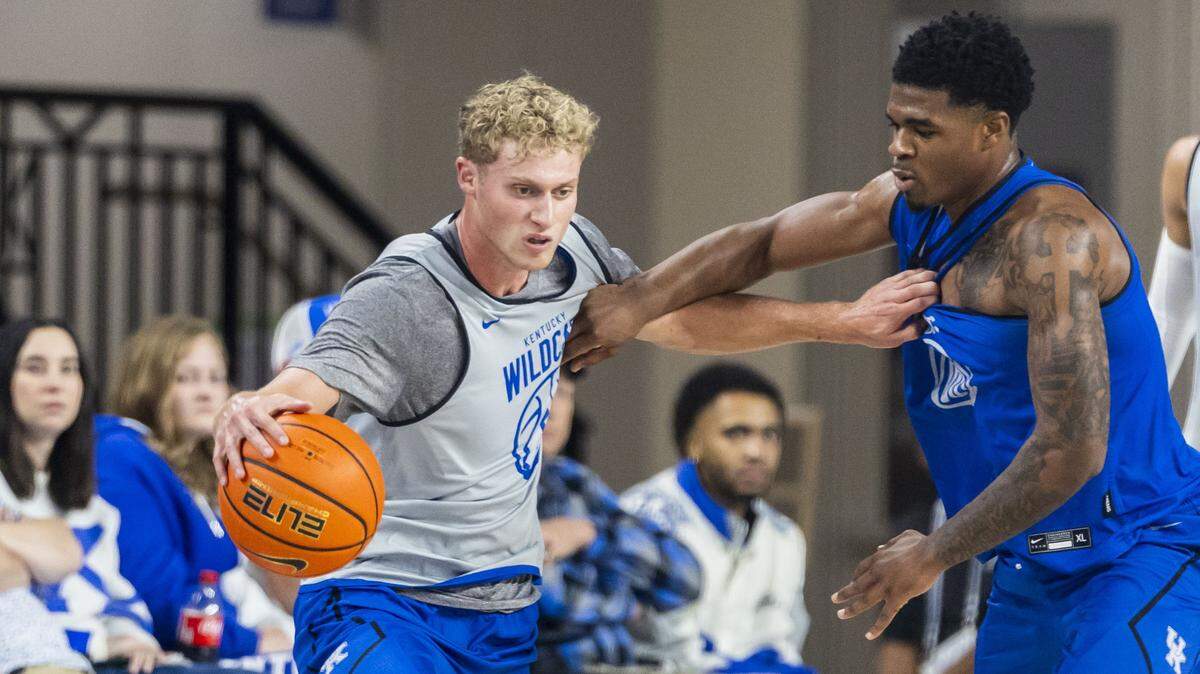
Some of that was on display in the Blue-White Game last Friday night. The UK players’ offense looked sloppy at times, and — while the coaches hope that’s corrected against outside competition — that’s kind of the idea for the time being.
There was plenty of physical jostling. There was pressure beyond the perimeter. That action led to ill-advised passes, and defenders filled those lanes to get easy buckets on the other end.
“We’ve got 12 or 13 guys that can really play, and we’re pretty athletic,” Fueger said. “And if we can defend, it’s going to turn into better offense.”
Chandler agreed.
The sophomore guard is expected to be one of Kentucky’s top 3-point shooters this season. The Wildcats will once again have that Pope/Fueger-led goal of putting up 35 long-range attempts per game. The Cats averaged only 25.3 per game last season. How to make up the difference?
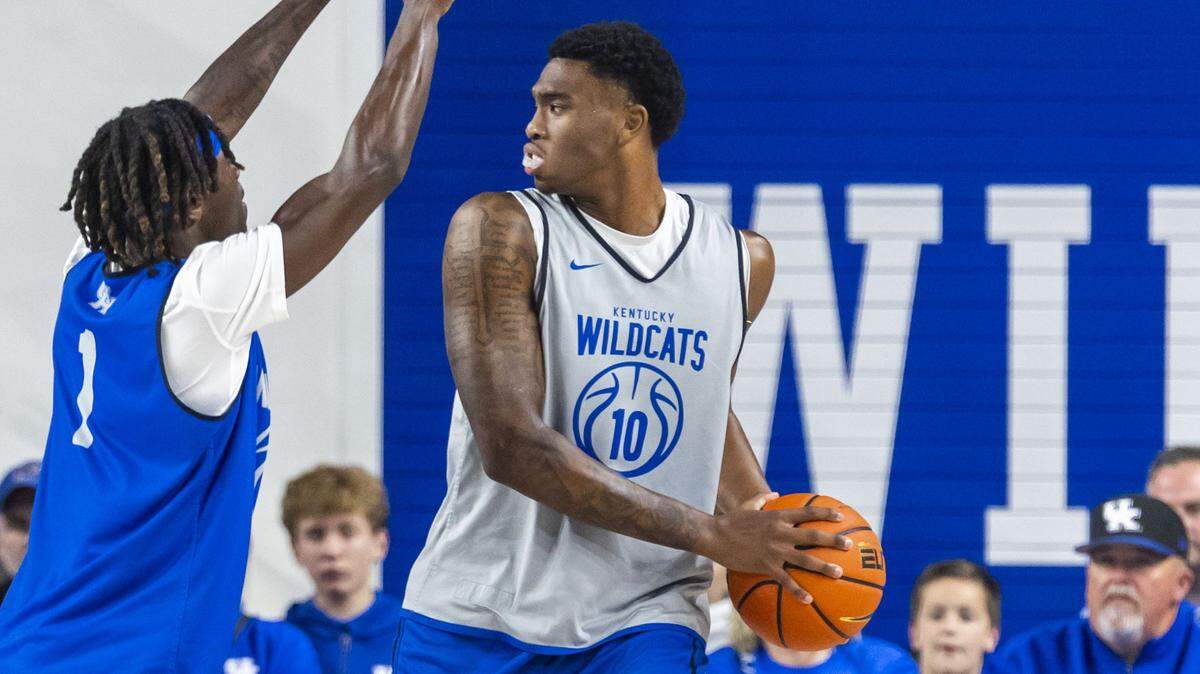
“From what I see, I think a lot of it is going to come from defense,” Chandler said. “We’re trying to get in transition — transition possessions and transition 3s are great for us. And so I think the more possessions that we can get, obviously, the more chances that we have to shoot. And so I think, defensively, we have a bigger emphasis on having an impact on the ball and creating more turnovers.”
Turning defense into offense
Still, the Cats want an elite offense again this season, too.
In Pope’s first year as head coach, UK ranked No. 10 in offensive efficiency nationally, according to the KenPom ratings. And that was with a rash of injuries at point guard, including losing offensive sparkplug Kerr Kriisa for most of the season and playing without the offensively proficient Jaxson Robinson at the end of it.
Pope’s last BYU team was No. 14 in the country in offensive efficiency. His first BYU team was seventh nationally. He and Fueger — the “offensive coordinator” on his staff — know how to employ a formidable scoring attack.
And this roster has the pieces to contend for another top-10 ranking. But Pope wants that same level of excellence on the defensive end, and getting there would be beneficial to both sides of the ball.
“We’re trying to extend out this game on our defensive side of the ball and make it even faster, more aggressive on the offensive side of the ball,” he said. “So we might be able to approach that number (of 35 3s), because I think we’re going to be capable of having more pace in this game.”
Another related area for improvement will be offensive rebounding. That wasn’t a strength for Kentucky last season — 229th nationally and 13th in the SEC in offensive rebounding rate — after Pope’s final three BYU teams all finished in the top 100 in the country in that stat.
That, too, was top of mind when Pope and his staff put this roster together. Dioubate, who proved to be a force in that area as a bench player at Alabama the past two seasons, should be the headliner for the Cats on the offensive boards. But he won’t go it alone.
“I feel like this year we’re going to be really balanced on that end, because we have Mo,” Oweh said, going on to mention Garrison, Quaintance and freshman center Malachi Moreno as others who will clean up on the offensive boards. “So guys like that, when their motor is going and running really high, they should be going to the board every single time.
“So, throughout the game, they should get maybe three or four offensive rebounds each. We have a lot of weapons in that department.”
Offensive rebounds equal extra possessions. Extra possessions equal extra shots and more points, especially if balls can be kicked out for open 3-pointers against a collapsed defense.
And forcing turnovers will lead to transition opportunities, where Kentucky will attack the basket but also be searching for open 3-point looks on the run. These Cats might even do some pressing, the ultimate example of extending the floor and applying pressure defensively.
The eight teams at the top of UK’s all-time list of turnovers forced per game all played during the eight seasons under coach Rick Pitino, who employed the full-court press with terrific results, especially with his deeper rosters. The 1996 national title team — the one Pope co-captained — led the country with 799 forced turnovers, an average of 22.2 per game. That team also led the nation in total scoring.
Expect to see at least a little of that as UK celebrates the 30th anniversary season of that squad.
“We have the personnel, and I think we have the depth, and I think we have the athleticism and the mobility and the determination — the togetherness to find a way to be functional in extending pressure, which is hard to do,” Pope said of the press. “It’s harder in college basketball than it’s ever been, because guys are so skilled. But I think we can do it.”