‘Santoro!’ Here’s what happens when Mark Pope doesn’t like a referee’s call
AI-generated summary reviewed by our newsroom.
- Santoro watches live game and limited broadcast on iPad, advising Pope fast.
- Kentucky uses “decaying success probability threshold” balancing challenges and timeouts.
- Santoro has a 83.3% (5-for-6) challenge success rate; he studies situations/timing.
At a crucial point in Kentucky’s 85-77 upset victory at Arkansas last month, Mark Pope saw a referee’s call that he didn’t agree with and raised one hand into the air.
Pope held that gesture — the universal sign for, “Give me a little more time” — as he turned to look at UK basketball video coordinator Matt Santoro, who was sitting courtside. Santoro’s head was already buried in his iPad, scouring video of the call that had just been made to see if it was the correct one.
The referee standing nearest to Pope held onto the ball, granting that silent request for a few more seconds. On the other sideline, one of the most recognizable coaches in college basketball had already lost his patience. And he was quickly losing his mind.
“Get the ball in!” John Calipari screamed at the official. “What are we waiting for?!”
Everyone — Pope, the ref, Calipari, the players on the court, nearly 20,000 inside a frenzied Bud Walton Arena and many more watching at home — hung on that moment.
They were all waiting for Santoro, the UK staffer who’s been tasked with telling Pope whether or not he should contest a call, based on the NCAA’s new challenge system.
Santoro ultimately gave Pope a thumbs down. The UK head coach calmly turned his attention back to the court. The referee put the ball in play. And Calipari, still flustered, found something else to yell about.
As the totality of that scene was recounted to Santoro a couple of weeks later, a look of surprise washed over the 26-year-old’s face.
“This is the first time that I knew that that happened,” he said in an almost apologetic tone. “I’m so consumed by the play and seeing if we should. But Coach has become really good at getting me a couple of extra seconds. I’ve become more aware of the refs, and I can kind of see out of my peripheral (vision) whether they’re going to get the ball in. And so the internal timing of giving him the thumbs up or thumbs down has gotten better.
“But I did not know about that. That’s pretty funny.”
For Santoro, one Hall of Fame coach bellowing in your direction while some opposing fans grumble about pace of play doesn’t rate too high on the pressure meter these days.
Home games bring the more nerve-wracking moments.
“I think Matt Santoro has done an unbelievable job, and he’s feeling a lot of pressure,” Pope said recently. “I think now every single person in a Rupp can feel the moment where there’s a potential challenge, and I think 20,000 — I guess we all have two, so 40,000 — eyes are trained right on Matt Santoro, and I actually love the moment for him. It’s pretty fun.”
Becoming Kentucky’s ‘challenge guy’
When Santoro first heard about the NCAA’s move toward adopting a challenge system for college basketball coaches, he figured out what was coming next.
“I had a feeling I was going to be that guy,” he said.
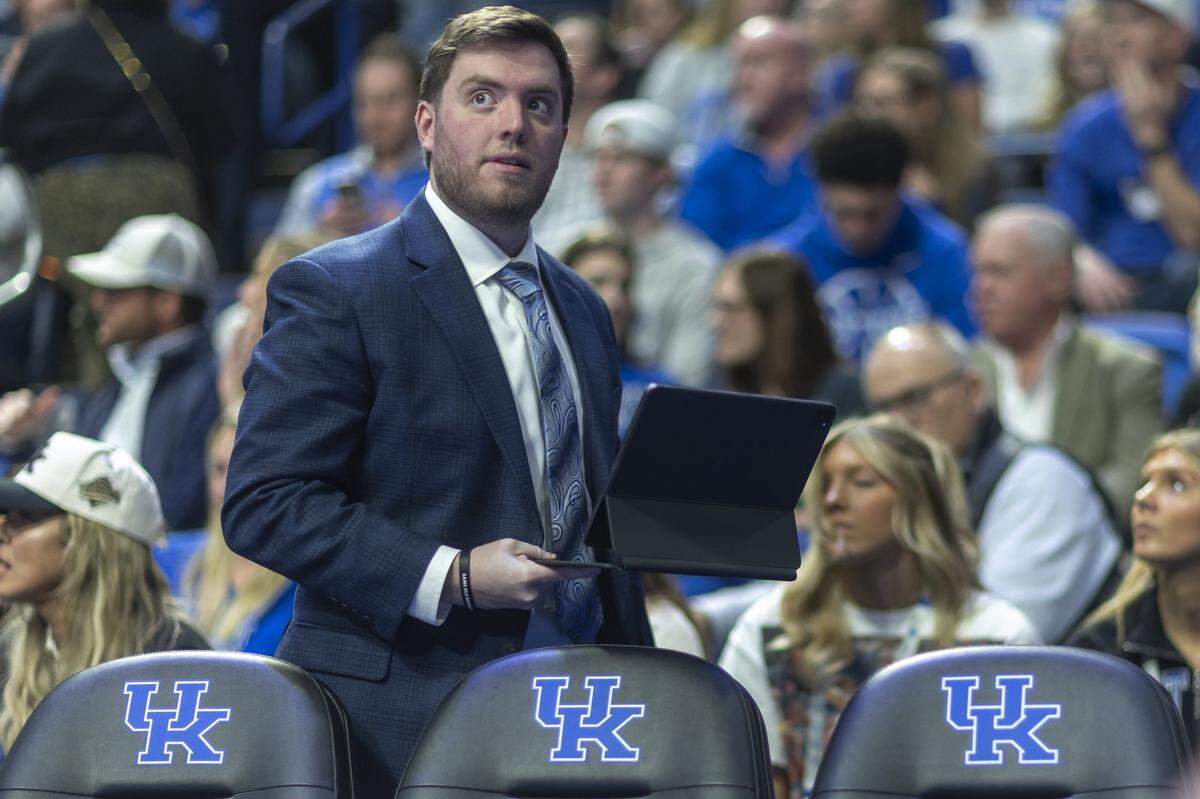
Santoro was already “the guy with the iPad” — as he described himself — next to the UK bench in Pope’s first season in Lexington, familiar with the video technology used on gamedays, responsible for relaying little things he noticed to the coaching staff in real time.
And he’d earned Pope’s trust relatively quickly.
A Philadelphia native, Santoro served as a student manager under coach Jeff Capel for all four of his years as an undergraduate at Pittsburgh, where a lack of traditional grad assistants early in his tenure allowed more opportunities for the managers to pursue higher-level duties.
Santoro took a deep dive into the video side of things. After graduating, he spent a season as a Division III assistant coach, and — upon seeing a post for a spot on Pope’s BYU support staff — he applied for the open job without knowing anyone in the program.
It was clear early in the process that BYU was looking for someone with video experience, and it all moved quickly from there. Shortly after his first season with that program, Santoro followed the news along with everyone else as Calipari abruptly left Kentucky for Arkansas and Pope was hired as his replacement.
Before Pope left Provo to be introduced as the new leader of the Wildcats in Lexington, Santoro let him know he would gladly tag along, if the coach would have him.
“I will pack up my car and leave right now,” Santoro told him. “… I was ready to roll.”
Pope made Santoro one of his first hires at Kentucky, linking him up with Cody Fueger — an assistant for all 11 of Pope’s seasons as a head coach — and putting them to work on finding possible additions in the transfer portal as they started to get a new era of UK basketball going.
There’s not really a “normal day” in Santoro’s position.
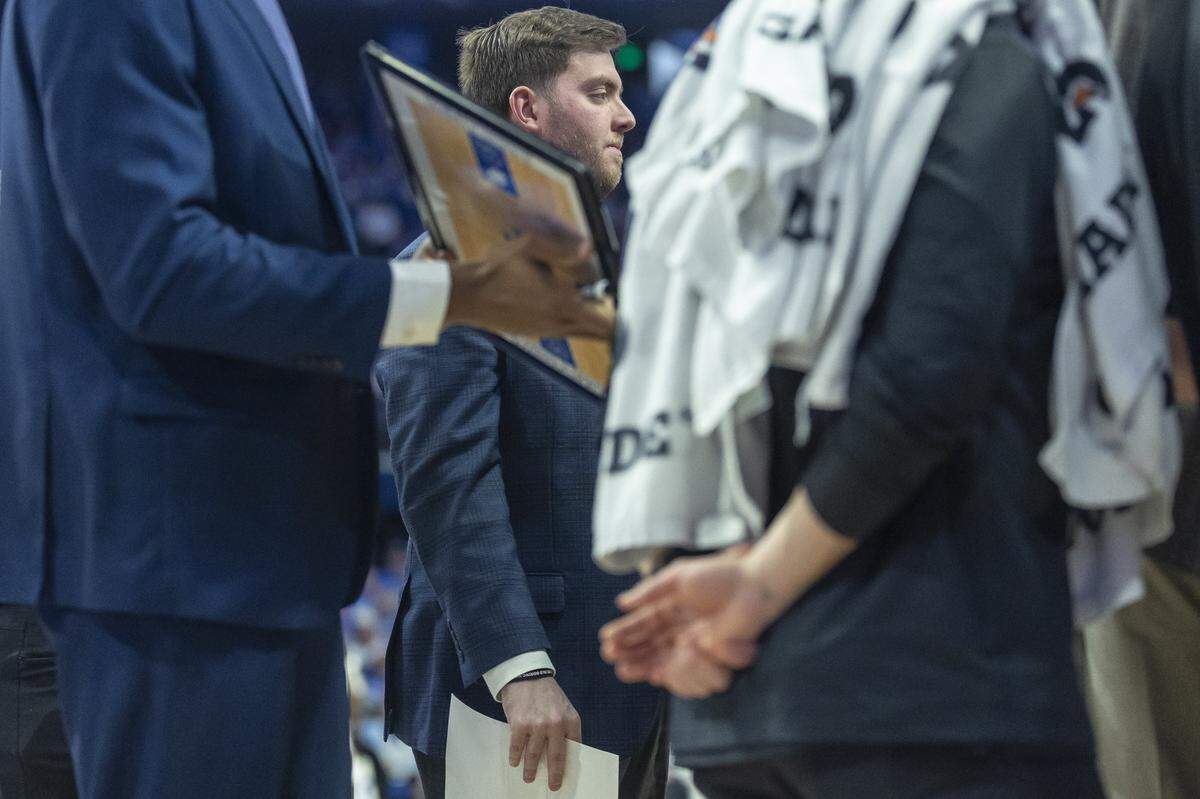
Spend much time in the UK coaches’ suite at the Joe Craft Center, and you’re likely to see him bouncing between offices — a laptop in his hand — as he goes over film with the UK coaches.
Santoro is responsible for helping prepare video scouts for the Kentucky coaching staff, and his work there finds its way to the players so they’re prepared for practices and games. He’s also often tasked with “special projects” on a game-to-game basis at the request of the head coach.
“Like if he sees anything in the scout that he wants to look at like, ‘Hey, how is Felix Okpara getting all those lobs? Or, like, ‘Can you just do a deeper dive into this or that?’” Santoro said.
He does preliminary player evaluations and background-level scouting on potential targets in the transfer portal, in addition to other video work for the program.
But he’s quickly becoming known to fans as the “challenge guy” on UK gamedays.
How UK basketball challenges work
The NCAA introduced the challenge process for the 2025-26 season, and Pope tapped Santoro to oversee those duties for Kentucky.
What college coaches are allowed to challenge is limited in scope. They can request a second look at out-of-bounds calls, basket interference/goaltending plays and whether a secondary defender was in the restricted-area arc.
Once it was clear Santoro would be UK’s challenge guy, he reached out to contacts in the NBA — where the challenge possibilities are more extensive — for advice on how to go about things on gamedays.
“What we can challenge is pretty clear,” Santoro said, “So every time a play comes up that I know I’m gonna have a couple daggers thrown my way, you just gotta get it ready and see what the play is like. But that’s all the fun part of it.”
What exactly teams can look at before they challenge varies by conference. Some leagues allow team personnel to see lots of different camera angles. The SEC mandates that only the game broadcast be used, so Santoro — who sits right behind Pope in Rupp Arena and in a similar spot at road games — has that going on his iPad while he keeps both eyes on the court itself.
He can usually sense when a challenge request is coming. But even in those moments, there’s a pretty clear cue from his boss.
“Usually, Coach Pope will yell my name and be like, ‘Santoro!’” he said, transitioning into a pitch-perfect impression of the head coach’s often-hoarse voice during the flow of games.
Then the fun begins.
Santoro has only a few seconds to rewind to the live portion of the play in question or pour over the video replays. He watches the game itself constantly thinking about the possibility of a challenge, so what he sees on the iPad is typically used to confirm or reverse what he’s already thinking.
“I just see what (fans) see,” Santoro said. “It sometimes helps if they show a replay that’s a good angle. But you don’t like to bank on that, just because they don’t always show it. And by the time they show that, it might be too late to challenge it. So you kind of have to go by the angle that you have, and make as good of a decision as you can.”
As far as when to challenge, there are many variables to consider.
Obviously, it’s important to be confident that the call will be overturned. If you lose a challenge, you lose a timeout. And teams are allowed just one challenge at the start of games. Winning the first one gets you a second challenge opportunity, but that’s it, even if you go 2 for 2. And if you lose the first one, you don’t get another.
It’s not only vital to be correct when challenging a call, but whatever happens after that call is overturned should put your team in a good position to either score or save points. Pope and the UK staff have developed a philosophy on how to deal with it all.
“We call it decaying success probability threshold,” Santoro said. “That’s just a fancy way of saying as the game gets further on, our confidence level gets lower and lower that we would need to challenge it.
“So, basically, if it’s the beginning of the game, you need to be almost certain that you’re going to win the challenge, just because you only get four timeouts in the game, and we tend to put a higher value on timeouts than most (teams). At least we have this year. One thing is, in a lot of our games we’ve been down, so we’ve probably needed our timeouts.”
Santoro pointed to the LSU game as a perfect example of that.
The Cats were down by as many as 18 points in that one before storming back to win it on Malachi Moreno’s buzzer-beater. Pope used his last timeout to draw up the play that led to that game-winning bucket.
“At LSU, in the first half, there were probably four or five plays that I thought might have been good enough to challenge,” Santoro said. “But we were down a good bit, so I thought, ‘We’re going to need all of our timeouts to probably get back into this thing.’ And luckily, all those plays were in the first half. If they were in the second half, I might have been a little quicker to the trigger to challenge it.”
It’s not simply about being correct. Santoro also has to weigh time and situation scenarios. Being right and getting the ball back is great, but it doesn’t do much good if you’re not in a good position to score as a result of the overturned call.
“If a ball goes out of bounds, and there’s three seconds on the (shot) clock, you don’t want to challenge that,” he explained.
Santoro also studies the opponent so he knows how good the other team is in certain situations that would arise from getting a challenge right. Some calls have been relatively easy to make.
In UK’s 80-78 win at Tennessee — where Santoro went 2 for 2 with his challenges — there was a goaltending call against Brandon Garrison that Santoro got reversed. That’s two points off the board, and Santoro said he was about 90% sure that the call would be changed. That gets into the concept of “expected points” — another thing he takes into account when making these decisions.
“So if I was 90% confident, that’d be 1.8 points that I think we would save on that,” he said. “And that beats any benefit of us having a timeout. It’s hard to get 1.8 points for a possession on a timeout. So that was a fairly easy one to be like, ‘Hey, this one is worth a challenge.’”
He’s typically pretty quick to shoot Pope a thumbs up or thumbs down. In a couple of cases — like the one that drew Calipari’s ire in Fayetteville — he’ll hold a finger up, asking for a little more time. There are more drastic measures the UK bench can take to give Santoro a couple of extra looks.
“There are a whole bunch of strategies that you can use,” he said. “We haven’t done this yet this year, but if I need more time to look at it, we can send in a sub to just give the dead ball a little bit more time. But it also depends on how quickly the refs want to get the ball in. Like, if they want the game to keep moving, it’s going to keep moving.
“And there have probably been one or two times this year when I might have wanted to pull the trigger on it, but the ball got in really quick, and you just got to keep moving on.”
In 26 games so far, Kentucky has challenged just six calls. Santoro would like to increase that percentage in the future. Timeouts are important to keep — as that LSU game proved — but the concept of “points saved” over the course of the season is crucial, too.
As of the NBA All-Star break, there had been an average of 1.47 challenges per game in that league this season. Again, NBA coaches can challenge more things — personal fouls being the biggest difference — but that’s still a much higher number of challenges than college coaches have been utilizing.
“We probably haven’t challenged as much as I would like to,” Santoro said. “We’re 5 for 6 on the year, so our record’s really good. But you kind of want to build up the amount of points saved over the year. … I think our strategy has worked out pretty well so far. I think I would like to get a little bit more reps at it. But I think it’s turned out well.”
All eyes on Matt Santoro
The rule change has led Santoro to watch basketball games in a completely different way.
Challenges are always on his mind.
“You do need to be ready for any type of scenario,” he said. “And so we do look at a lot of different scenarios, even if I don’t want to challenge it. Like, I’ll look back at (film) and just get the reps at it and be like, ‘Oh would I have wanted to challenge in this situation or not?’”
That extends to watching other college teams play in his spare time.
“I’ve gotten so much more interested in like, ‘Ooh, I think he should have challenged that one.’ Just as a couch quarterback,” he said. “I’m sure they’re looking at different angles than I have on TV, but that’s just part of the everyday life.”
Santoro’s 83.3% success rate is hard to top, even if he feels like he could be challenging more.
The Cats missed their first attempt of the season, an out-of-bounds call that went against them during the loss at Louisville on Nov. 11. They’ve been 5 for 5 since then.
The first win came three days later in a blowout victory over Eastern Illinois. That’s been Santoro’s only challenge in Rupp Arena so far.
He won one late in the 78-66 win over St. John’s on Dec. 20. The highlight of the season has been his 2-for-2 showing in Knoxville last month. There was the goaltending call against Garrison that got reversed upon further review. Then came an out-of-bounds call that Santoro challenged. UK won that one, and Denzel Aberdeen scored on the ensuing possession.
That’s four points gained in what turned out to be a two-point victory for the Wildcats.
“Matt Santoro is going to become legendary here at the University of Kentucky,” Pope declared a couple of days after that win. “... He has a tough job. So not only is he reviewing film in real time, but he’s also reviewing time and score and situation, time left on the shot clock — the fatigue on our team — he’s taking all these things in consideration in terms of saying, ‘Hey, let’s go review this.’ …
“Matt was 2 for 2 in the game at Tennessee, and clearly — in a game that’s decided by the slimmest of margins — those plays were really important.”
Before Santoro decided not to contest that call at Arkansas, he was successful on a different challenge. It was another out-of-bounds play that ultimately gave the ball back to Kentucky, and Andrija Jelavic hit a 3-pointer on the possession that followed. Three more points gained in a game that went down to the final minute and turned out to be UK’s best win of the season so far.
“This Matt Santoro is driving me crazy, man,” Pope said a few days after that one. “Like, we’ve only missed on one. His people are calling me. His agent’s calling me. Everybody’s trying to renegotiate his contract. I’m just like, ‘Slow down, Matt.’”
Pope was kidding, of course. Santoro hasn’t asked for a raise based on his challenge success. Not yet, at least. Earlier this week, Pope kept up the pressure on his video guy, saying on his statewide radio show that he wanted fans in Rupp to start chanting Santoro’s name if it looked like a challenge might be coming.
That has to cause some high stress levels for someone whose work is supposed to be limited to behind the scenes. Right?
“It’s gotten better over time. But it’s always nerve-wracking,” Santoro acknowledged. “And now everybody knows that there’s a guy back there that does it. So it feels like 20,000 people have their eyes on you. But you don’t even have enough time to think about that, because I’m just so consumed by the play and whether we need to challenge. So I don’t think about that until afterward.
“But the rush is great. Especially if you know you’re gonna win the challenge.”
By the time the postseason rolls around, the attention will only be amplified. One of those March Madness games could come down to the difference in one possession. And if that happens, Santoro’s challenge decisions are almost certain to be dissected.
Maybe he’ll be celebrated for having a hand in an NCAA Tournament win. Maybe he’ll be second-guessed for getting one wrong or failing to pull the trigger quickly enough.
How does he feel about all of this public attention Pope has placed on his new role?
“I mean, you know, with great power comes great responsibility,” Santoro said with a smile. “And if I can save a point or two for this program — to try to win a game — then I’m going to do everything I can to do it, because it’s just doing your job at the end of the day. And I’m happy to do it for this program. And for Coach.”
This story was originally published February 19, 2026 at 6:00 AM.