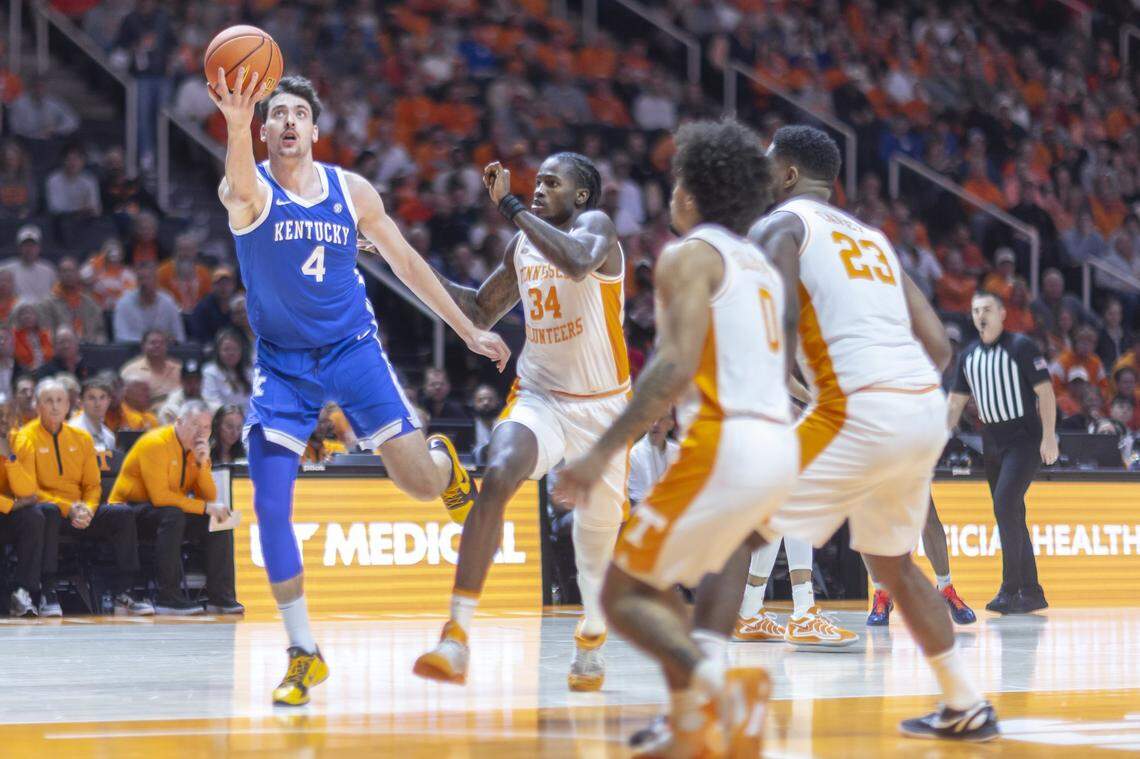
Kentucky is where Andrija Jelavic wanted to be. It’s been an interesting journey
AI-generated summary reviewed by our newsroom.
- Jelavic arrived late to Kentucky, forced to catch up with teammates and system.
- Coaches stressed physicality and defense; Jelavic improved and earned a starting role.
- Jelavic projects as a high-ceiling player with two more years of NCAA eligibility.
No one involved with Kentucky basketball knew quite what they were getting when Andrija Jelavic arrived in Lexington toward the end of last summer.
Jelavic had been a surprise addition to the Cats’ 2025-26 roster. A 6-foot-11 player from Croatia with professional experience, he emerged fairly late in the recruiting cycle as the mystery man of Mark Pope’s incoming class.
He was such a mystery, in fact, that virtually no one involved with the program had actually seen him play in person until the first time he picked up a ball in the Joe Craft Center.
The rest of the Cats had been together on campus for the entire summer. Eight weeks of practice time — along with all the weightlifting and strength training and team meetings and off-the-court bonding and everything else that accompanies the start of every offseason — went on while Jelavic was still back home in Europe.
Kentucky’s coaches knew he was coming. The players had heard his name. Some had seen his film. But beyond that, nobody knew much about the final Wildcat to show up in town.
So when Jelavic finally stepped foot in the Craft Center for his first workout with his fellow Cats, everyone in the gym had to press the pause button and take a long look at the new arrival.
UK assistant coach Mikhail McLean, the program’s point man for frontcourt players, laughs as he thinks back on that day.
“I’ll never forget the first practice he was there — because he missed the whole summer — (Brandon Garrison) and all these guys are like, ‘Oh, who’s this? Oh, what does he do?’” McLean said. “They were playing one on one, and they didn’t have the scout on him. ‘Can he shoot? Can he drive?’ And then he made a 3 on them, and they’re like, ‘Oh, he can shoot.’ And then he had to drive. ‘Oh, he can drive.’
“And then he had a turnover. ‘OK, he’s just like us. He’s just a normal person.’ So, it’s been really fun.”
That’s probably not the word to describe the entire experience. There’s been fun, for sure. But there has also been plenty of frustration.
Jelavic was getting a chance to live a basketball dream of playing for the University of Kentucky. But he came to Lexington at a disadvantage, forced to play catchup with his teammates and his competition while already going through the difficult transition from European ball to high-level college games.
UK’s coaches were getting a tantalizing talent, but they were also tasked with getting him up to speed in a short amount of time, all while not knowing a heck of a lot about his overall game.
Andrija Jelavic’s basketball beginnings
Jelavic was born and raised in Zagreb, the capital of Croatia, and — like most of the sports-minded kids in those parts — he grew up playing soccer.
Unlike most kids, he kept on growing.
Jelavic was around 14 years old — and taller than the rest of the players on his club soccer team — when his dad asked if he’d like to give basketball a try. He had barely touched a ball by that point in his life. He’d shot around some, played a little pickup with friends. But that was it.
He declined. Soccer was his sport. His dad kept asking. The kid kept saying no.
Finally, he relented.
“I wanted to go just for him to, like, leave me alone,” Jelavic said with a grin. “I was gonna go to one practice, and that’s it.”
He went to a couple of practices, and that was indeed almost it. The coach at his high school also coached the local club team for more accomplished players, and he told Jelavic that he belonged on that squad instead. He gave him the time and place for the next club practice.
Jelavic no-showed it. He didn’t think the coach was serious.
When he went back for the next high school practice instead, the coach was ticked. They worked it out, Jelavic started showing up for the club team practices, and it wasn’t long before he had given up soccer to concentrate full time on hoops.
“I saw the potential in playing basketball, and I came to love the sport a lot,” he said. “… It was just a logical decision.”
As Jelavic’s skill started to catch up with his size, other coaches took notice. A few years later, he had made a name for himself in Croatia and earned an opportunity to play for Mega Superbet, a top professional team in Serbia that had sent several players — including Denver Nuggets superstar Nikola Jokic — to the NBA.
When that opportunity came, Jelavic was nearly 18 years old and ready to pursue his dream.
“Everyone wants to go to the NBA,” he said. “And that’s why I went there, because I thought that going there would be the best way for my future — playing there for two or three years. I knew they were going to give me minutes and that if I used them correctly, I could go do great things.”
He spent one season with Mega’s developmental team and two seasons with the senior squad. During that time, he started to become familiar with college basketball, thanks primarily to Zvonimir Ivisic — aka “Big Z” — a familiar name to Kentucky fans.
“That was like the first time that Croatian/Balkan guy went to like that big of a name — like that great of a college like Kentucky,” Jelavic said. “And it was an unexpected move. Nobody knew. It was just like one morning, ‘Oh, he’s going to Kentucky.’ And that’s when I started exploring the colleges and college basketball, and started to watch and follow it, especially him and Kentucky that year. And that’s when I started to get into college basketball a little bit.”
As Jelavic continued to progress in Serbia, talent evaluators in America took notice.
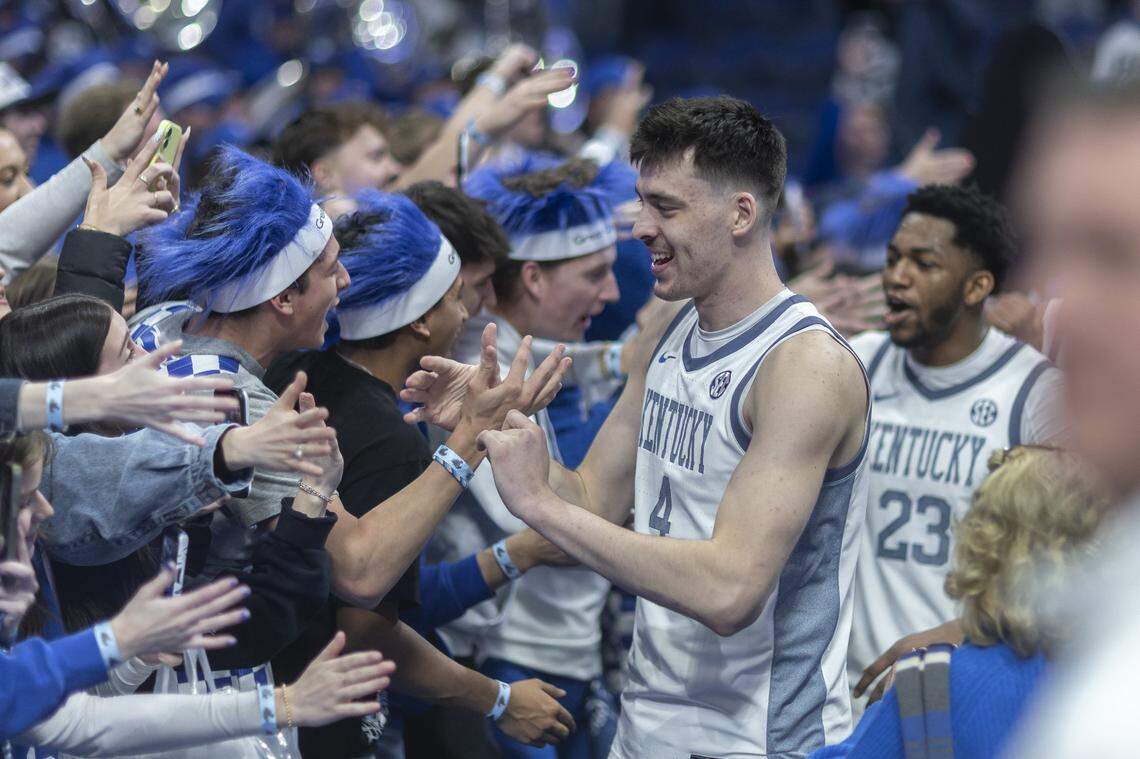
Andrija Jelavic to Kentucky
The particulars of Jelavic’s college recruitment are still hard to fathom.
“It was very … interesting,” McLean said. “It was quick. It happened really fast.”
So fast, in fact, that those directly involved still shake their heads at the circumstances.
“I just remember laying in bed one night and just thinking to myself, like, ‘It would be really awesome if Kentucky really wanted me.’ I didn’t know it would happen,” Jelavic said. “I just thought it would be really cool if Kentucky wanted me. I really wanted to go there. And then everything else happened.”
Jelavic didn’t know Zvonimir Ivisic personally, but he had played with his twin brother, Tomislav Ivisic, and traded messages with the Kentucky player via social media. He followed “Big Z” closely during his first season of college, which happened to be John Calipari’s final season as UK’s head coach. He dreamed that might be him someday.
“Even someone who doesn’t know college basketball at all knows about Kentucky,” he said. “Because it’s Kentucky.”
Once college basketball started to emerge as a realistic option, Jelavic pined for Kentucky interest. Mark Pope was the head coach by then, and there was buzz around the Mega program that the Cats did indeed have eyes on Jelavic, who had impressed enough that NBA scouts were talking about him, too.
He didn’t quite know what to believe at the time. Jelavic explained that the recruiting process works differently there, with direct contact not as common and outside offers typically coming at the end of the pro season. One of the Mega coaches told him UK was interested, but was it true?
“I was just like, ‘What are you talking about?’” he said, still in disbelief.
There were other major colleges pursuing him, too. Lots of them, apparently. But that contact went primarily through his agent, Jelavic staying out of the process as he concentrated on his season. He never saw anyone from UK’s staff at his games. He never had any contact with anyone involved with the program.
Still, he kept hearing the Cats were interested. And then he was told to expect a call from Pope the next day. Jelavic wanted to believe it, obviously, but he remained skeptical.
The Kentucky coach called. Pope and Jelavic spoke for 10-15 minutes via FaceTime. Pope said he liked his game and saw him as a good fit for UK’s next roster. He asked what Jelavic knew about Kentucky. More than most European players, it turned out.
Was he interested in playing for the Cats? Yes. Was he prepared to move to the United States for the 2025-26 season? Of course. Pope told Jelavic, who had lots of other college offers but zero contact with American coaches to that point, to tell his agent he wanted to come to Kentucky, and they would figure out the rest from there.
“It was short, but decisive,” Jelavic said of the conversation. “That was my first call and last call.”
If only every recruitment was that easy.
Adjusting to the American game
It turned out to be a little more complicated than that.
And there was a lot more due diligence on UK’s end than Jelavic knew.
Kentucky assistant coach Cody Fueger actually made a trip to Europe to scout Jelavic in person before the Cats reached out with an offer. Between those in-person observations, film study and a check into Jelavic’s background, the UK staff decided he would be a good fit. After the commitment, McLean traveled to visit with the new recruit in person.
But there were still a lot of questions about his game. And those would take longer than originally anticipated to answer.
Jelavic had completed the required academic work to get into college in America, but the nuances of the system he was in meant he couldn’t get the official transcripts necessary for enrollment until July, when the Cats would be wrapping up their eight-week summer session.
“I understood that maybe some people here would have doubts — will I ever come here?” Jelavic said. “So that was a little bit difficult telling them every day, ‘I’ll be here, I’ll be here, for sure.’”
He knew there was skepticism in Kentucky, especially among the fans that had followed Ivisic’s enrollment saga two years earlier. But UK’s coaches kept the faith, and Jelavic showed up in August, as promised.
It was a difficult adjustment.
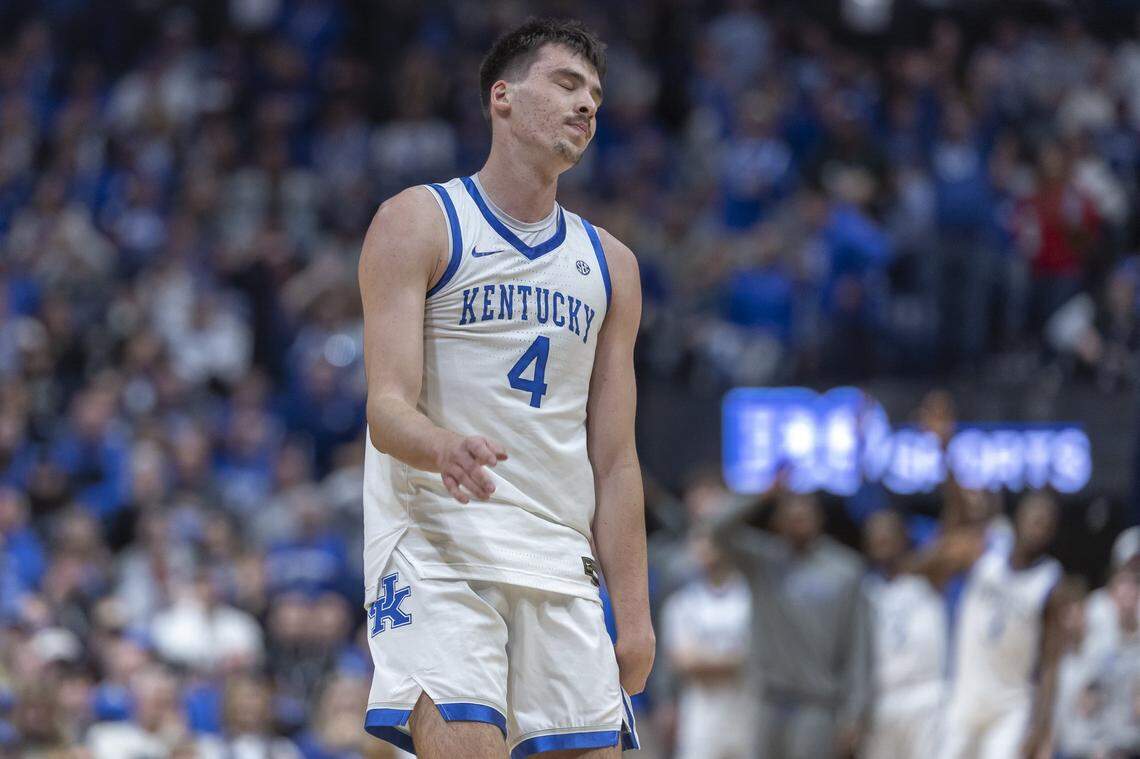
Jelavic knew before he came to the United States that he would have to adopt a more bruising style than he was used to in Serbia, where he said the kind of physicality that is commonplace here stands out as an anomaly. “But here, It’s just something elemental that you need to have to play the game. … Without that, you just can’t play basketball.”
He had a tough time going up against guys like Garrison and Mouhamed Dioubate, a couple of seasoned college players who take no prisoners from a physicality standpoint, even on the practice floor.
Pope took issue with several facets of Jelavic’s game. He wanted that toughness at all times. He needed to see better defensive performances. He needed the newcomer to get going in transition. It was all a major adjustment.
Jelavic has been pleased with his development.
“Maybe not a lot of people would say this, but the coaches — especially Coach McLean — know what my defense was like when I first came here. And my physicality,” he said. “I’m not saying that there is not much improvement I can do in that area, but I think I’ve improved myself a lot in that area. I was always talented offensively. I could score in multiple ways, with my offensive instincts, but now I can contribute on the other side of the floor.”
He averaged 6.0 points and 4.3 rebounds in 15.5 minutes over UK’s first 10 games. Jelavic struggled from 3-point range — and he was clearly uncomfortable at times — but it was a respectable start, under the circumstances. The Cats, however, were struggling as a team.
And then the playing time fell off. He didn’t play at all in breakthrough wins over Indiana and St. John’s — the latter game marked Jayden Quaintance’s return from a knee injury — and also sat out the entirety of UK’s first two SEC games, losses to Alabama and Missouri.
“It was pretty difficult. I’m not gonna lie,” Jelavic said. “ Because it just happened, like, overnight, you know? At one point, I was playing my 15-20 minutes, and just overnight — the first game was the Indiana game — it’s just like zero minutes, instantly. And we won that game. We also won the St. John’s game. I knew what he was doing. He was just finding his lineup, finding the winning lineup.”
Pope and the UK coaching staff tried to keep Jelavic’s confidence up.
“Even when he and everyone came to talk to me, I said it. ‘I understand the circumstances. I understand the situation.’ I mean, if I was the coach, I would also try to find some answers through different lineups,” Jelavic said. “So it was just like, ‘Be ready. Be prepared. Don’t stop believing.’”
He got back into the rotation in a 92-68 win over Mississippi State on Jan. 10 — after Quaintance was sidelined again due to knee issues — and Pope inserted him into the starting lineup four days later at LSU. He’s been a starter ever since.
“He went a stretch where he went like four games where he didn’t play. If I went through that, I’m moping the entire time. I’m pissed off,” said McLean, who played his college ball at Houston. “But Jelavic went through that, his body language and his attitude never changed. And I’m not trying to sound like the cliché coach — he worked harder when he wasn’t playing. And that’s when we kind of knew, this guy’s played professional basketball for a few years. Because he stayed ready. And then we threw him in the game against (Mississippi State), and he played a really good stretch. And now he’s starting in the SEC.
“So it’s just been really good to see his growth. And, like I said, he was like a wild card. Outside of what his numbers and his film said, we didn’t know what we were getting.”
What’s next at Kentucky?
His first season of college basketball has been a challenge, but it’s also been rewarding.
Jelavic has found a support system among his coaches, teammates and friends he’s made at UK. His family has also been there for him. His parents and younger brother have visited Lexington. His girlfriend, who also lives in Zagreb, has made three trips to America in the past few months.
For most of the season, there’s been a six-hour time difference between his old home and his new one. That obviously makes staying up for the night games difficult. His father still catches every one, even those 9 p.m. ET tipoffs. And dad wants to talk after every game.
Jelavic doesn’t know how he does it.
“He watches no matter what,” he said. “And you need to tell him after that, ‘Go to sleep, man. Go to sleep.’”
Lexington is bigger and more modern than he thought it would be. “It’s much better than I expected.” He enjoys the green space and says UK’s campus is “amazing.” In the little spare time he has, he likes going to arcades and bowling. He and his girlfriend, both movie lovers, hit the cinema when she’s in town.
But the focus is on basketball, and he knows all about what’s coming next.
“The first thing you know about college basketball is March Madness,” he said. “I’m really looking forward to March Madness. And I know what kind of season we had. There were a lot of ups and downs. But I believe that no team really wants to play us. Because they know, no matter what seed we are, I know that they don’t look forward to playing us, because they know our potential and that we are a dangerous team.”
Jelavic has kept the faith in his team, and Kentucky’s coaches have kept the faith in him.
Pope acknowledges that his delayed arrival put him at a disadvantage, but he sees a player who’s done everything he can to catch up and keep improving.
“Every day that he’s been here has been good for him, in terms of growing. He’s got a massive ceiling,” Pope said. “You think about a guy his size that can shoot it the way he can shoot it. That can be a decision maker the way he can be a decision maker.”
He’s been pleased with the way Jelavic embraces more physical play. As Kentucky’s season has progressed, so has the team’s late arrival.
“And it’s just like everybody — trying to take the little niches of the game that hold them back, and overcome them,” Pope said. “And that’s one that’s a marker for him. And the thing is, he’s successfully done it this season. He’s done it in multiple games over multiple runs. It’s just being consistent and then growing consistently in the physicality of the game. He was poor. His physicality was really poor at Texas A&M (two weeks ago). That happens sometimes.
“But he knows what it is. And he knows where he’s going to grow. And I think he’s got a big-time future. I think he’s going to be a really good player. Especially the way we like to play, he can really fit us.”
Jelavic, who turns 22 years old in May, has two seasons of NCAA eligibility beyond this one. He’s clearly not ready for the NBA. The transfer portal is an option to every player these days, but he’s wanted at Kentucky.
What will he do next season? He’s not that far along yet.
“No one really talks about it, just because of how locked in we are on the next games,” he said. “Like, it’s the final lap here. We really want to make an impact here. So I haven’t really talked with anyone about it. I want to finish what we started here.”
Jelavic did say it’s been “a really great experience” playing at Kentucky — despite the struggles this season — and he clearly has believers where it matters most. When the possibility of a second year at UK came up, McLean smiled.
“He missed when we were working our hardest in the weight room. He missed a lot of the conditioning protocol that we did,” McLean said. “And he was actually a lot more prepared to play at Kentucky than we anticipated. We thought he was gonna need, like, six weeks to get ready to play, in terms of his conditioning.
“But if he was to come back, and he had a full summer and this spring offseason in the weight room? He knows how we play. He’s gonna make shots. He’s gonna be really good.”