
UK basketball notebook: Rodrick Rhodes offers words of wisdom for Andrew Harrison
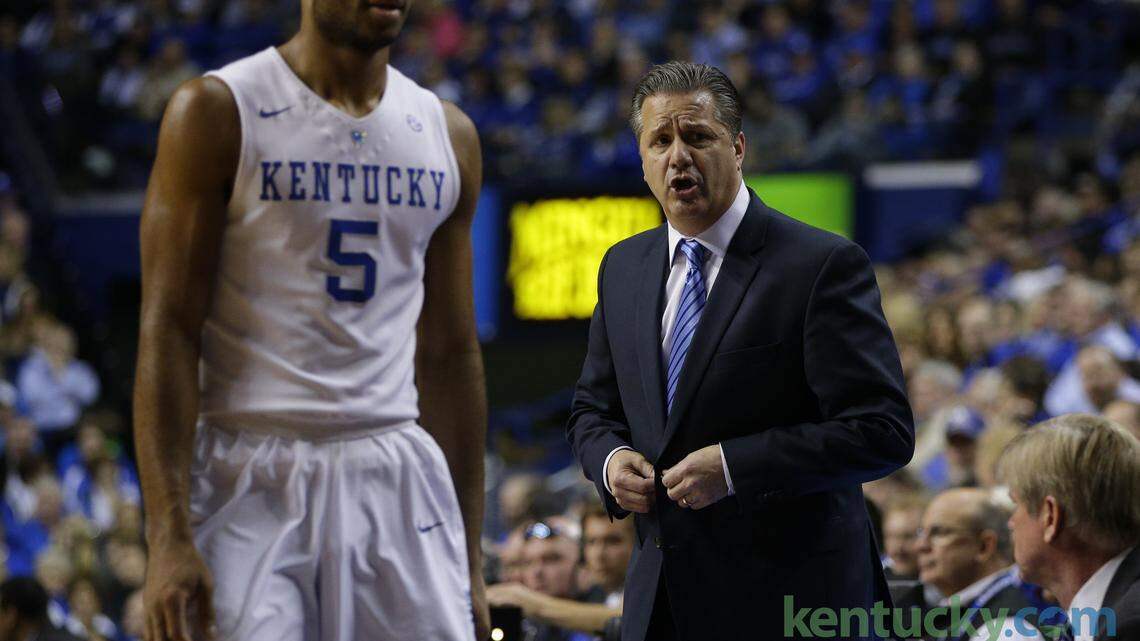
Highly regarded high school prospect. Expectation of great college success as prelude to triumphant entry into NBA. Disgruntled Kentucky fans when expectation not immediately met.
That scenario seems to fit UK point guard Andrew Harrison. As well as he plays, it's never quite good enough. As much as he improves as a player, it's not fast enough.
The last player to be UK basketball's version of Sisyphus, seemingly fated to forever play on a court tilted upward, was Rodrick Rhodes. He came to UK in 1992 as the nation's No. 2 prospect. Only a point guard named Jason Kidd was considered a better prospect.
As the latest star produced by famed St. Anthony's High in Jersey City, N.J., Rhodes had enough leverage to force then Coach Rick Pitino to publicly state he was staying in Lexington. Only then did Rhodes sign with UK. Three turbulent seasons later, he transferred to Southern California.
"Looking back, he has to concentrate on what Coach Cal wants him to do," Rhodes said of Harrison last week. "Nothing else.
"If I had to do it over again ..." His voiced trailed off.
More than once in a 15-minute telephone conversation, Rhodes stressed the importance of listening to UK Coach John Calipari.
"John is all about getting these kids to the NBA," Rhodes said. "So why would he not want to see you get to the NBA?"
When asked if he listened to voices other than Pitino's, Rhodes blurted out, "Oh my God. Too many. I should have only been listening to Rick Pitino."
A big difference between then and now are the many more voices competing for a player's attention.
"It's even tougher now for these kids because of social media," Rhodes said. "And it's all in your face. God forbid if we had had that when we were playing."
Now the coach at Cordia High School in Knott County, Rhodes tries to dampen the impact of social media.
"People are vicious," he said. "Basically, they can take free shots at you behind keyboards, and there's nothing you can do."
As Kentucky coach, Pitino liked to talk about the precious present. Live for today. Do not fret about tomorrow until tomorrow. Rhodes was not heeding that advice.
"I was thinking I had to do this, I had to do that," he said. "I had to score this amount of points. I had to score that amount of points. And I didn't concentrate on what coach was asking me to do."
Rhodes claimed no special insight into Harrison's mind. But he said the UK player need not worry about his NBA stock.
"He's going to play in the NBA," Rhodes said. "That's a fact. ... There's a spot waiting for him. He has to believe that.
"Now, whether he's caught up in being a top-five pick, a second-round pick, unrestricted free agent. If he's caught up in all that stuff, then he's making a huge mistake."
Rhodes sounded particularly impressed by Calipari saying in October that Harrison cared too much about playing well.
"Pretty powerful stuff ... ," he said. "I can relate to that."
A review of Rhodes' three seasons for Kentucky might surprise. He was a 1,000-point scorer (1,209 points, to be exact). He made the coaches' All-Southeastern Conference third team as a sophomore, their second team as a junior.
"Coach Cal said it best: I care," he said. "I still love basketball. I love Kentucky basketball. People think I'm jaded about the University of Kentucky. I'm not."
Rhodes had powerful proof. A daughter, Roderia Rhodes, is a freshman studying marketing at UK.
"Like Andrew, I cared too much," he said. "And I wanted to do well. Sometimes, when you care too much, you press. And when you press, sometimes things don't always work out like you want them to.
"My advice would be: Whatever Coach Cal tells you to do, do it."
Rookie at 59
First-year Missouri Coach Kim Anderson turns 60 on May 12. With Social Security looming, he did not see the window of opportunity remaining open to become a Division I coach.
"I thought it was closed," he said at SEC Media Days in October. "No doubt. I didn't think I'd get this opportunity."
Anderson, who played for Missouri in the mid-1970s, had coached for Central Missouri the previous 12 seasons (career record of 274-94). He led the Mules to the 2014 Division II national championship.
Then last spring, Missouri hired Anderson to replace Frank Haith. He'll be coaching against Kentucky in Rupp Arena on Tuesday.
"A Division II coach doesn't get this opportunity very often," Anderson said. "I hope I represent a lot of really good Division II coaches, and I hope that we do well. I'm excited about being at Mizzou and having this chance."
Anderson described himself as the benefactor of good timing. Norm Stewart, the coaching icon of Missouri basketball, retired in 1999. The next three coaches were not connected to Stewart's tenure: Quin Snyder, Mike Anderson and Haith.
"I think there was a desire for a connection from the past," said Anderson, a Missouri native who played for Stewart. Guiding Central Missouri to a national championship helped, too, he said.
Of course, the move from Central Missouri to Missouri brought big changes. For instance, media day in the Missouri Intercollegiate Athletic Association had the coach go to a room on campus and tape a five-question interview that was posted on the Internet. Reporters clicked on which coach they wanted to hear.
"So this is a little bit neater," Anderson said at SEC Media Days, which were held next to a golf resort in Charlotte, N.C.
At Central Missouri, he had two assistants and a graduate assistant. He said his Missouri staff included three assistants, a strength coach, a basketball operations guy, a video guy, two secretaries, an equipment manager, a trainer, two graduate assistants, eight managers and six student workers.
"I said, 'What do you guys all do?'" Anderson said. "I quickly found out there's plenty to do."
Done before one?
Joel Kendrick, an editorial assistant for the political website OtherWords.org, advocated allowing players to go directly from high school to the NBA in a Dec. 30 column.
After noting that alternatives to the so-called one-and-done system do not please everyone, Kendrick wrote, "The strongest argument for doing away with the one-and-done system is this: Most fresh-off-the-vine picks were quite successful in the NBA.
"An overwhelming 84 percent of players who were drafted straight out of high school between 1995 and 2005 stayed in the league for at least eight years. And the median career length for that group was 10 years, more than double the league's average."
UK Coach John Calipari has opposed allowing players to once again skip college and go to the NBA after high school. Too many players would abandon high school classwork with the expectation of playing in the NBA, he said. Coincidentally (?), programs like Kentucky's benefit if elite players must wait a year or more before being eligible for the NBA Draft.
"Watch for changes as soon as 2017, when the NBA or its players union might reopen negotiations," Kendrick wrote.
Wallace recalled
Reader Bill Hiles attended Vanderbilt at the same time as Perry Wallace. He was an eyewitness to Wallace the player and Wallace the person.
"I couldn't believe that when the top 50 all-time SEC basketball players were listed a few years ago he was omitted," Hiles said. "From 1968-70, I was a graduate student at Vanderbilt. I frequently had breakfast with Perry during the offseason in Rand Hall. He was always affable and a real gentleman."
A new book by Andrew Maraniss titled Strong Inside detailed Wallace's college career as the first black player in the SEC.
When Wallace's career ended, he spoke to sportswriter Frank Sutherland of The Tennessean and a reporter for the Vanderbilt student newspaper about his experiences. He noted the loneliness of being a pioneer and how, if he had to do it over, he'd have attended a college outside the South.
"When Frank Sutherland's article about Perry was published, I sent a copy to C.M. Newton (my coach at Transy) because I knew he had signed Wendell Hudson as Alabama's first African-American player," Hiles wrote. "C.M. later told me that he shared the article with Wendell and it opened a line of communication between them in ways C.M. never previously imagined."
Hiles, 69, retired as a newspaper reporter in 2007. He had worked for The Tennessean and the State Gazette in Dyersburg, Tenn.
'How times change'
Last week's note about Perry Wallace, the first black basketball player in the SEC, brought back a memory for reader Gerald Hill.
He wrote an email about attending a Christmas tournament in Evansville in the early 1950s. Mississippi State and Denver won first-round games. But because Denver had one black player, State returned home rather than play the championship game.
"How times change!!" Hill wrote.
Hot air
With the approach of the football signing date on Feb. 4, a comment recently made by former Georgia Coach Hugh Durham hit home. He recalled the recruiting efforts of Georgia football coach Vince Dooley.
"I used to get a kick out of every year just about January and February, Georgia was going to throw the ball," Durham said. "We're going to start putting it up. It's going to be 'Air Dooley' or 'Air Dawgs.'"
Things always changed between the signing period (or the period when fans must buy season tickets) and the following season.
"It gets to be July and 'Air Dooley' files for bankruptcy, and they go back to the same old stuff," Dooley said with a laugh.
Incidentally, hasn't Kentucky football promoted an Air Raid attack and other offensive pyrotechnics in recent offseasons? Then hasn't the "same old stuff" happened in the games?
Said Durham of the various references to an Air Raid attack: "It's a sales pitch."
Happy birthday
To Terrence Jones. He turned 23 on Friday. ... To Shagari Alleyne. He turns 31 on Wednesday. ... To Kirk Chiles. He turned 66 on Thursday. ... To Mike Scott. He turns 48 on Wednesday. ... To Rod Barnes. The former Mississippi player and coach turned 49 on Thursday.
This story was originally published January 10, 2015 at 5:26 PM with the headline "UK basketball notebook: Rodrick Rhodes offers words of wisdom for Andrew Harrison."