UK women’s basketball leads the nation in blocks. Here’s how they do it, why it matters.
For perhaps the first time in its history, it would be apropos to refer to Kentucky’s frontcourt as a Venus flytrap.
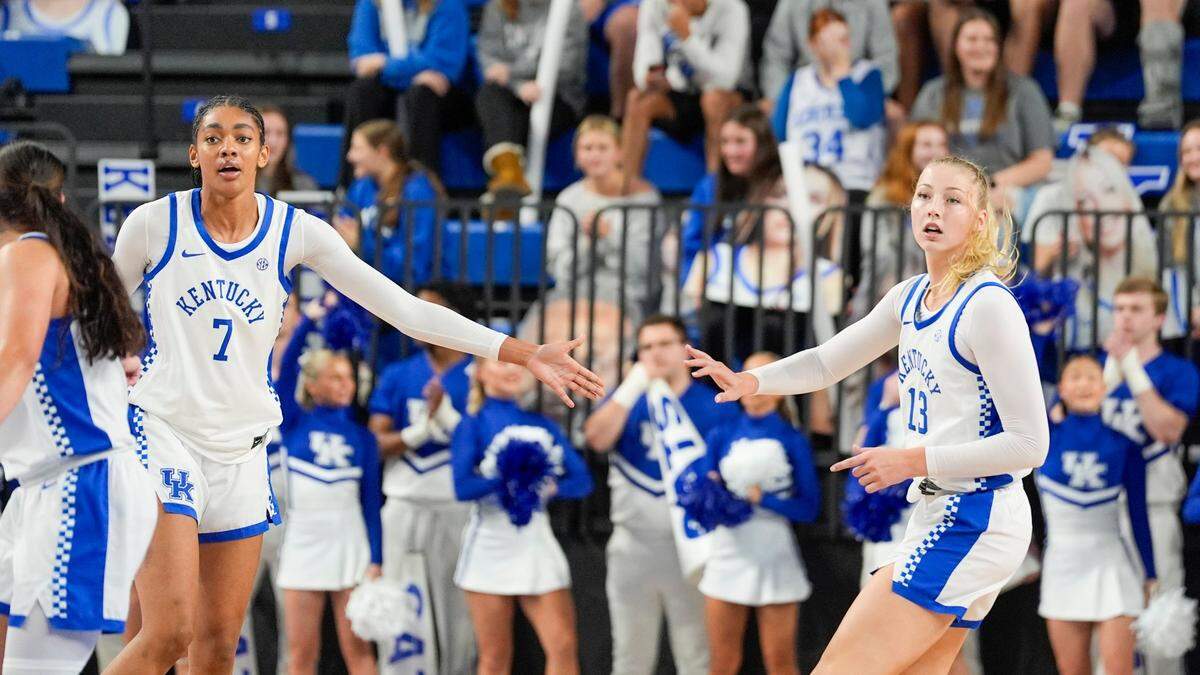
A term first ascribed to the No. 12 Wildcats (15-1, 4-0 SEC) — specifically their defense-anchoring, lockdown trio of Clara Strack, Amelia Hassett and Teonni Key, known colloquially as “CAT” — by head coach Kenny Brooks, he’s taken stock of his roster, injuries and all, and not only moved through a commendable first-year nonconference slate, but also found a way to navigate a challenging start to Southeastern Conference play unscathed, with style.
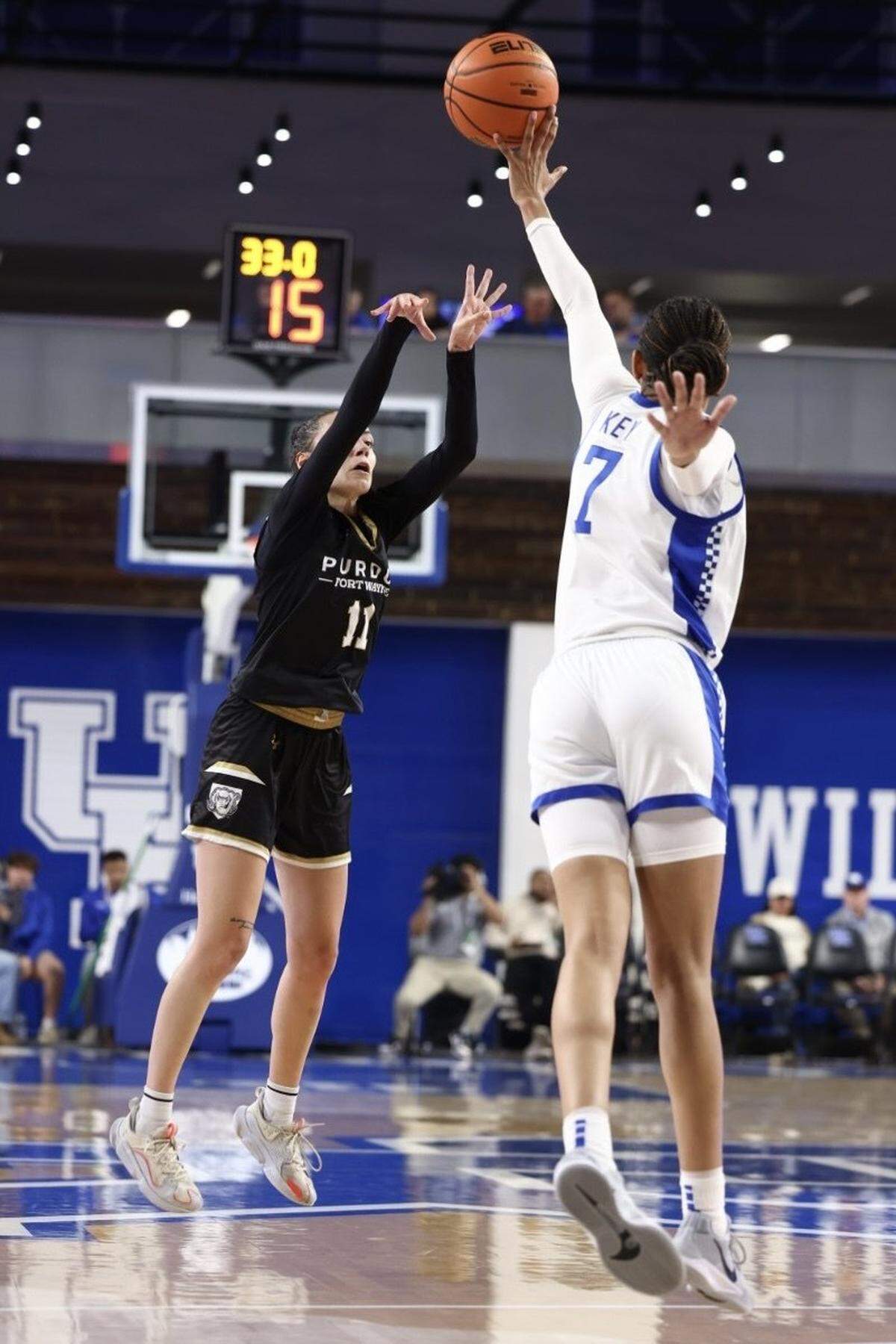
While it’s true the Wildcats are off to their best conference start since 2012-13, during which they also started league play 4-0, and that they’re one of three remaining SEC teams (alongside LSU and South Carolina) without a conference loss, it’s also true that Kentucky leads all of Division I college basketball in blocked shots per game, at 7.4 through 16 games.
“We want to play to our strengths,” Brooks said. “And our strength is our length, our height, and what we lack, maybe in foot speed, you know, laterally, we make up for it with our length and our IQ. And they do a really good job of baiting people. I’ve mentioned it as like the Venus flytrap. You know, it looks like you can go in there and get a layup, but at the worst, we’re going to contest a shot and make you make a very tough shot. And then we do a really good job. We have good instincts.”
Though there’s certainly plenty of basketball left to be played this season, Kentucky’s current average of 7.4 blocks per game rates higher than any final season Kentucky women’s basketball blocks-per-game statistic since, at the very least, the 1987-88 season, besting that of fellow UK coaches Sharon Fanning, Bernadette Mattox, Mickie DeMoss, Matthew Mitchell and Kyra Elzy.
Elzy’s best season for blocks per game came in 2021-22, when the Wildcats embarked on a Cinderella run through the SEC Tournament to earn the program’s first conference tournament title since 1982, and second overall. That team punched its ticket to the NCAA Tournament with the championship before falling in the first round to Princeton. Kentucky finished that season 19-12 (8-8 SEC), and ranked eighth in the nation in blocks per game with 5.5.
Mitchell’s blocks-per-game peak came in 2012-13, which Kentucky finished 30-6 (13-3 SEC). The Wildcats’ season ended in the NCAA Tournament regional finals with a loss to eventual champion Connecticut, and they finished the year No. 24 in the nation in blocked at 5.0.
DeMoss and Mattox each posted season-best averages of 4.5 blocks per game. DeMoss’ came in 2006-07, which the Wildcats ended 20-14 (6-8 SEC). That year, Kentucky’s 4.5 blocks per game ranked No. 42 among Division I teams. Mattox’s best arrived during 1999-00, which UK finished 15-14 (5-9 SEC) and ranked No. 18 in blocks per game. Neither roster made the NCAA Tournament.
Fanning’s season-best happened in 1990-91, when the Wildcats finished 20-9 (4-5 SEC), and recorded 3.3 blocks per game — No. 65 nationally. That year, UK fell in the first round of the NCAA Tournament to James Madison.
This season’s Wildcats sit 0.1 ahead of Southern California, which ranks second in blocked shots per game. The remaining members of the top 10 are Washington State (6.7), TCU (6.5), Kansas State (6.4), Notre Dame (6.4), Florida State (6.1), South Carolina (6.1), Central Arkansas (5.8), Boise State (5.7) and Baylor (5.7).
“We do a really good job of going in, contesting shots without fouling, for the most part, and making it tough on them,” Brooks said. “And we knew that was going to be a strength of ours, and we were going to play to it. And it’s kind of similar to what my defenses have been in the past, with the exception, (in) years past, we weren’t as quick. We were smart, we weren’t as quick, and we would force you into certain situations and contest your shot. Well, this year, we add another element to it. We can force you into a situation, contest your shot, but also have the ability to block your shot. And I think a lot of people, they don’t really believe it until they get up on it and they see it in person. And it’s a little bit different because people can try to say that our length is not a factor, but it really is throughout the basketball game because we contest so many shots.”
Around the SEC
If the current blocks-per-game standings hold through the end of the year, it will mark the first season since 2018-19 that South Carolina wasn’t either in sole ownership of or tied for first place among Division I teams. It would also mean that, for the first time since Mississippi State (5.1) held the honor in 2012-13, the Gamecocks weren’t the SEC’s leader in blocked shots per game.
As of Wednesday night, the top five SEC programs in blocked shots per game were Kentucky (7.4), South Carolina (6.1), Texas A&M (5.4), Ole Miss (5.3) and Texas (5.3).
Individually among conference leaders in blocked shots per contest, Kentucky boasts two players in the top five — No. 1 Strack (2.6) and No. 2 Key (2.3) — plus No. 11 Clara Silva (1.1) and No. 27 Hassett (0.8). The remaining members of the top five, Texas A&M’s Lauren Ware (1.9), South Carolina’s Ashlyn Watkins (1.9) and Texas’ Taylor Jones (1.7), each play for opponents still ahead on UK’s schedule. However, it is important to note that Watkins is out for the season after sustaining an ACL tear in the Gamecocks’ win over Mississippi State on Jan. 5.
Below is a list of the top five SEC programs in blocked shots per game since 2018-19, with Kentucky’s season averages and Kenny Brooks’ Virginia Tech averages added for comparison’s sake. If applicable, regular-season champions are listed in bold, while conference tournament champions feature an asterisk.
▪ 2018-19: 1. South Carolina (6.4), 2. Georgia (5.9), 3. Mississippi State (5.5)*, 4. Arkansas (3.9), 5. Texas A&M (3.5).
Kentucky (3.4, sixth in SEC), Virginia Tech (3.0, 14th in ACC).
▪ 2019-20: 1. South Carolina (8.6)*, 2. Tennessee (6.9), 3. Mississippi State (5.1), 4. Georgia (4.1), 5. LSU (3.9).
Kentucky (3.5, tied for eighth in SEC), Virginia Tech (4.7, third in ACC).
▪ 2020-21: 1. South Carolina (7.0)*, 2. Georgia (6.2), 3. Tennessee (5.5), 4. Mississippi State (4.3), 5. Vanderbilt (4.1).
Kentucky (3.9, sixth in SEC), Virginia Tech (3.9, fourth place in ACC).
▪ 2021-22: 1. South Carolina (7.4), 2. Georgia (6.4), 3. Tennessee (5.6), 4. Kentucky (5.5)*, 5. Mississippi State (5.2).
Virginia Tech (3.4, ninth in ACC).
▪ 2022-23: 1. South Carolina (8.8)*, 2. Ole Miss (5.1), 2. LSU (5.1), 4. Mississippi State (4.7), 4. Auburn (4.7).
Kentucky (4.3, seventh in SEC), Virginia Tech (3.7, tied for eighth in ACC)*.
▪ 2023-24: 1. South Carolina (7.8)*, 2. Ole Miss (5.8), 3. LSU (5.4), 4. Arkansas (5.2), 5. Mississippi State (4.6).
Kentucky (3.1, 12th in SEC), Virginia Tech (5.6, second in ACC).
Furthermore, South Carolina won the NCAA Tournament championship in 2022 and 2024. LSU won it in 2023, and defeated Brooks’ Virginia Tech team in the Final Four.
Blocked shots throughout Brooks’ coaching career
While the 2024-25 Wildcats have posted unprecedented numbers in program history on blocked shots, the 7.4 blocks per contest is also notable in the grand scheme of Brooks’ career, from James Madison to Virginia Tech to Kentucky.
In fact, Brooks’ teams have averaged a minimum of 5.0 blocks per game only three times — twice at James Madison (5.8 in 2013-14, 5.6 in 2015-16), and once at Virginia Tech (5.6 in 2023-24). Each of those seasons included, at the very least, a regular-season conference championship and a trip to the NCAA Tournament; the pair of 5.0+-blocks-per-game seasons at James Madison also included Colonial Athletic Association Tournament titles. They also put his rosters within the top 15 nationally of blocked shots per game.
Brooks noted during his most recent weekly radio show that he and his Hokies staff made a conscious decision ahead of the 2021-22 campaign to steel up their roster “on both ends” of the floor, with the hopes of becoming a well-rounded, “championship-caliber team.”
“Probably the year before we went to the Final Four,” Brooks said, “Is when we said, ‘OK, we want to be a championship-caliber team, we’ve got to be able to play both ends.’ And we don’t get out and deny the lanes, and, you know, press you a lot. So it doesn’t look like the sexy defense that people love to see, or that they think is defense, where you’re getting steals and whatnot. But what we are, is we protect the paint. And we’re so long, and we get into gaps and we make it hard for people to get in there. And, sometimes, the way people score, it looks like that we’re not really a good defensive team. But then you look up, and we’ve held somebody to 60 points, we’ve held somebody to 55 points, and that’s hard to do with this league because there are a lot of very talented basketball players in this league.
“So I’m very proud of our defense, and I think that if people who really know basketball and love to want to dive into it, look at the way we play and look at how we’re going to funnel you to a certain spot, we’re going to contest your shot and then we’re going to do what we do best, is rebound the basketball.”
Next game
No. 12 Kentucky at Georgia
When: 2 p.m. Sunday
TV: SEC Network+
Radio: WLAP-AM 630
Records: Kentucky 15-1 (4-0 SEC), Georgia 9-10 (1-4)
Series: Georgia leads 41-23
Last meeting: UK won 64-50 on March 6, 2024, in the first round of the SEC Tournament at Greenville, S.C.