‘Everything that we do is by design.’ How Kentucky women keep winning with a short bench
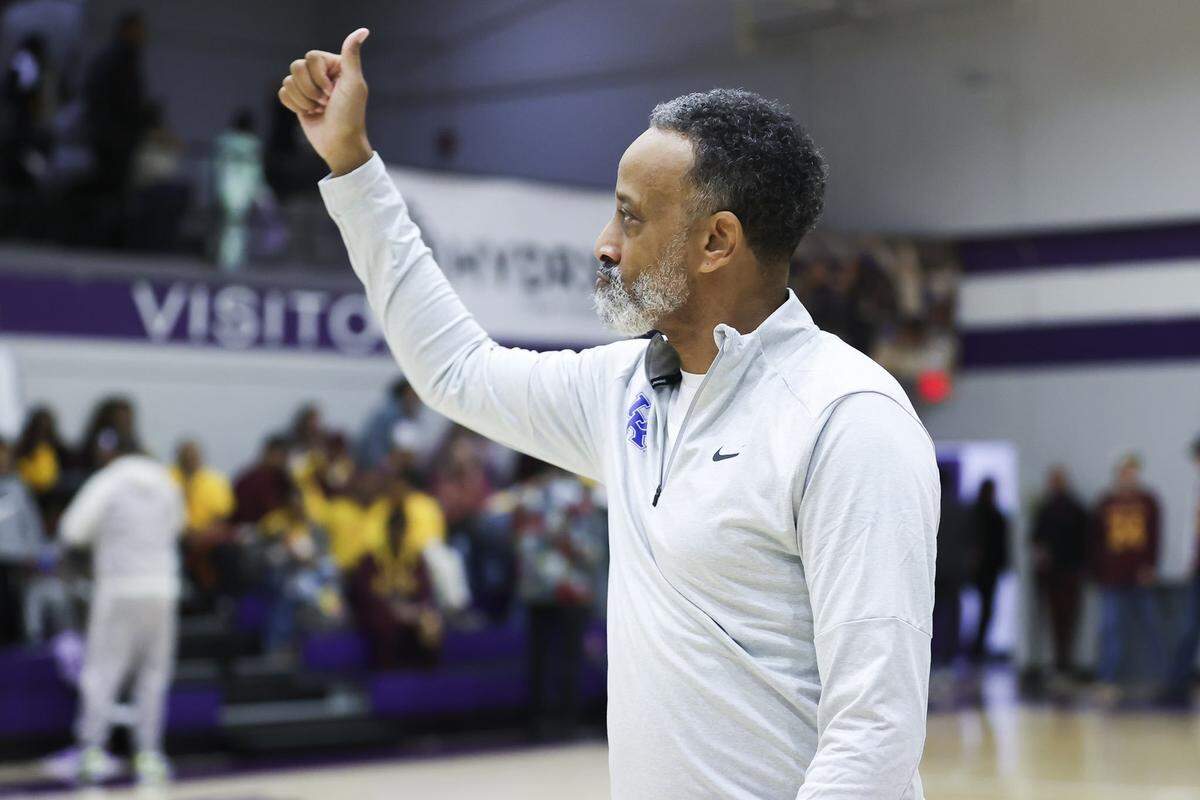
Kenny Brooks’ regular rotation included “six-and-a-half” players the year Virginia Tech reached its first Final Four.
Seven of the 11 Hokies to take the floor during that 2022-23 season played in at least 18 games, and five of them averaged at least 28.5 minutes per contest. That group shouldered the weight of a 27-4 (14-4 ACC) season, helping the program to an unbeaten nonconference slate, its first Atlantic Coast Conference Tournament title and a No. 1 seed in the NCAA Tournament, where it navigated a Seattle Regional 3 that included 16-seed Chattanooga, 9-seed South Dakota State, 4-seed Tennessee and 3-seed Ohio State. The Hokies defeated three of their four tournament foes by double digits, and gave third-seeded LSU (the eventual national champion) an outstanding effort before falling 79-72.
Not only was Brooks’ second-to-last season with the Hokies a historic one, but it also put the greater college basketball landscape on notice, and made athletics directors across the country pay attention to what he’d built in seven years in Blacksburg.
Sure, Brooks won four regular-season titles and five Colonial Athletic Association Tournament championships while at the helm of James Madison, which led to his hiring at Virginia Tech. But, as Big Blue Nation is well aware, conquering the Lady Vols and going toe-to-toe with Kim Mulkey are no small feats.
And this part bears repeating: He did it with “six-and-a-half” players.
.JPG "LEX_02_250102UKWomenQuick_rh (1).JPG")
Is Kentucky’s short rotation sustainable?
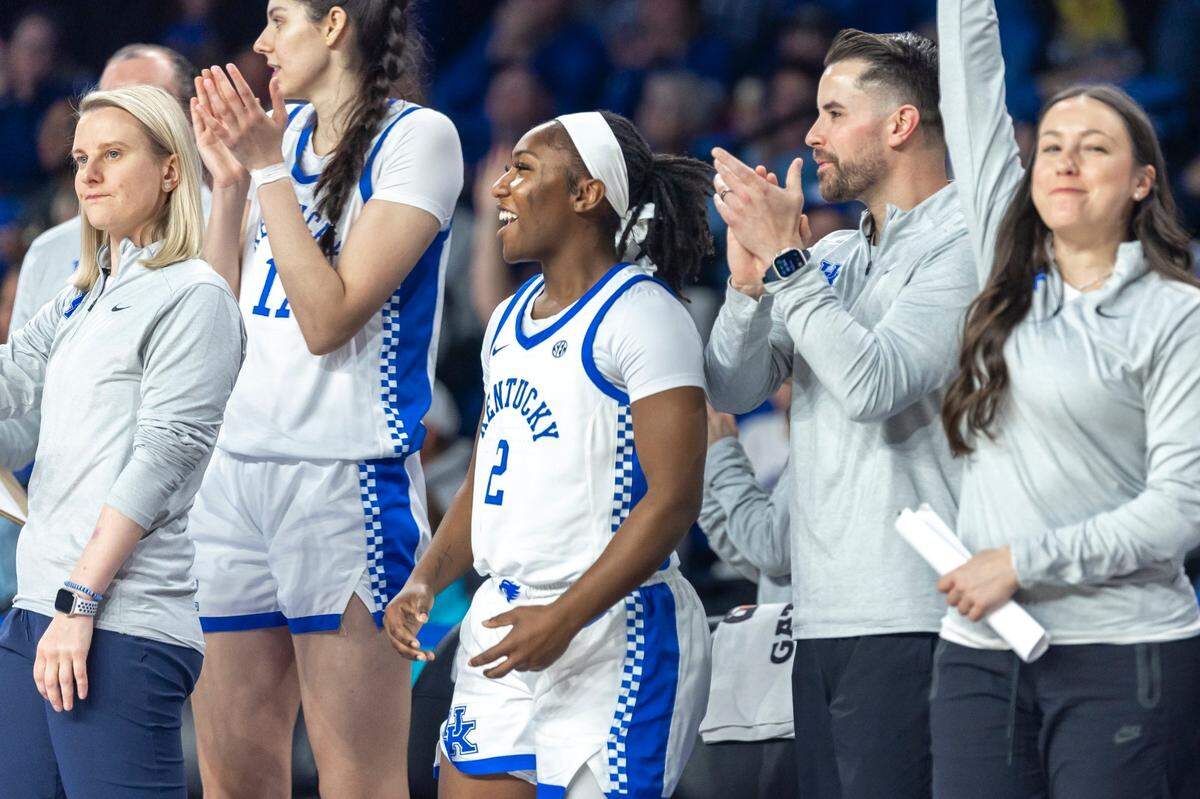
Seven games into SEC play, Kentucky’s 2024-25 squad in its first season under Brooks is ranked No. 12, is 17-2 (6-1 SEC) and holds an undefeated home record. The Wildcats boast one of the program’s tallest rosters across its 51 years of varsity status and runs an offense orchestrated by All-America point guard Georgia Amoore, who followed the new head coach to Lexington from Virginia Tech.
Many have been quick to highlight the fact that five players — Amoore, Clara Strack, Teonni Key, Amelia Hassett and Dazia Lawrence — are not only the lone Wildcats to average more than five points per game, but also the ones playing the majority of the minutes. Ahead of Kentucky’s matchup with No. 22 Alabama on Thursday, Amoore (35.7), Hassett (32.4), Lawrence (32.2) and Strack (31.1) average at least 31 minutes per game, with Key’s mean sitting at 28.7.
The next-closest player, in terms of minutes per contest, is freshman center Clara Silva (12.9), followed by junior guards Cassidy Rowe (12.7) and Saniah Tyler (11.6). Tyler, alongside freshman Lexi Blue (8.1), have each played in only 14 games; Rowe has played in 18. Silva is the only Wildcat outside of the starting five to have taken the floor in all 19 games. Season-long injuries to projected rotation players Jordan Obi and Dominika Paurová left Brooks with an unintended short and youthful bench that is requiring time to develop.
Whether by choice or not, is leaning so heavily on so few players sustainable, especially with an SEC schedule that still includes No. 22 Alabama, No. 13 Oklahoma, No. 5 Texas, No. 7 LSU, No. 18 Tennessee and No. 2 South Carolina?
Brooks’ track record proves the UK coach knows how to manage a small rotation.
“We treat them very professionally,” Brooks said of players he coaches. “They come out . . . might get a massage one day instead of practicing, or they might get shots instead of practicing. And then we’ll practice really good one day to get their timing and everything. And it works, and it’s worked, and it’s something that I’ve done, I’ve had to do. Like I said, the year we went to the Final Four, I played six-and-a-half. OK? One kid got in sometimes, sometimes she didn’t, but we operated in that fashion.”
During Brooks’ final season at Virginia Tech last year, during which it won the ACC regular-season title, eight of the 10 Hokies to receive playing time did so in at least 29 contests. Five of them — Amoore, Elizabeth Kitley, Cayla King, Matilda Ekh and Olivia Summiel — averaged more than 21.8 minutes per game. Amoore and Kitley averaged more than 34 minutes each, while King and Ekh each clocked at least 30; Summiel’s 21.8 minutes put her more than four minutes ahead of Carly Wenzel (17.1) and eight minutes ahead of future Kentucky Wildcat Strack (13.8). Notably, Strack received a massive uptick in responsibility after Kitley sustained an ACL tear in the team’s regular-season finale, and played more than 20 minutes in a single game only twice before Kitley’s injury.
Skeptics would be correct in pointing out that, first, each roster, each season, develops a different chemistry, and, second, a team’s odds of reaching a Final Four increase significantly if it’s led by All-America selections (such as Kitley and Amoore). Something as large as a bad stretch of games or key injuries, or as small as luck of the draw or dumb luck, could result in a drastically different outcome from what’s expected of a great coach, or a great starting five, any given season.
So much so, that, without Kitley, the 2024 ACC champion Hokies fell in the conference tournament semifinal to Notre Dame, and suffered a three-point heartbreaker, on their home court, as the No. 4 seed to fifth-seeded Baylor in the NCAA Tournament round of 32. Two days after the season ended, on March 26, UK athletics director Mitch Barnhart announced Brooks as the ninth head coach of Kentucky women’s basketball.
With him, Brooks brought several key members of his staff, plus Amoore, Strack and a trio of Virginia Tech signees. Not to mention, a slew of intriguing portal acquisitions ranging from a former McDonald’s All American and top-10 prospect to a pair of experienced graduate guards meant to work alongside his point guard.
Since arriving in Lexington, Brooks hasn’t promised a trip to this year’s Final Four, nor a league title. All he’s promised the Kentucky faithful is a group of good people, working hard to “put a product out there that you’ll be able to get behind.”
How Kenny Brooks keeps his UK players fresh
In college basketball, January can be difficult. Regardless of a team’s record, ranking or opponent. Take it from the 13 ranked teams to lose at least one game last week — from North Carolina to West Virginia to Kentucky, anybody could lose on any given night.
After opening conference play 5-0 for the first time since 2012-13, the Wildcats lost to Texas A&M on the road — a disappointing, disjointed Thursday showing that included zero blocks, just one made 3-pointer and several players in foul trouble. To their credit, they immediately righted the ship, tackling Arkansas 89-69 in Historic Memorial Coliseum on Sunday to improve to 6-1 in the stacked SEC.
“Everybody contributed in a really good way, especially our bench,” Brooks said. “We got some good minutes for our bench as we continue to try to grow that because we’re going to need that as we go down the stretch.”
When asked how the players are able to avoid thinking ahead to all the upcoming, marquee matchups against ranked opponents, junior forward Teonni Key noted the importance of taking the schedule one game at a time.
“Focusing on the next one ahead of us,” Key said. “Like the next one is the most important one. Just being who we are as a team on and off the court, we have a lot of trust and connectivity with each other. Including the staff, so they know what’s best for us. We know what’s best for us.”
When asked Sunday how the team is working to avoid fatigue, Brooks acknowledged the grind that comes with this part of the season. However, he also detailed why he’s confident they can manage it.
“We are well aware of their level of fatigue,” Brooks said. “There’s not a team in the country right now that’s not tired. OK, there’s a lot of teams who might play eight or nine people, but then they might go into practice, and they might practice for four hours, and they might go up and down. They might, you know, scrimmage. We’re well in tune with their bodies and what they need to do and how we need to operate. And we can’t have magic dust where, losing Jordan and losing Dom, when we lost them, OK, they were a big part of what we were going to do, and it was really going to bolster our bench.”
In terms of minutes per game, each of UK’s starters ranks within the top 700 of all Division I women’s college basketball players, including four in the top 350. Amoore, who ranks No. 24 in the nation in minutes per contest, also leads the SEC, and ranks third in the Power Four behind No. 17 Kymora Johnson (36.0) of Virginia (11-10, 3-6 ACC) and No. 19 Kaitlin Peterson (35.9) of Central Florida (7-11, 0-8 Big 12).
“Probably the last three years when I was at Virginia Tech,” Brooks said. “We had to have load management in practice. And so we do. And we reworked it, and we do it a way that it’s worked out very well for me. Understanding, yeah, I know Georgia is gonna play a lot of minutes, but Georgia doesn’t practice a lot. Clara Strack is to the point where she’s playing a lot of minutes. She doesn’t practice a lot. And we practice enough to keep ourselves sharp, but we also want to make sure that they’re fresh as possibly can be in January and February and March.”
.JPG "LEX_11_250102UKWomenQuick_rh (1).JPG")
Comparing Kentucky’s minutes played to nation’s top teams
Over the years, Brooks and his staff have had to learn how to effectively manage playing time in order to achieve high levels of success. There is no perfect formula, and every team requires a different approach.
Brooks’ practices are, as he’s described them, “structured differently,” as the Wildcats strive to be “rested, not rusted.”
“We tend to have more like a pro practice,” Brooks said. “As opposed to a college practice, where, you know, some people are still running around, crashing in each other, you know, press, press, press, run up and down the court during practice. And we’re fine-tuning a lot of things, but also with an understanding that we have to rest them enough for vigorous play on Thursdays and Sundays.”
But how do some of the nation’s other top teams delegate responsibility and distribute playing time? What does it look like across the SEC? Or reflected in the history books, on recent national championship-winning rosters?
▪ No. 1 UCLA (20-0, 8-0 Big Ten), college basketball’s last remaining unbeaten team, has nine players who have contributed in at least 17 of the Bruins’ 20 contests. Eight of those athletes average anywhere between 18 and 29.1 minutes per game; there is not a single player on the roster, not even national player of the year candidate Lauren Betts (29.1), who averages 30 minutes per game. Though only three Bruins — Betts, Kiki Rice and Gabriela Jaquez — average double-figure scoring, five others contribute between 6.2 and 8.7 points per game.
▪ No. 9 TCU (20-2, 8-1 Big 12), led by former Louisville and LSU guard Hailey Van Lith, has three players who average at least 31.9 minutes per game, and three others who average between 22.4 and 25.3 minutes. While Van Lith, center Sedona Prince and guard Madison Conner each contribute at least 15.8 points per game, the Horned Frogs can also count on at least 5.3 points per game from its trio clocking in for at least 22.4 minutes per contest — plus forward Aaliyah Roberson, who adds 5.1 points in 14.1 minutes per game.
▪ At a media availability Jan. 7, not 48 hours removed from the Wildcats’ win at Vanderbilt, Brooks answered a question about the significant minutes played by his starting five. In his response, he noted how “unfortunately, I’m a pro at this,” and said he compared this year’s Kentucky team to Notre Dame (17-2, 8-0 ACC), which has held strong at No. 3 since Dec. 16.
“You can look across the country,” Brooks said. “There’s a lot of teams who are playing, you know, they’re shortened benches. Look at, one team that I compare ourselves to, I went down a rabbit hole last night, and I looked at a lot of the top teams who are playing and how many people they’re playing. And we’re not far off from most, and we’re almost identical to Notre Dame. If you look at Notre Dame, they play their starters, you know, for significant minutes.”
Brooks’ sentiment still rings true weeks later. The Fighting Irish, who stand alone at the top of the ACC, join the Wildcats as the only two Power Four programs with four players ranking within their respective leagues’ top 20 in minutes per game.
Notre Dame guards Hannah Hidalgo (35.1), Sonia Citron (34.0) and Olivia Miles (33.8), plus forward Liatu King (31.8) not only rank within the ACC’s top 20 in minutes per game, but also within the national top 300. Hidalgo, who ranks second in the country in points per game at 25.4 and first in steals per game at 4.2, rates No. 40 nationally in minutes per game, while No. 77 Citron and No. 90 Miles, who ranks fourth nationally in assists per game at 6.9, join her in the top 100.
While it’s true that the Fighting Irish have also dealt with injuries this season, four additional, available players average between 19.3 and 25.5 minutes per game. Five players — Hidalgo, Miles (16.4), Citron (13.7), King (12.6) and the recently returned Maddy Westbeld (10.3 points, 21.0 minutes) — average double-figure scoring.
.JPG "LEX_13_250102UKWomenQuick_rh (1).JPG")
Around the SEC
In the Southeastern Conference, teams have also found varying degrees of success while managing playing time.
▪ No. 5 Texas (20-2, 6-1) gets the most run out of impact players Madison Booker (16.1 points, 28.0 minutes) and Rori Harmon (10.1 points, 28.0 minutes), but asks at least 17.8 minutes per game out of seven available players.
▪ No. 4 LSU (21-1, 6-1), No. 22 Alabama (17-4, 4-3) and No. 23 Vanderbilt (17-4, 4-3) each have three players within the SEC’s top 20 in minutes per game. However, Alabama’s trio of Aaliyah Nye (13.8 points, 31.9 minutes), Karly Weathers (7.6 points, 31.3 minutes) and Zaay Green (16.4 points, 30.9 minutes) makes the Crimson Tide most similar to Kentucky; Alabama has three more players averaging between 23.7 and 27.3 minutes, but doesn’t ask more than 13 minutes from its remaining available athletes.
▪ Defending national champion South Carolina, which is hunting its fourth title since 2017, is similar to UCLA in that it does not ask as many minutes of its players. Te-Hina Paopao leads South Carolina in minutes at just 25.1., but seven other available players average between 18.3 and 24.3 minutes. The Gamecocks have relied on their depth to carry them through grueling schedules year after year, including last year’s undefeated (38-0) campaign, during which nine players contributed between 15.1 and 27.9 minutes per game.
Is history on Kentucky’s side?
▪ Connecticut’s legendary 2015-16 team, which won the national title with a 38-0 record, featured eight future WNBA draft picks; only Moriah Jefferson (30.9) clocked at least 30 minutes per contest. Breanna Stewart (29.1), Kia Nurse (28.3), Morgan Tuck (26.8), Katie Lou Samuelson (23.5), Gabby Williams (18.6), Napheesa Collier (17.2) and Saniya Chong (12.4) each averaged more than 12.0 minutes for that iconic Huskies roster.
▪ Since the 2014-15 season, two NCAA Tournament-winning rosters (2014-15 Connecticut, 2016-17 South Carolina) did not have a single player average even 29 minutes per contest, but received at least 15.6 minutes per game from eight separate players.
▪ During that same span, three championship rosters (2015-16 Connecticut, 2020-21 Stanford, 2021-22 South Carolina) featured only one player averaging at least 30 minutes per game. Tara VanDerveer’s third and final NCAA title team at Stanford had six players average between 15.3 and 31.6 minutes, while Dawn Staley’s first NCAA championship was won with six players averaging between 16.6 and 30 minutes.
▪ Three teams (2017-18 Notre Dame, 2018-19 Baylor, 2022-23 LSU) — including the Angel Reese-led Tigers team that defeated Brooks’ Hokies in the Final Four — featured two or more players averaging at least 30 minutes per game. The 2023 LSU Tigers received 33.6 minutes from Reese and 33.3 minutes from Alexis Morris, and anywhere between 21.7 and 28 from four others, including then-freshman Flau’Jae Johnson, who has increased her average minutes from 27.6 that year to 34.4 minutes this season — placing her ninth in the SEC. Kim Mulkey’s final championship at Baylor featured two players — Chloe Jackson (32.1) and Juicy Landrum (31.6) — who averaged at least 30 minutes per contest. The Bears also received impactful minutes from Lauren Cox (29.4), DiDi Richards (26.9) and Kalani Brown (26.8).
▪ Only Muffet McGraw’s 2018 championship team, a Notre Dame roster headlined by future WNBA draft picks Jackie Young (34.4 minutes), Arike Ogunbowale (34.3) and Marina Mabrey (34.3), had more than two athletes play at least 30 minutes per contest during its title-winning season. Three others logged at least 26.3 minutes per game.
Kentucky’s Brooks eyeing ‘a bigger picture’
No matter how a coach opts to leverage their roster, the ultimate goal remains the same. And, though Brooks is clear in his belief that success is built one step at a time, he, his staff and his players are all on the same page as far as how to get there. The intricacies of that process, however, is not meant for outside ears.
“I could tell you, but you would never understand unless you were at my practices every day,” Brooks said. “Everything that we do is by design, and we know what we’re doing. We know who needs to be in the game with who. I know that, you know, maybe Amelia hasn’t scored in a game, so maybe she does need some more time out there. And then I watch every one of them in practice to see, ‘OK, who deserves what and what opportunities?’ (Saniah Tyler) has gained opportunity through us because she’s working her butt off in practice. Not to say that Lexi’s not, you know, but there’s a bigger picture. There’s a bigger picture in us and us gaining our chemistry with everyone. And they all know. They are fully aware.”
All data used is accurate through games played on Jan. 28. Statistics pulled from ESPN and Sports Reference.
Next game
No. 22 Alabama at No. 12 Kentucky
When: 7 p.m. Thursday
TV: SEC Network
Radio: WLAP-AM 630
Records: Kentucky 17-2 (6-1 SEC), Alabama 17-4 (4-3)
Series: Kentucky leads 36-19
Last meeting: Alabama won 91-74 on Jan. 28, 2024, at Coleman Coliseum in Tuscaloosa, Ala.