Point Guard U? How Kenny Brooks’ past two lead guards have set UK’s assist record
As Kenny Brooks tells it, Tonie Morgan and Georgia Amoore have really only met once.
It was spring of last year at the Bluegrass Airport in Lexington; Morgan, then a prospective transfer from Georgia Tech seeking to improve her draft stock, was flying in to take her official visit. Amoore, a face of not one but two program transformations under Brooks, was going to New York to attend the WNBA Draft, where the Washington Mystics would select her sixth overall.
“They pass each other at the terminal,” Brooks said. “They took a picture, they sent it to me, and they haven’t spoken since. … I think Georgia came here, and they talked a little bit, but it’s just very fitting for the whole situation.”
It’s a passing connection for two of Kentucky women’s basketball’s all-time best passers, players who at first glance are very different but are bonded by their performance in Brooks’ offensive system.
“One’s from Australia, one’s from Tallahassee,” Brooks said. “One’s white, one’s Black, one’s tall, one’s short. And they play very similar. And Georgia thinks like me, and her basketball movements are somewhat like mine. Tonie, the way she thinks is somewhat like mine; we’re getting on the same page, but her basketball movements are almost identical to mine.”
The UK record book binds them, too.
In its 52 seasons of varsity status, Kentucky women’s basketball has had no shortage of great point guards. Despite that, the single-season assists record — 209, set by Patty Jo Hedges during the Wildcats’ 1981-82 campaign — stood for more than 40 years. Hedges also held the second- and fifth-highest single-season totals.
The top eight spots on the Wildcats’ top-10 single-season assist totals had held on since the 1980s, with only Rita Adams (162 assists in 2001-02) and Amber Smith (161 in 2009-10) breaking through this century.
That was until the Australian Amoore reset the record last season.
And before the Floridian Morgan did it again this season.
“I take credit for that because I’m able to put great point guards in that situation,” Brooks said. “(Morgan) was a great point guard at Georgia Tech, she just didn’t have the ball in her hand as much. And I think that was part of the reason that she wanted to come here; the ball was gonna be in her hand more, and she was gonna be a facilitator. And that’s something that’s added an element to her game that’s very attractive to the next level.”
Seated next to Morgan, who nodded along in agreement, Brooks said that facilitator role is necessary for and developed by his style of play, a notion that could appeal to potential future Kentucky point guards.
Brooks added that it was “one of the reasons” UK was able to land class of 2026 point guard Maddyn Greenway, the hopeful heir to the position and, at No. 13, the highest-ranked recruit in the Wildcats’ signing class, a trio of top-25-ranked McDonald’s All-Americans.
Brooks likens his point-guard preference to former NBA MVP Steve Nash. Rather than kick the ball ahead, Brooks said, he wants his point guards to dribble across halfcourt and facilitate offense.
“It’s the way I wish I could’ve played,” Brooks said.
That style didn’t always come naturally to Morgan. She had a tendency toward the hit-ahead pass, which Brooks said he had to “take out of her game a little bit.”
“...(T)he way we’re constructed, if you kick it up to our players, I don’t know what’s gonna happen,” Brooks said. “I don’t. But I know if she’s bringing it across the floor, I know what’s gonna happen. And if we can kick it out to our shooters so they can shoot, or she gives it to (Clara Strack), good things will happen.”
While Kentucky has had great point guards throughout its history, UK’s style of play has never rewarded the facilitator quite like this, especially as the game has ramped up in pace.
Brooks’ system, Hedges said, benefits point guards because they’re making decisions with the ball: “The offense is always geared around them and what they decide to do.”
“When I watch Tonie and Georgia both, I think you could really see quick, one, that Coach Brooks has an eye for point guards,” Hedges told the Herald-Leader. “I mean, I’m sure he knows what he’s looking for. And they’re both more extensions of him.”
Kentucky’s one-two passing punch
The 5-foot-6 Amoore, in her fifth and final season of college basketball after four seasons at Virginia Tech, recorded 213 assists across Kentucky’s 31 games. She finished the 2024-25 season ranked third nationally and first in the SEC at 6.9 assists per game.
She did not eclipse Hedges’ decades-old record of 209, a mark spread across 32 games, until the Wildcats’ final game of the season, an 80-79 overtime heartbreaking loss to Kansas State in the second round of the NCAA Tournament. In 45 minutes on the floor of her 31st game, Amoore totaled six assists, and the record was hers.
“When I watched her at her other school, I just, I was like, ‘Man, this girl is good,’” Hedges said. “And then when she came to Kentucky, I just loved her game. And so I was really happy for her (when she broke the record).”
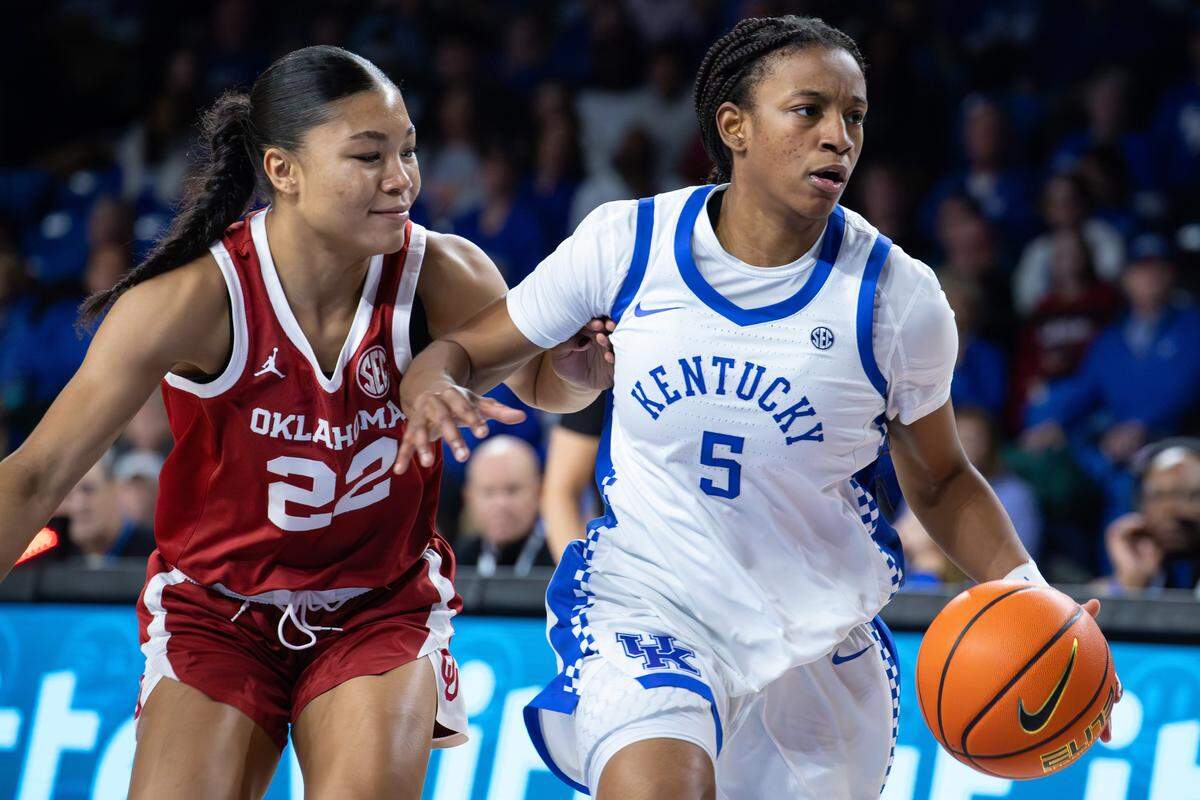
The 5-foot-9 Morgan, who leads the conference and the country in assists per game at 8.5 through 28 contests, reset the record Feb. 12 against Texas A&M, in the 26th game of her sole year as a Wildcat. Morgan recorded eight assists in the 20-point win, with four games left in the regular season and both the SEC Tournament and the NCAA Tournament ahead of her.
“It’s a surreal experience,” Morgan said after the game. “I’m obviously thanking my teammates because they gotta make shots for me to get that. But it just feels great to leave my mark here, even though I’m only gonna be here one year.”
Three days later, ahead of UK’s home victory over Ole Miss, Brooks — himself a former point guard at James Madison — awarded the senior with a commemorative basketball honoring the breaking of the record.
Morgan’s success in his system comes down not only to her skill set, Brooks said, but also a “willingness to be receptive to whatever I said without argument,” though he clarified that Morgan has had a lot of say as they’ve worked together to execute his offense this season.
After half a decade with Amoore, Brooks’ next point guard was always going to have to deal with the elephant in the room. Nobody was going to be like Amoore; nobody was going to replicate her connection to and understanding of Brooks.
Amoore was responsible, in part, for the Wildcats’ resurgence. She’d left her mark on the program’s record books, and she’d willed the team to a top-16 overall seed in the NCAA Tournament for the first time in eight years, as Brooks declared her his “mini-me.”
Amoore and Morgan competed in the ACC before Amoore’s transfer to UK. And when Morgan followed that path to Lexington, she found that in Brooks’ office, “pretty much it’s a shrine” to her former opponent, Brooks said.
“And you go down to the locker room, and there’s a big mural down there of (Amoore) and everything,” Brooks said. “But (Morgan’s) never talked about it, never winced about it.”
Brooks put different demands on Amoore and Morgan in each of their seasons at Kentucky. His consistent refrain since Morgan’s signing has been not a desire for her to fill the big shoes left by Amoore but “to bring her own.”
Different stars, similar results
Success as a point guard, Hedges said, is dictated by winning as a team and how well you can work with your teammates.
A member of the 1982 SEC Tournament Championship team, Hedges said she “didn’t even think about the record, to be honest,” but that her proudest accomplishment is how unselfishly she and her teammates, like Valerie Still, Lea Wise Prewitt, Leslie Nichols, Lori Edgington, Tayna Fogle, the late Lisa Collins and other Wildcat greats played together.
“Everybody just played their role,” Hedges said. “A point guard is only as good as the people around them, and vice versa.”
Morgan did not transfer to Kentucky to play with the exact roster Amoore had last year, but she did inherit three starters from that foundational first season under Brooks and her predecessor.
Strack was the reigning SEC Defensive Player of the Year; Teonni Key, an athletic stretch four, was entering her senior season playing the best basketball of her career; Amelia Hassett, a 3-point specialist, had in one year of Division I basketball found a more consistent shot and become a defensive stopper.
“With the transfer portal, you get a player who is as decorated as Tonie, she comes into a situation and, because of her personality, she just doesn’t want to step on people’s toes,” Brooks said. “She already knew that Clara Strack was established here. She knew that Teonni Key was established here. She knew that Amelia Hassett was established here. And she didn’t want to come in like, ‘Hey this is my team. You guys follow me.’”
Instead, Brooks said, Morgan’s goal was to blend in.
Morgan has more freedom to settle into the role of facilitator. She’s not carrying the offensive weight Amoore did. Morgan doesn’t need to be the face of the program for the Wildcats to win this year.
That doesn’t mean Morgan has been without star-making moments.
Take her 3-point buzzer-beater to down then-top-5 LSU in Baton Rouge, or her unending fight in the team’s home victory over then-top-five Oklahoma despite fall after fall.
“If you want to compare them both here at Kentucky, they’re a little bit different,” Brooks said. “Because Georgia had to score a little bit more here on this team.” The Tonie Morgan Show in Lexington looks different from Amoore’s, but you can see the parallels between the two in Brooks’ system by comparing Morgan’s season to Amoore’s upperclassman years at Virginia Tech.
“She was a facilitator first,” Brooks said of Amoore. “Facilitate, facilitate and then score when the opportunity presented itself. When Georgia came here, I needed Georgia to score more. And so she looked at scoring a little bit more and then facilitating second. Tonie came here, and obviously she has great players around her, so she looks to facilitate first, looks to facilitate second and then looks to score third.”
That’s why Morgan’s assist rate is higher than Amoore’s in Lexington, Brooks said, and why Amoore scored more (15.7 points per game last season to Morgan’s 14.3 this year).
“In the beginning of the year, it was like straight facilitate, facilitate, facilitate” for Morgan, Brooks said. “I never told her to do it, it’s just what she felt, and she wanted to get her teammates. She’s a consummate teammate. She wants to make sure they are good and they’re getting better.”
To Brooks’ surprise, that swap “happened organically.” The coach said he didn’t even tell Morgan what he needed from her until UK’s Nov. 22 matchup with Louisville.
“Right before the Louisville game, I sat her down,” Brooks said. “I said, ‘I love it. I love what you’re doing, but I think there needs to be a little more balance. Because you can score, and I need you to score a little bit more, too.’ And ever since then, we’ve never talked about it. And she understands the balance of what she needs.”
When his point guard strikes the right balance, Brooks’ style of play is difficult to disrupt. He likes to joke that, due to his playing career taking place in a different era, he “started playing my best basketball,” near the end of his time, as the game began to allow players more freedom.
He carried that modern, dynamic style into his coaching career, passing down bits of his personality as a player along the way.
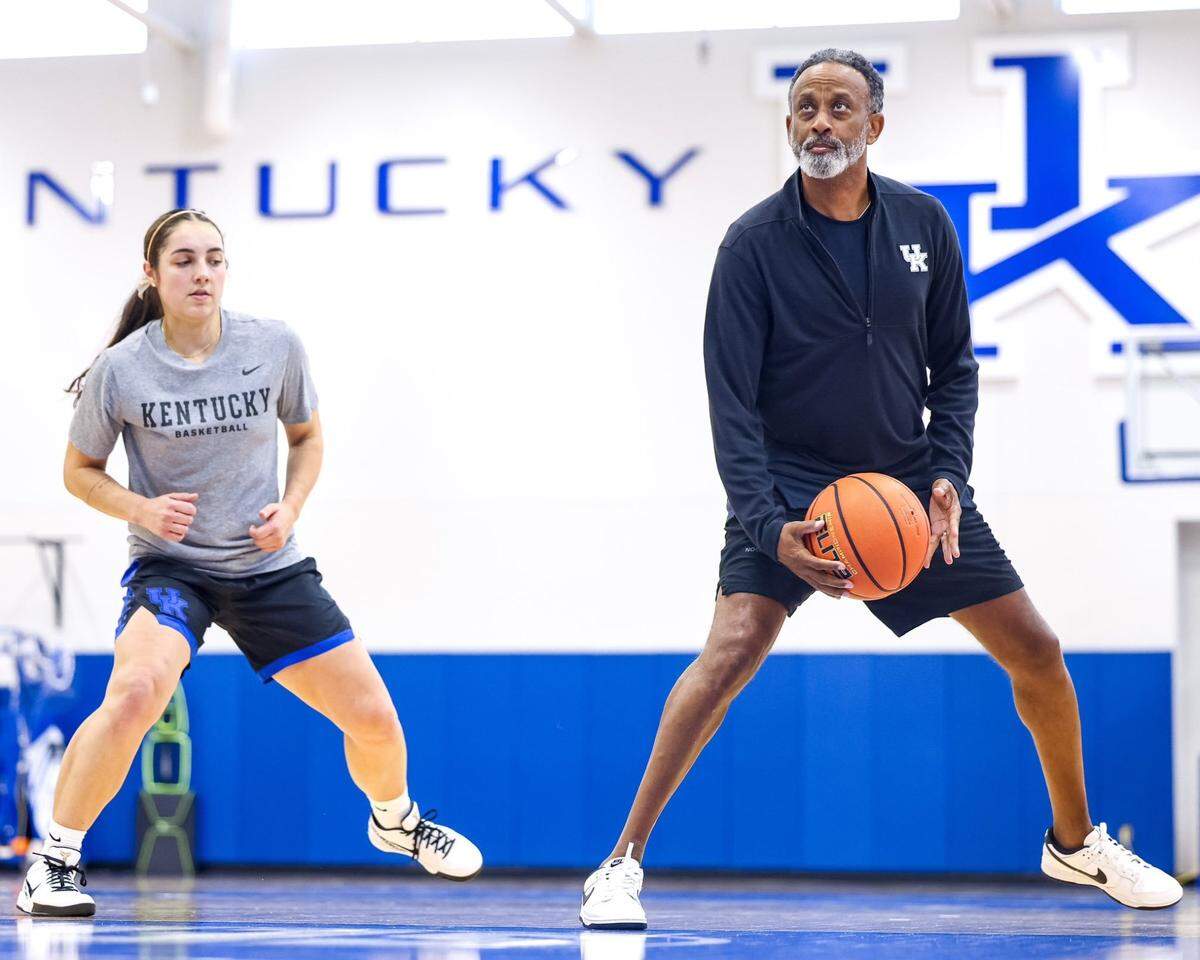
Will Sims, Kentucky’s director of player development and assistant coach, often helps Brooks during his individual workouts with Morgan. He’s noticed that if Brooks shows Morgan a move, she can duplicate it exactly.
“(Sims) says, ‘You guys look identical in the way that you’re doing it.’” Brooks said.
“I think it’s cool,” Morgan said. “I’ve never seen (Brooks) play. He’s shown me little clips here and there. But knowing that he’s been in the position that I am, and he sees what I see, for the most part, I think it makes it easier for him to coach me as a player and as a person.”
Amoore’s moves looked different, but was so in sync with Brooks mentally that she’d sometimes finish his sentences.
Though their approaches differ, Morgan’s play in Brooks’ system — like Amoore’s — has generated increased buzz from WNBA scouts. Teams love that Morgan is “shifting over to a pure point guard,” Brooks said, and the way she controls the tempo of a game.
“The scout is out (on) what people want to do with her,” Brooks said. “But essentially, you can’t stop her from getting to her spot. You know she wants to get to a certain spot. She just does it in a very crafty way, using her size, her ability, her ball handling. And they love that.”
With few questions about her physical skills, Brooks has told Morgan scouts are digging into the finer points of her game — how she leads; her demeanor when the other team is playing physical defense;
Morgan, whom Brooks described as “a very quiet kid” and a leader by example, was never going to break the assist record — or lead UK to a single-season record for wins over top-five teams — if she’d been asked to be like someone else.
“You have to figure out their personalities,” Brooks said. “You have to figure out what they’re comfortable with. You have to figure out what their style is going to be. And then you build upon that…leadership is different year-to-year, and you don’t know what to expect.”
Given her more introverted nature, coaxing authentic leadership out of Morgan — like finding the balance between giving and taking opportunities on the floor — is an organic process. Morgan knows right from wrong “most of the time,” Brooks said. She just needs to better express it to her teammates, and has “gotten a lot better as the year’s gone on.”
He’s hoping for even more as Kentucky closes out its regular season with games Thursday at Auburn and at home Sunday against No. 3 South Carolina and moves on to postseason play.
“Coach wants me to be more vocal, I think he’d like to say,” Morgan said. “I think that I personally just try and do the right thing all the time for these young ladies and for myself. Because that’s what we need, someone who’s always doing something right. I mean, of course, players mess up. You know it happens. But take accountability, and move forward. And you keep pushing it the right direction, then you can trend upward.”
This story was originally published February 26, 2026 at 6:30 AM.