‘When they win, I win.’ How a podcast and a group text made five coaches better
AI-generated summary reviewed by our newsroom.
- Five Black men coaching Division I women’s basketball formed a support network.
- Their COVID-era #RELENTLESS podcast and texts became forums for strategy and life.
- Their council guided career moves, grief coping and program building.
Summer takes on new meaning on the AAU circuit. Whistles echo across countless courts; combined with squeaking shoes and hollering parents, the sounds create a recruitment symphony. It can be exhausting, particularly for the college coaches searching for players to represent the future of their programs.
Tarrell Robinson certainly did. Last summer, North Carolina A&T’s head coach was sitting in the stands when Kenny Brooks walked onto the court.
When the old friends locked eyes, Robinson stood without hesitation, and they made a beeline toward each other for what he described as “that good, solid, hard dap and hug.” It’d been quite some time since they’d caught up in person.
They watched “maybe a game and a half,” Robinson said, brought each other up to date and, much like everybody else, moved on.
It’s the kind of moment you’d miss if you weren’t looking for it. The recruiting trail isn’t the time to slow down and catch up. It demands calculation and evaluation — showing face to prospects, parents and coaches — then moving on to the next court.
It’s a difficult — and often lonely — aspect of a taxing line of work, which demands results and a competitive mindset.
But for Robinson and Brooks, that embrace means more than professional networking; it’s a show of genuine friendship, built over years of making space in an industry that doesn’t always leave room for deep connection.
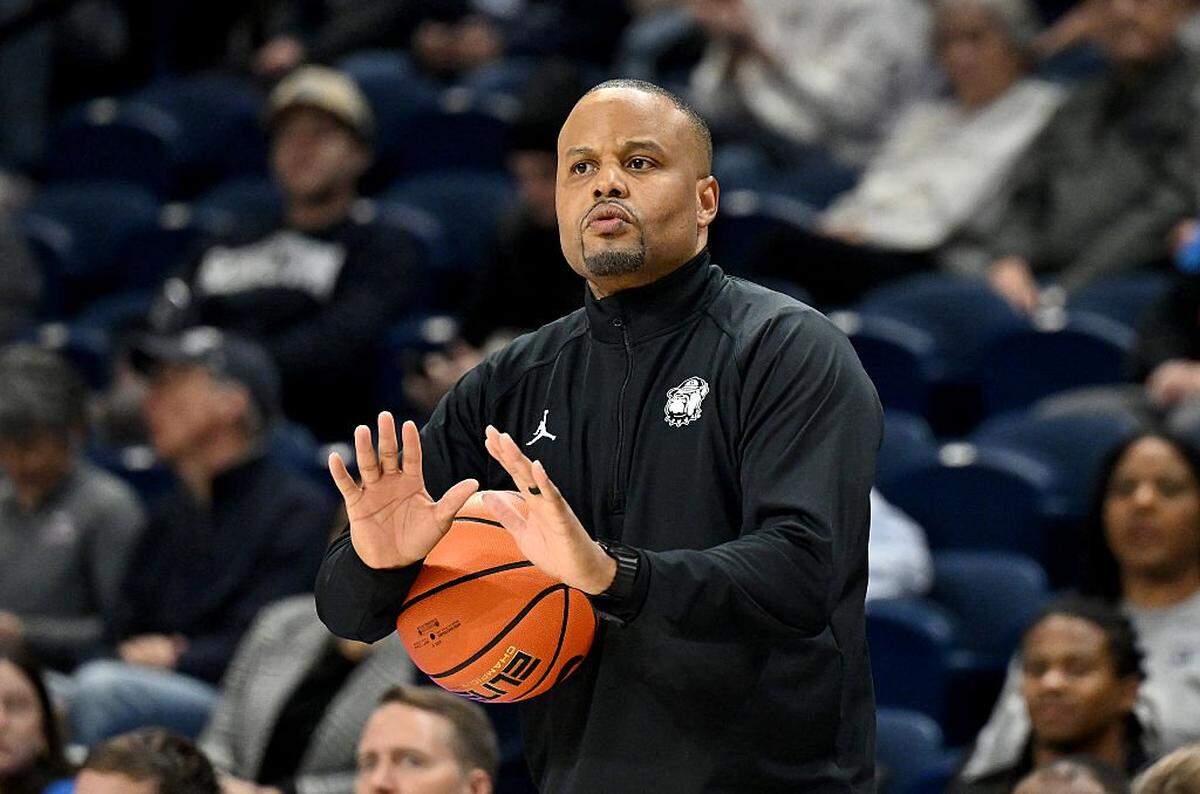
Robinson, Brooks, Georgetown head coach Darnell Haney, Ole Miss associate head coach Quentin Hillsman and Virginia assistant Ronald Hughey are close friends and confidantes. They’re five Black men coaching Division I women’s basketball teams who support one another in ways the public doesn’t see.
Their long-running group text is never just basketball, nor was their COVID-era podcast, “The #RELENTLESS Podcast with Coach D. Haney,” also known as a conversation with “The Generals.”
The podcast and the group text serve as safe spaces to speak openly about careers, ask tough questions and share strategy and skill. But most importantly, through the highs and lows of coaching, their circle is a soft place to land — a reminder that they are never alone.
A ‘Relentless’ friendship
The #RELENTLESS Podcast was Haney’s brainchild, born out of 2020’s forced break from basketball and the sudden abundance of time. Haney, then head coach at Jacksonville University, figured a podcast would be a way to “stay connected” with friends in the industry while keeping his mind fresh.
“We call each other brothers, right?” Haney said. “So I got on the horn, and I made some phone calls and I texted some people. … We called it barbershop talk a little bit, but it’s coach talk as well. We got a chance to do that, and it kind of blew up.”
Its premiere featured just Haney, Brooks (then at Virginia Tech) and Robinson. For nearly an hour, the trio shared an uninterrupted conversation about their journeys to head coaching and the impact they’d had on one another and their players.
Over the course of 12 episodes, Haney, Brooks and Robinson — joined by coaches like Hillsman (then at Syracuse), Hughey (then at Houston), Terry Fowler (then at South Alabama), David Six (then at Hampton) and James Howard (then at Georgetown) — spent more 15 hours in their “barbershop,” learning and connecting on Thursday nights.
Haney called it a pivotal time for their friendships.
“Now, there was mutual respect and friendship,” Haney said. “… But my connection with all of them, I wanted to make sure we connected with each other. So a lot of others had a connection, but it wasn’t like it is now.”
As Hillsman put it, “D is the brains of the operation, he’s the engineering mind” who drove the evolution of the virtual hangouts into a podcast.
“Once COVID hit, everybody was Zooming like crazy,” Hillsman said. “We were all in the house, and I remember D-Hanes was like, ‘Listen, man, we need to start getting together. We need to start talking more.’ Everyone was having a little bit of cabin fever. … He’s like, ‘Man, we got to do a podcast.’”
Hughey, unfamiliar with the concept of a podcast when Haney called him, said he had no reservations joining what would become “a safe space for us.”
“Everything is competition,” Hughey said. “And we all started just to unleash things because we started to notice the one thing about all of us — besides being competitive — everybody wanted to see everybody be successful. And so that’s why you didn’t mind sharing. That’s the love that started to form between us.”
Prior to “#RELENTLESS,” the group never had the opportunity to gather and enjoy one another’s company; their friendships were limited by the coaching schedule.
“We already had our relationships, and Darnell just brought it together,” Robinson said. “And man, oh my God, it was great times. That was some of the best times in terms of my profession as a basketball coach. Spending those evenings with those guys, just kind of talking basketball and sharing our thoughts.”
But the best stuff, they all agree, came when they weren’t recording.
“I don’t have to wonder how Kenny Brooks does his offense or practices or anything,” Hughey said. “Now he’s there where I can ask him. I ain’t have to wonder about Haney and his family, and what are some things that he do to keep his family involved with basketball so he’s not missing out on that quality time. It’s Tarrell and his marriage. … We had a chance to talk on so many different subjects without having a schedule, without having a meeting, without having something that we had to rush off to.”
.png "The Generals (1).png")
‘The Generals’
The gyms reopened, and jobs changed hands. But “The Generals” remain close, and their roles continue, even six years later.
Haney, the organizer, is now leading the charge at Georgetown. Hillsman, the detailed achiever and the first among the five to break through to the Final Four, is associate head coach to Yolett McPhee-McCuin as Ole Miss ascends. Hughey, the defensive specialist, resigned after 11 seasons as Houston’s head coach and has brought his expertise as an assistant to Virginia, where Amaka Agugua-Hamilton’s Cavaliers have returned to the Sweet 16. Robinson, the steady foundation architect, is the winningest head coach in the history of North Carolina A&T women’s basketball. Brooks — referred to by the group as “the OG” — has lifted Kentucky to its first Sweet 16 in a decade.
They don’t gather on Zoom anymore, but the text thread still lights up after wins, losses and recruiting battles. They still trade coaching questions, provide their own sports commentary on the Dodgers or the WNBA. And they still — always, without fail — provide support.
The messages range from joyful to joking to vulnerable. Sometimes it’s lovingly delivered trash talk. Others times, hard truths one could only hear from someone they love and respect. The consistent thread is honesty and the earned understanding that there are four other men checking in, listening.
Brooks, Hillsman, Hughey and Robinson are part of Haney’s “board of advisers,” along with his wife, Aaliyah, and other friends and guides he’s picked up along the way.
In the fall of 2023, Haney had accepted a job as assistant to Georgetown’s first-year head coach Tasha Butts, who was coaching during a two-year battle with advanced metastatic breast cancer. He knew he’d need support during a time he thought Butts would return for conference play.
But the group thread took on a new importance when Butts, whose cancer — thought to be in remission — returned aggressively. She died on Oct. 22, 2023.
The job Haney had accepted as Butts’ right-hand man suddenly gave way to the unexpected reality of leading Georgetown in an interim capacity and guiding the program through a year of grief.
“I get a call in October,” Haney said. “I’m in the shower. I get a call before I go into work, and it’s from our athletic director, Lee (Reed). And he told me that Tasha had passed. And then when we found that out, we had to get the girls together. To get the team together, and we let them know what was going on. It was crushing to them. It was crushing to us as a staff.”
It was the beginning of a grueling stretch for Georgetown. The first week of November, Haney said, the Hoyas practiced on the third, flew to Georgia for Butts’ funeral on the fourth, practiced on the fifth and played a game on the sixth.
“We had some people that lost their parents” that year, Haney said. “We had some young women who had just had some trying personal times. We had some young people’s parents who were sick. So, all in all, it was just definite, put your head to the ground and just continue to work and honor all those that believe in you and trust in you.”
Georgetown finished 23-12, its most wins in a decade. It reached the Big East Tournament championship for the first time ever.
Through the ups and downs, Haney leaned heavily on his board of advisers. When it came to his friends, he heard from them by way of group text and individual message, too — notes that said, “I see you. I feel your pain. I get it.”
“Especially in the times that aren’t the best, you got to figure out how you can make the most of the situation,” Haney said. “And it can be tough at times, after a tough loss, after a tough injury, after a death in the program, it can be tough. So just having someone outside of the immediate circle that kind of sees you, and you can talk to ‘em about struggles, triumphs, things of that sort. I mean, it’s definitely healing.”
X’s and O’s
This brotherhood isn’t only about comfort and friendship. It’s critique, suggestion and craft.
In their circle — and for many coaches far beyond it — Hughey is the first call for any defense-related questions, and for good reason. Protecting the basket became a priority for Hughey at a young age, and he’s built his career on taking away possessions through pressure.
Hughey described himself as always having been “a person that wanted to be aggressive and dictate.” He was never going to be denied, or have his own possessions shortened, and neither were any of his players. His teams would be the ones setting the tone.
As Hughey put it, “I couldn’t care less about offense. … I still embody everything about the defensive side of the ball.”
That mindset led to his hiring by longtime coaches like Gail Goestenkors, Sue Semrau and C. Vivian Stringer, and made him the right fit for Agugua-Hamilton’s UVA program ahead of this year. It also served the Generals, two of whom specifically credited Hughey with program-elevating tactics. Back in the days of the podcast, Hillsman remembered, Hughey was keen to explore both sides of the floor.
“De-fense!” Hillsman said. “Here’s the thing. It’s so funny. We were all doing this podcast, talking about offense. Kenny and I were the same. I shot out threes, Kenny shot out threes, we cared about offense at the end of the day. And Hughey was like, ‘Let’s talk about defense!’ And we were like, ‘Well, you gonna do all the talking.’”
In the 2016 NCAA Women’s Basketball Tournament, Hillsman led Syracuse to the program’s first-ever Final Four and national championship game appearance. In Hughey’s eyes, it was possible because of the emphasis on shrinking possessions.
Hughey’s passion for defense makes him a natural foil for Brooks, who’s always found himself drawn to offensive strategy and scoring.
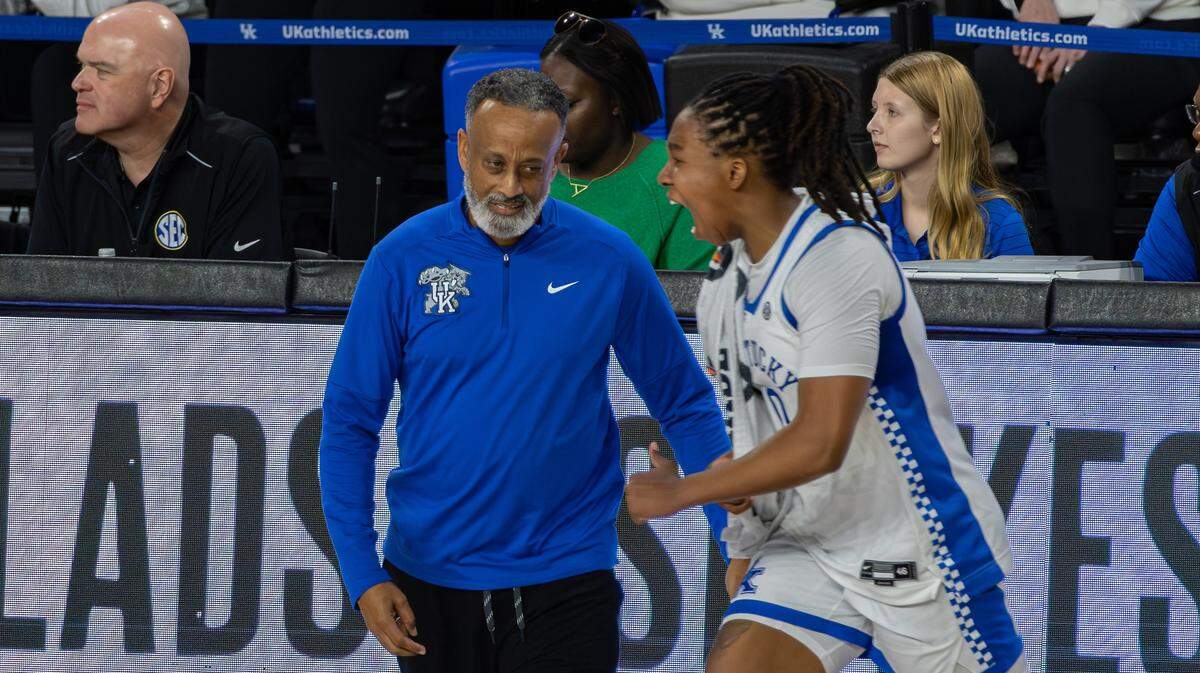
Brooks’ offensive prowess and focus have guided his success as a head coach. After 337 wins at James Madison, he transitioned to the ACC in 2016 with his hiring at Virginia Tech. During his first four seasons in Blacksburg, Brooks was assembling 20-win campaigns; but it wasn’t yet what it would become — a national power built to contend on both ends.
“And he was scoring all these points!” Hughey said. “And I was like, ‘Ken, if you could ever just decide to do a little bit more defense.’ And he was like, ‘Hughey, I tried some, man, I’m just an offensive guy,’ and those kinds of things. And I said, ‘There’s nothing wrong with it. You just have to change the different concepts here and there.’ Well, he bought into that. And he became really good. And there were times that we sent him graphics and things like that. ‘Kenny, you like top five in the country in defense. You like top seven in the country in rebounding.’”
Since the making of the podcast, Brooks’ teams — at Virginia Tech and now at Kentucky — have not missed an NCAA Tournament. He even made a Final Four of his own in 2023 when the No. 1 seed Hokies reached the national semifinal for the first time in program history.
“Every time they would talk about defense, you would just see my attention span …” Brooks said. “I was like, ‘When are we gonna start talking about offense?’ But we talked so much during COVID that I’m like, ‘Well, maybe I should try this defense thing and see if I can just try to get a little better at it.’ And we did, and when we did at Virginia Tech, we started being one of the elite teams because we were good on both ends of the floor.”
Pressure to perform
Though women’s college basketball has grown in parity, popularity and commercial success, it’s never seen an accurate reflection of the diversity of its players on the sidelines.
Per an NCAA report published in February 2025, the 2023-24 academic year saw a 3.4% increase in the number of Black student-athletes across all divisions for an all-time-high total of 86,451. According to the report, 28% of participants in women’s basketball that year were Black, the highest of any women’s sport.
However, only 15% of head coaches across all sports were Black.
When Brooks was hired by Virginia Tech at the end of March 2016, he became the second of only two Black male women’s basketball coaches in what was then the Power Five. His hiring came days before Hillsman, in his 10th season at Syracuse, led the No. 4 seed Orange’s rout of No. 7 Washington in the Final Four.
“We grew up in this business together,” Brooks said. “He got an opportunity at Syracuse, took that team to a Final Four. And he was one of the people that kind of advised me. … We lean on each other.”
Hillsman described Brooks’ first year with the Hokies, 20-14 overall in the 2016-17 season, as “solid,” but not up to the standard he had set when he was at James Madison. Brooks may have been unsure at the time, but Hillsman was quick to uplift him.
“I said, ‘Man, you’re a great coach, man,’” Hillsman said. “‘You’re not going to struggle for long. You’re going to get this thing going, and you’re going to be winning at a high level, and you’re never gonna look back.’...He and I, we were successful together at the same time, so we both felt a lot of pressure to perform, just to be able to give people that look like us a chance to be in the Power 5, and to be head coaches because we got a lot of brilliant minds out there.”
Wherever the path leads
The Generals have walked one another through forks in the road, helping one another identify the need-to-know while taking things one step at a time.
When Brooks was weighing the decision to leave Virginia Tech for Kentucky, Hillsman was coaching professional men’s basketball in Brazil. Hillsman had taken time away from college basketball, resigning in 2021 amid a Syracuse investigation following allegations of abuse from players.
Brooks made the decision to call his friend anyway.
“I was like, ‘It’s Kentucky, bro. Like, I mean, what are we talking about right now?’” Hillsman said. “Kentucky’s Kentucky. Some things you don’t really have to talk about, you know what it is..”
Brooks had never led a program outside his home state. Born and raised in Virginia, he played for the late Lefty Driesell at James Madison before becoming an assistant coach for the Dukes, first on the men’s team, and then the women’s before a surprise promotion thrust him into the head job. Virginia Tech was a big jump, but it still wasn’t so far.
Hillsman said Brooks was struggling to weigh the Kentucky decision. Should he continue building with the Hokies, so close to home? Or should he choose to step away from the comfort of the familiar?
“Man, that’s an opportunity that you really can’t pass up,” Hillsman said. “And obviously … he went to Kentucky from V-Tech.”
Career advice doesn’t only flow toward Brooks; they call him “the OG” for a reason.
When Robinson had an opportunity at an SEC program, his first call for perspective was to Brooks.
“(It) always starts with Kenny,” he said. “Kenny’s been doing it so long, and he sets the tone as far as how we operate.”
A lot of coaches might not have been so willing to lend an ear and their thoughts. But Robinson said that Brooks’ kind response was another example of how their circle of friends feels more meaningful than anyone’s individual career ambitions.
“He was like, ‘Yeah, you may be in my conference, but that excites me,’” Robinson said. “‘I want you to have that opportunity. Yeah, I may be competing against you, but that’s not what it’s about. It’s about putting us in those seats, in those positions, and showing that we’re just as good of coaches as anybody.’”
Hughey also leaned on Brooks when considering his next steps after resigning from Houston at the end of the 2024-25 season.
Hughey received several power conference offers, but he felt he “had to find a place where it allowed me, first of all, to be with great people.” In order to decide whether UVA was that place, he described taking “bits and pieces” of guidance from people’s specialties before speaking with Brooks about “the whole thing.”
“We’re like brothers,” Robinson said. “We tell each other the hard stuff. We celebrate one another and we respect each other as such. And I think that’s why our relationship has lasted through transition of jobs and opportunities. Because the reality is, a lot of us (are) competing for the same opportunities. But we’re also respectful once one gets that, and we celebrate them. And we try to make sure that we encourage them to continue to be great.”
The cost is high
For all the talk about on-court philosophy and career progression, coaching comes with a high price to pay . It takes you away from sleeping in your own bed for much of the year. It often asks you to spend less time with your spouse and children than they need from you.
Much like sharing an embrace at an AAU tournament, Hillsman said that the job has a way of compressing even the closest relationships into small moments you can steal. Ironically, he said, The Generals typically spend the most time together when they play each other.
“We’ll be sitting in the locker rooms before the game talking to each other,” Hillsman said. “Then we go, ‘Oh shoot!’ And we got to run out to the floor because we gotta go meet with our team …and then after the game, I’m in the locker room and we’re talking again until the bus leaves to go to the airport.”
When Brooks and Kentucky played at Ole Miss last season, Hillsman likened the time shared to a family reunion, more so than a coaching matchup.
Hillsman and his wife, Shandrist, “had coffee, chilled out” with Brooks and his wife Chrissy, Hillsman said, describing the foursome as “just family, man.”
“That’s my guy, man, and I would never let this game, or anything that’s professional, come between our friendship,” he said. “‘Cause I really value it.”
Hughey is on his third marriage, and he chalks that up to the rigors of coaching. His family is in Florida. After 11 years at Houston, he’s in Virginia.
“I don’t think I ever have balance in my life,” he said. “And I try every single year, every single day. …I battle it every single day.”
It’s part of why those “jewels” of private conversations, Hughey said, are so valuable.
In those conversations, Brooks shared how he learned to make sacrifices in the summer — turning down recruiting trips and planning family vacations instead — because he’d “been going all year.”
Brooks learned balance from Driesell. He calls it “the biggest thing that he taught me, other than being a man.”
“He taught me how to be a husband,” Brooks said. “He taught me how to be a father in this business. And what I mean by that is when Mrs. Driesell would come around, it didn’t matter what kind of mood he was in, you just saw his face light up. And it wasn’t like, ‘OK, well, you can’t incorporate family into this business.’ … It proved to me that you can have family around and still be serious about your business.”
At Jacksonville, Haney didn’t necessarily need to leave the region in order to recruit; he was able to stay more local in Florida and still find ways to make it home. Once Butts offered Haney the Georgetown position, he left for D.C. while his wife and children stayed in Jacksonville so his daughter, then a senior in high school, could finish out the year.
“You have a group of people that knows what you’re going through,” Haney said. “That knows what you’ve been through, and you can lean on for advice, you can lean on for support. It’s important to have that because sometimes you can feel like you’re on an island.”
March together
Comfort, at this point of the season, can serve as a unique fuel. All eyes turn to college basketball in March, but the noise gets louder, too. Sleep lessens. The games are more frequent, and they carry the weight of “win or go home.”
Haney’s season came to a close as Georgetown fell to top-seeded UConn in the Big East Tournament quarterfinals. Robinson and North Carolina A&T’s ended in the first round of the CAA Tournament at the hands of William & Mary. Hillsman and Ole Miss fell in last weekend’s buzzer-beating loss to Minnesota in the NCAA Tournament round of 32.
On Saturday, Brooks and No. 5 seed Kentucky will vie for the program’s first Elite Eight berth since 2013 when UK faces No. 1 seed Texas in Fort Worth. Hours later, in the same arena, No. 10 seed Virginia will try to pull off another upset win, this time against No. 3 seed TCU.
And yet The Generals’ rhythm doesn’t change much. The phone still lights up with congratulations or perspective.
They’ve all competed at one point or another throughout their careers, either on the recruiting trail or coaching from opposing sidelines. The point of the group’s brotherhood was never to circumvent competition. It was to pay attention to and share with one another all parts of the job — the travel, the loneliness, the grief, the coaching development, the opportunities, the losses and the wins.
On the recruiting trail, the embrace and conversation are quick — a hard dap, a hug and catching up before moving along back to work. It’s practical, and it’s a far cry from weekly quality time over Zoom.
But it’s also a reminder that — in a profession that can strain lives and isolate — there are still four other men who will always stand up when you walk into the gym.
“And that’s just how it is in this industry,” Robinson said. “In this game we see each other, we show each other love and obviously we connect, and we text in our group message. But that just means everything to know that you have someone, no matter what the circumstance is, that has your back.”