In the SEC, football pays the bills. What a season lost to coronavirus would cost.
In the 2017-18 fiscal year, 10 of the country’s 25 highest-revenue-generating athletics programs were in the Southeastern Conference, more than any other college conference, according USA Today’s NCAA financial database. All 13 of the conference’s public universities ranked in the top 35 that year (Vanderbilt, a private school, is not required to disclose its filings), and probably will do so again in fiscal year 2018-19 once numbers for all schools are known.
Football is the biggest reason why. How would things look if the sport went away for a year because of COVID-19?
The Herald-Leader, through multiple Freedom of Information requests this year, was able to acquire financial information filed with the NCAA by 10 of the league’s 14 schools — Kentucky, Alabama, Arkansas, Auburn, Georgia, Florida, LSU, Mississippi, Missouri and Tennessee — for the 2018-2019 fiscal year (Sept. 1 through Aug. 31), which includes financial figures from the 2018 football season. Fellow McClatchy news organization The State obtained the latest report for the University of South Carolina. Using those documents, as well as partial information available for Mississippi State and Texas A&M through the U.S. Department of Education, we can somewhat forecast what a fiscal year without college football might look like to SEC universities faced with that potential future amid the COVID-19 pandemic.
No one knows what things will look like come August, when most schools begin their fall training camps ahead of their season openers scheduled in the first week of September. Several schools — football stalwarts LSU, Ohio State and Wisconsin — have already suspended in-person classes through their summer terms. UK, in addition to announcing its own suspension of in-person summer classes, on Friday revealed plans to build 400 hospital beds at its indoor football practice facility. Those aren’t positive developments for the occurrence of summer workouts, for which many coaches have hoped since spring practices were canceled.
Numerous possibilities could be on the table when it comes to the actual season — reduced schedules, playing games without fans, traveling with fewer players, moving the sport to next spring, or even business as usual — depending on the advice and guidance of health experts moving forward. The only certainty is that anything less than a completely normal college football experience would have negative consequences for university athletics budgets, especially in the 2020-21 fiscal year. A complete absence of the sport would be crushing, even for the elite.
Take defending College Football Playoff champion LSU, for example: Tigers athletics in fiscal year 2018-19 generated $8,809,902 in net profit. If you remove the more than $56 million in profits the football team generated in that same year, LSU would have been looking at a loss of more than $47 million. And that’s not even the biggest swing in fortunes: Georgia generated $30,742,928 in net profit in fiscal year 2019. Without football? The Bulldogs’ athletic department would have suffered a loss of $43,122,987.
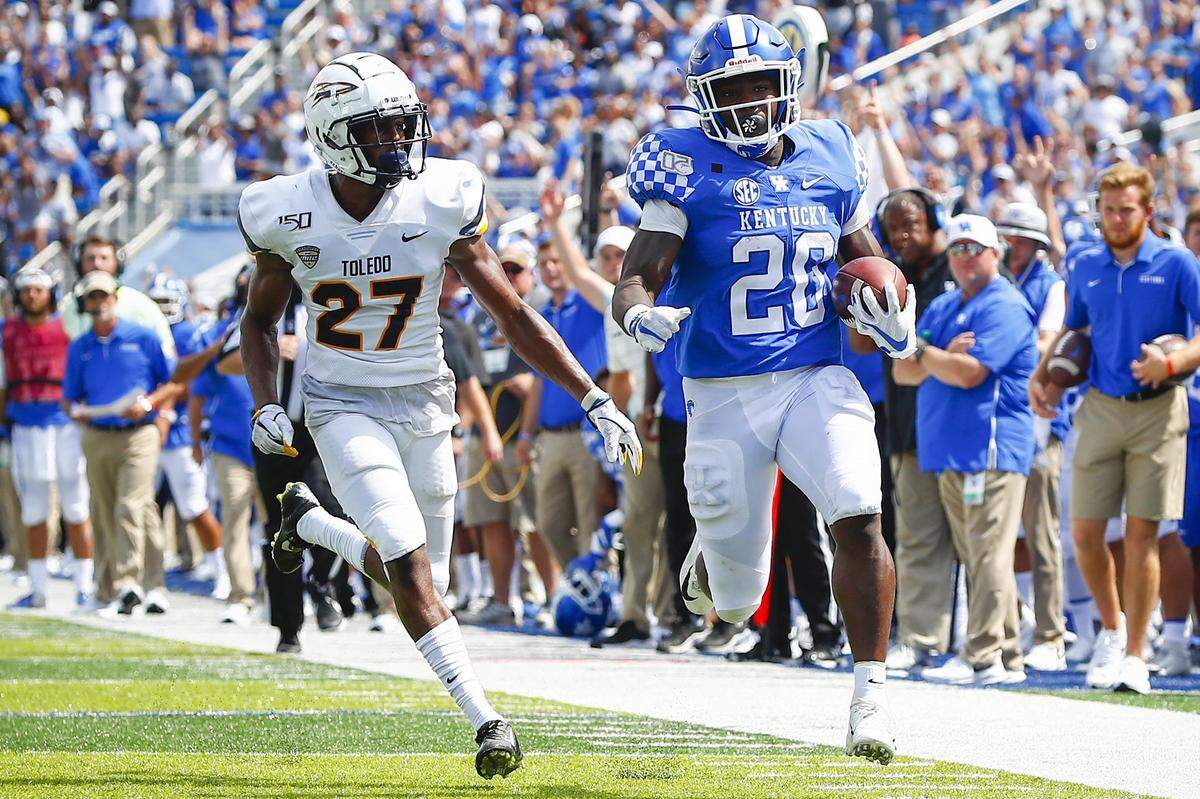
Of the 13 programs for whom data was available, Kentucky actually fares best in a hypothetical erasure of football revenues and expenses. Buoyed in part by the league’s richest basketball program, UK Athletics would have shifted from a profit of about $5.5 million to a loss of about $11 million if all money directly attributed to football was completely wiped from its books in fiscal year 2018-19. Only Mississippi State — which goes from a department profit of $8 million to a loss of $5.9 million — would fare better in the absence of all football revenue and expenses.
Things would get easier for the Wildcats without any fall sports, which would certainly be canceled along with football if it was called for by health circumstances. UK Athletics in fiscal year 2018-19 would have operated at a loss of $1.2 million had it not had to account for any fall sports revenue or expenses. Complete fall sports data was not available for Mississippi State, but based on the removal of football it’s likely that the Bulldogs’ total loss would be the league’s lowest amount in this scenario as well. (Note: Due to how they’re accounted, track and cross country are considered a single sport; they were included together as a fall sport for this exercise.)
Reality
Of course, the above numbers are cut-and-dry and don’t account for the real world, in which schools would have to continue funding athletic scholarships for athletes whose sports aren’t being played, not to mention food, housing and medical expenses. Taking care of athletes’ needs and paying for their classes won’t stop when the games do (at least, it shouldn’t), but doing those things — across entire athletics programs, not just across football rosters — would be much more difficult to achieve without football: the Kentucky football team alone accounted for $5,619,177 in expenses related to student aid, non-travel meals and medical expenses/insurance. If fall sports aren’t played and those expenses remained the same, UK’s loss would be closer to $6.8 million.
The previous exercise also doesn’t consider that coaches and staff who are under contract must still be paid. Even if the football team hadn’t brought in a dime in 2018, Kentucky would have owed its coaching staff more than $10 million in salary and bonuses. Assuming football coaches and staff took no pay reductions in a fall without sports, the annual loss quickly balloons to about $17 million.
Football head coach Mark Stoops recently said that he’d be willing to “give back” to the university, if necessary. UK Director of Athletics Mitch Barnhart has not discussed the possibility of reductions in coaching salaries but one Power Five school, Iowa State, has announced a program-wide 10-percent pay reduction, including coaches. It’s unlikely to be the last major program to get ahead on cutting costs.
It’s not immediately clear how severely SEC media rights, particularly those related to television broadcasts, might be affected in the event of reduced games or an entire removal of football from the schedule. The SEC office in January distributed $44.6 million to each member school, and that figure will probably be trimmed come fiscal year 2019-20 due to the cancellation of postseason basketball tournaments and the spring championship events (the NCAA, also, has already announced a drastic reduction in revenue distribution). No football in 2020 would guarantee the SEC distribution is significantly lower in fiscal year 2020-21; UK’s revenue generated by football media rights in fiscal year 2018-19 was $12,716,333, or 24.6 percent of the $51,546,817 total revenue the school’s media rights generated that year.
Donations could decrease, too, in a bumpier economy In a LEAD1 survey responded to by 95 Division I athletic directors, 75 percent of respondents cited donations as the biggest revenue-stream concern for fiscal year 2020-21, followed closely by ticket sales and additional revenue generated from in-person events (74%). Among those same respondents, 35 percent said their “worst-case scenario analysis” projects them as having a revenue decrease of greater than 30 percent in fiscal year 2020-21. Ninety-two percent of respondents project a revenue loss of at least 10 percent that year.
UK’s accounting showed it received a total of $23,172,781 in athletics donations for fiscal year 2018-19, all considered “non-program specific.” Revenue not attributed to specific teams totaled $67,357,637, accounting for 44.7 percent of the $150,435,842 total revenue generated by UK Athletics.
UK’s largest expense — a total of $61,871,228 that’s also considered unrelated to specific teams — includes administrative overhead (more than $20 million), administrative and support staffing ($18.2 million) and fundraising ($3.3 million). While those expenses probably would decrease without fall sports, their relatives on the revenue side likely would as well. The bulk of its media rights package — $35,369,099 — is considered non-program specific; any fall cancellations that occur are likely to negatively affect any non-program specific revenue stream, as many of those are still dependent on the existence of football.
Big 12 Commissioner Bob Bowlsby was blunt about the possible fallout last week. “It’s a whole new ballgame if we find ourselves not playing football, because it affects everything we do,” he said. “It affects the largest portion of our television contracts. It’s the largest section of campus revenue — which is live gate. If that doesn’t happen, the underpinning of what we know as normal goes away, and we’ll have major changes to make.”

Basketball
It wouldn’t nullify the loss, but UK’s financial standing in basketball would soften the blow from a fall without revenue, especially in relation to conference rivals who are much more reliant on football revenue streams.
Most men’s basketball programs in the SEC generate a profit for their universities (Alabama and Mississippi were the only exceptions from the 11 schools for whom 2019 data was available), but no school makes as much as UK, whose basketball team in fiscal year 2018-19 netted $19,097,927 for the athletic department.
It was the only basketball team in the conference that out-earned its football team, as UK football netted $11,086,211, and they were the only two teams at the school to turn a profit, as was the case across most of the SEC (a couple of schools — Arkansas and LSU — generated profits of less than $1 million from their baseball programs). UK’s next-closest program to breaking even was its co-ed rifle team, which lost $572,291.
Outside of “non-program specific” revenue, football was responsible for the most revenue generated by UK Athletics. It brought in $41,365,946, or 27.5 percent, but was followed closely by basketball ($38,829,661, or 25.8 percent). All other sports accounted for less than 2 percent of the athletic department’s revenue but were directly responsible for about 25 percent of its expenses.
Only five other public schools in the SEC generated a double-digit percentage total of their revenue from basketball, and none come close to approaching UK (Arkansas was closest, deriving 15.5 percent of its revenue from basketball in fiscal year 2018-19). All of them were more reliant on football for revenue than UK, however: Missouri was the least dependent at 36.1 percent, followed closely by Mississippi State at 37.4 percent. Georgia was the most reliant at 70.7 percent. Revenue directly generated from football accounted for at least 50 percent of the total revenue generated by Alabama (58%), Arkansas (55.1%), Auburn (62.4%), Florida (54.8%), LSU (58.3%) and Tennessee (66.8%).
Data
Below you’ll find several graphs: One shows net income data available from 13 SEC schools for fiscal year 2018-19; one shows net income data for those 13 schools in fiscal year 2018-19 if football revenue and expenses are removed; one shows net income data for 11 schools in fiscal year 2018-19 if all fall sports revenue and expenses are removed; the last shows total net income figures for all athletic programs at the University of Kentucky in fiscal year 2018-19.
This story was originally published April 4, 2020 at 9:11 AM.