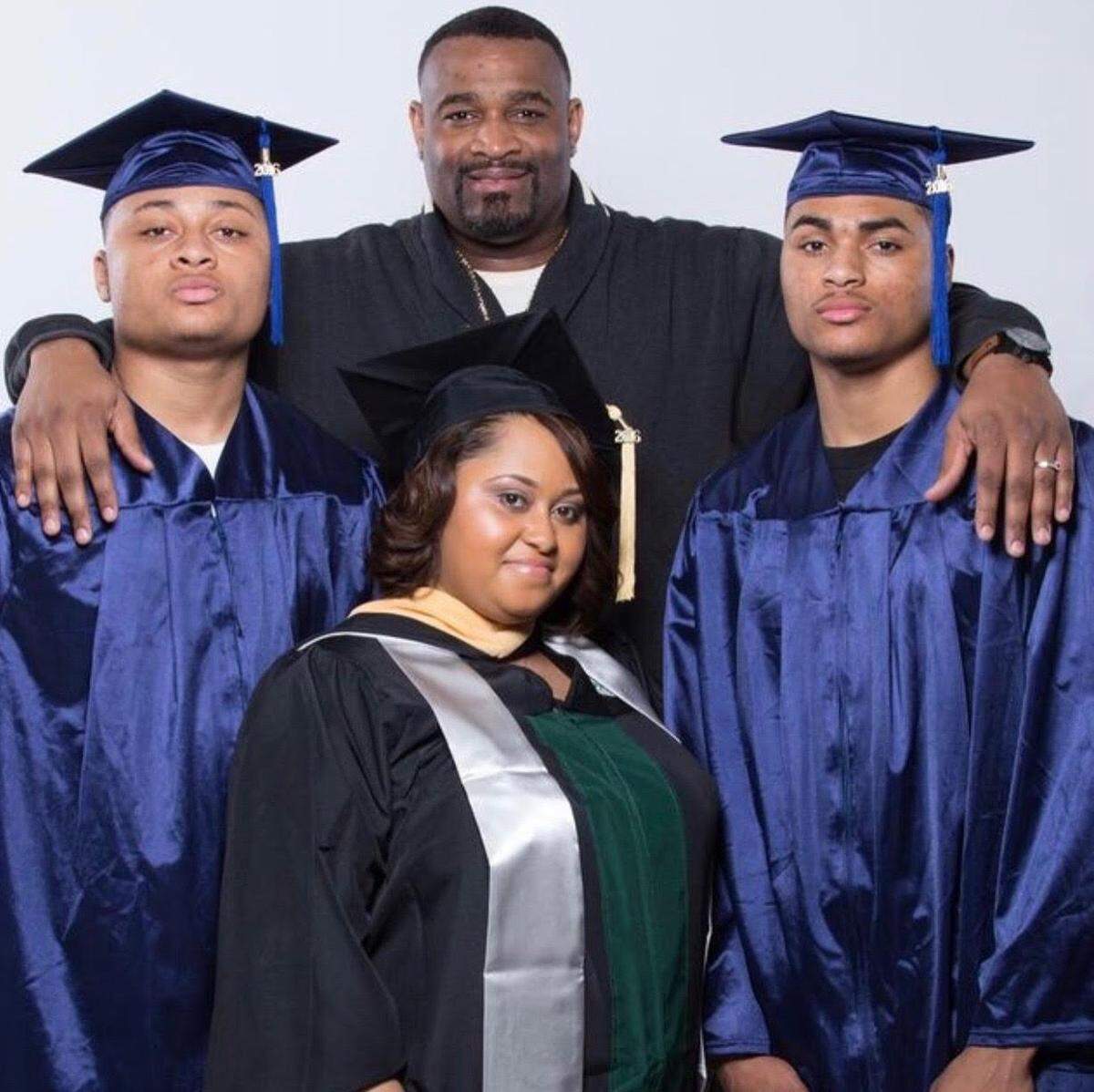
One of UK’s top seniors has two dream jobs in mind: NFL player and undercover cop
A.J. Rose wants to be a cop.
Surprised? He’s used to that.
“To be honest, when I say that around my friends and my peers, they look at me different,” Rose told the Herald-Leader recently.
The University of Kentucky senior first and foremost wants to play in the NFL, and he should get that opportunity next year after graduating in December. But he’s preparing as much for a future away from the field as he is for one on it. That’s the case for many of UK’s star football players, most of whom, as the NCAA so often likes to remind people, go pro in something other than sports.
Rose’s “something other than sports” is booming: according to the National Law Enforcement Officers Memorial Fund, there are more than 800,000 sworn law enforcement officers — a designation that includes police along with other public-sector employees like arson investigators and special agents — serving in the United States, more than at any point in the country’s history.
It is also a profession, as recent events have demonstrated, subject to constant scrutiny. Rose is used to grappling with that, too, even more so over the past couple of weeks.
“A couple of my close friends have called me up and asked if I really want to be a police officer,” Rose said. “I’m telling ‘em, ‘Yeah.’ I really believe that I’m not one of those ones that’s gonna make bad decisions. I feel like if the opportunity presents itself, I would be a great police officer and would do things the right way.”
Like the men who preceded him in devoting their lives to law enforcement, A.J. — if met with the opportunity — is intent on being a good one.
Family business
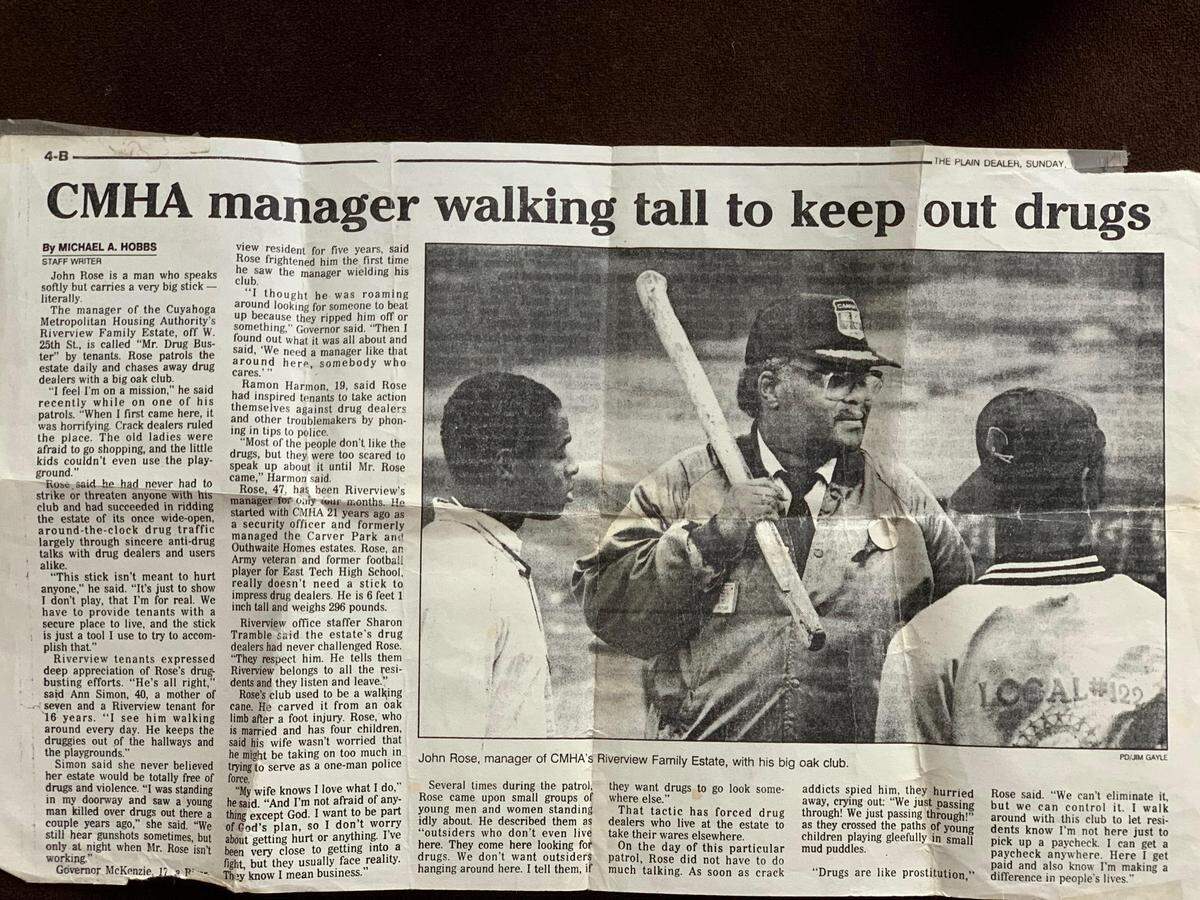
John H. Rose served in the Army before working in security for the Cuyahoga Metropolitan Housing Authority in Cleveland. He eventually became the manager for CMHA’s Riverview Family Estate, where the literal wielder of a big stick earned the moniker “Mr. Drug Buster” from tenants.
“This stick isn’t meant to hurt anyone,” John once told the The Plain Dealer newspaper, a picture of him and his club on full display two columns away. “It’s just to show I don’t play, that I’m for real. We have to provide tenants with a secure place to live, and the stick is just a tool I use to try to accomplish that.”
John, A.J.’s late grandfather, would share how he felt without reserve, says Asim Rose, A.J.’s father and after whom the star running back is named. John worked with the Cleveland police department in the 1960s, a decade that saw “race riots” occur with frequency across the country.
“The earlier in life that you were out here, the worse things were,” Asim said. “Things just have to change through time. My dad, being in his age bracket growing up, I can’t imagine the things he went through. I remember different conversations, him talking to my mom about different things that were going on at the district and what he didn’t approve of.”
John’s commitment to protecting others rubbed off on Asim, who for more than 20 years has worked in various security positions, mostly for school districts in and around Cleveland.
A.J. recalls times in his youth where his dad worked multiple jobs at a time to help provide for him and his brother, De’Sean, and their mother, Shauna, who’s a social worker. Their dedication to serve the public inspired him to want to do the same, as did actor Denzel Washington. He doesn’t want to just be a police officer; he wants to be an undercover detective.
“If football doesn’t work out, I don’t really want to work a regular job,” A.J. said. “I want to be out doing something in the community. Like what Denzel did in ‘Training Day,’ but not in the way he did it in that movie. Just that job, you know? Taking down large drug cartels or whatever the case may be. I want to be one of those people who’s gotta get in real good with people and eventually turn ’em in.
“That’s a bad way to say it, but that’s the job I’d like.”
A.J. has the right personality to go the undercover route, his father said. Those who’ve interviewed him, whether in group or one-on-one settings, whether before or after games, might attest to that as well — he seldom exhibits extravagant emotion, good or bad.
“He’s young enough to be a private detective or possibly even be a federal agent,” Asim said. “It’s there for him. The way he goes about doing things, his demeanor is equipped for that line of work. I know he would be an outstanding agent or officer, whatever he decides to do. He’s pretty much a neutral guy.”
Side by side
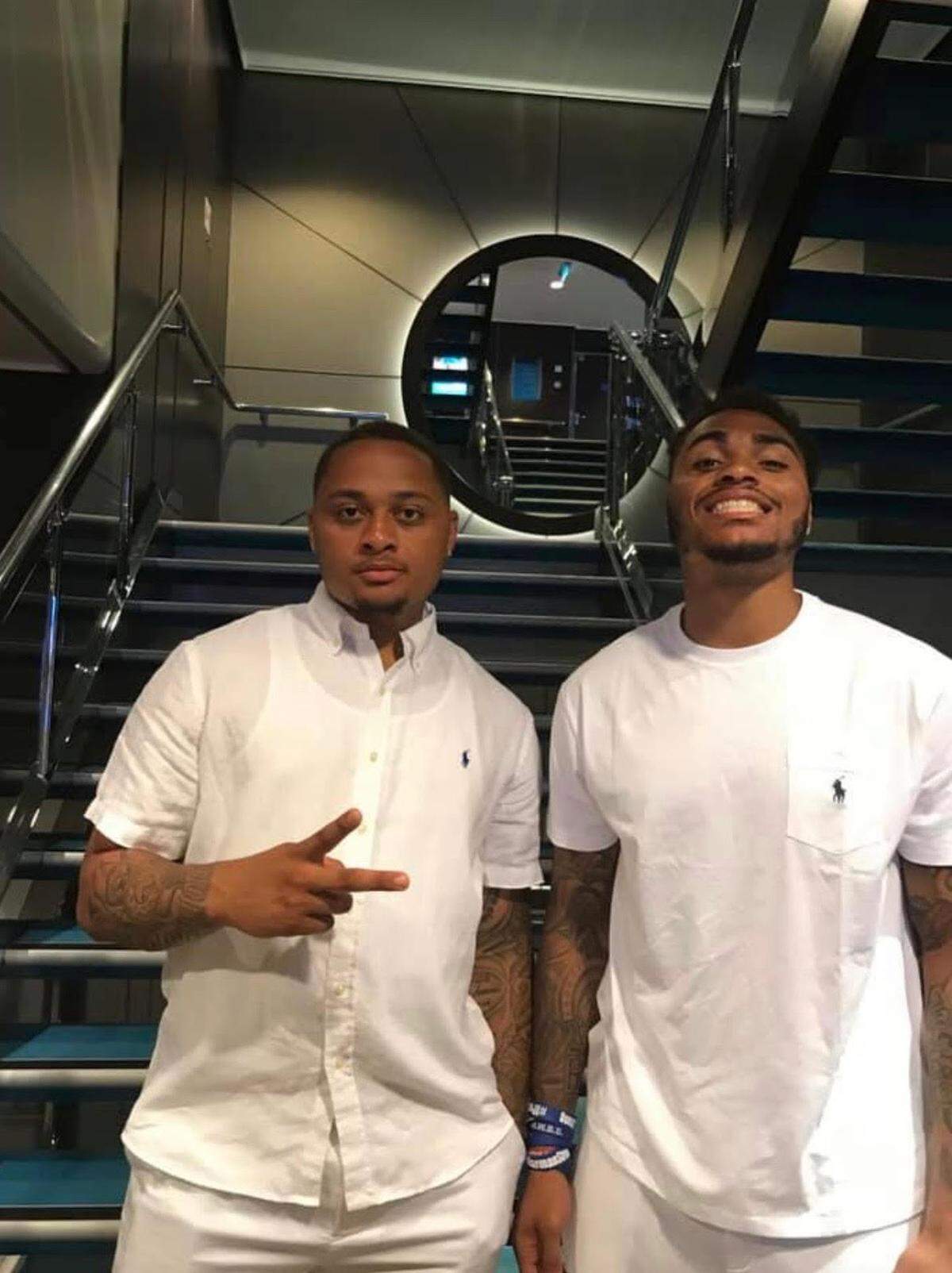
De’Sean knew A.J. was special in the fifth grade.
That’s when A.J. made it clear that he was the faster of the Rose brothers, who were born only 10 months apart from each other. The separation so often seen between A.J. and opposing teams in the Southeastern Conference was on regular display in the parks and streets of Garfield Heights, Ohio.
“I didn’t have speed, so I went over to defense,” De’Sean said with a laugh. “He made me better, chasing him around in practice. I’m glad he was my brother so I didn’t have to go against him in the games or anything like that, ‘cause he’d tire the hell out of me.”
(He’s modest; De’Sean goes to Central State University, a historically black university with a Division II football team to which he was recruited to play linebacker. His first year on campus he re-aggravated a hamstring injury suffered late in his high school career and eventually decided to stop playing.)
De’Sean was among the first witnesses to the gifts that would ultimately land A.J. on Kentucky’s roster. In his first turn as the Wildcats’ starting running back last season, Rose rushed for 826 yards and six touchdowns out of a crowded backfield that for most of the year also included an unplanned ball-carrier in Lynn Bowden.
After opting to forgo the NFL Draft and return for a final go-round with the Wildcats this fall, Rose should end his career as one of the school’s 10 all-time leading rushers despite, to this point, never receiving the team’s most carries. Speed and evasiveness are big reasons why; over his career he has averaged 5.5 yards per carry, which would be good for fourth-best in program history. He could rush for 100 fewer yards in 2020 than he did last season and would still become just the 10th Wildcat ever to top 2,000 career yards.
De’Sean is set to graduate from Central State this winter, in the same time frame A.J. will receive his degree in community and leadership development from UK. De’Sean is studying public relations in part because he wants to assist his brother in tending to his post-UK football pursuits. NFL star Travis Kelce, whom the Roses know through a cousin, helped inspire that idea.
“I’m gonna do whatever I need to do behind the scenes for my brother so he don’t have to worry about going out and finding somebody,” De’Sean said. “He can keep it in the family since the trust is already there. … Travis is helping his friends and keeping them on track, always giving them something to do.”
Asim likes to call the pair “Mutt and Jeff,” jargon for “good cop-bad cop” that has its roots in a long-running syndicated comic strip about two friends. Growing up and through high school, you couldn’t see one without the other.
“Nobody was gonna disrespect me or him,” De’Sean said. “We were side by side. That’s how our parents raised us. ‘If anything happens, y’all gotta handle that.’”
He paused for a second and laughed, continuing.
“Then we’d call our father and he could come handle the rest.”
In the field
During the 2020 spring semester, A.J. was in the midst of an internship with the Lexington Police Department. He was able to go on three daytime ride-alongs with officers before the COVID-19 pandemic interrupted school and sent him back to Ohio.
“I was trying to take advantage of that opportunity before it was taken away,” A.J. said.
One of those ride-alongs was with Brandon Muravchick, a neighborhood officer and high school basketball coach in the area.
He’s also a Louisville fan.
“So he was cracking jokes here and there throughout the ride,” A.J. said. “Things that Louisville people do, but at the end of the day he knows who runs Kentucky.”
Sometimes, when instructing interns, students give off a vibe that they’re in the field more for class credit than legitimate interest in policing, Muravchick said. It was easy for him to tell that wasn’t the case for A.J., who continually asked questions and was “100-percent in” the day that he served as his “backup.”
During their ride-along, the pair pulled a man over for not wearing a seatbelt. Muravchick let A.J. make the call on whether he would issue a ticket or a warning; A.J. cut the guy some slack. Later, after Muravchick shared a picture of he and A.J. on Twitter, the man figured out it was one of his favorite running backs who saved him a fine.
“its all love brody BUCKLE UP!!!” A.J. tweeted in response to his discovery.
It’s “super important,” Muravchick says, for young black people to have interest in policing. Census data showed that 13.3 percent of police officers, nationally, were black in 2018.
“For him to come out and say he wants to do this, especially in today’s climate, that’s huge,” Muravchick said.
He encourages everybody, at a minimum, to go on a ride-along at least once in their lives. The ones that A.J. was able to be a part of were eye-opening, and left him eager to get back into the passenger seat of a police car.
“People really dislike police officers in this state and others,” A.J. said. “No one really likes the law, to be quite honest, and they take a risk every day. It was something to see. I just took it all in.”
Scouting
The police killing of George Floyd, a black Minnesota man, and other recent acts of police violence have ignited protests around the country.
According to 2018 research published by the American Public Health Association, black men in America are 3.5 times more likely to be killed by law enforcement than white men. Data recently published in the New York Times showed that, in Minneapolis, police use force against black people seven times the rate that it’s used against white people.
“There were plenty of ways to prevent that, to prevent him from dying,” A.J. said of Floyd’s death. “There’s plenty of things that the police officer could have did. That’s just the world we live in. Those police officers are not representing the badge the way they should. It just makes me want to attack the career and show that there are real police officers out here that aren’t like that, that really care about the community they’re from and other people.
“I want to be out there to make that change.”
A.J., along with a few teammates, attended one of the protests in downtown Lexington last week. Shauna was nervous, but understanding.
“You need to be able to experience it so you know what to expect,” she said.
Between their parents, Shauna is the bigger worrier of the two, De’Sean said. A.J. at a time in high school considered joining the Army instead of attending college, but his mother “shut that down,” he said.
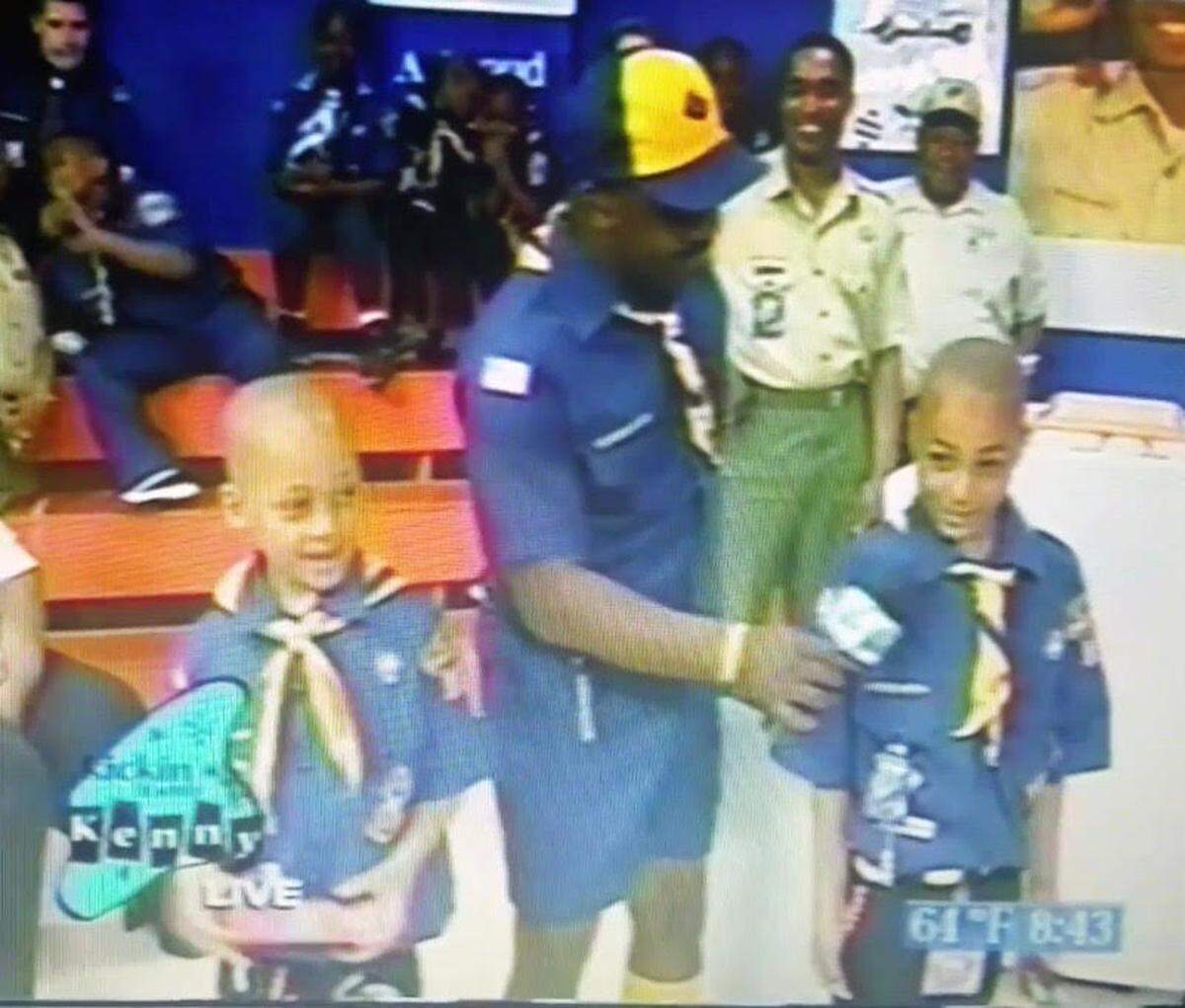
Both Shauna and Asim credit their sons’ participation in Boy Scouts of America for helping develop their leadership skills and discipline. Both boys remained scouts through high school, and earned the distinction of Eagle Scout, the highest individual honor attainable from the organization and one achieved by about 4 percent of its total participants.
The boys both reflect fondly upon their time in scouts, but …
“It was hard to get ‘em to do some of the things ‘cause they were in high school, playing sports and having their friends and stuff like that,” Shauna said, “but they knew they had to finish it and they were gonna finish it because that’s just what we do.”
A.J. said his time in scouts played a role in him wanting to pursue a law-enforcement career. A lot of people are surprised when they hear that the brothers were scouts, let alone Eagles.
“When I first told my adviser at school that I made Eagle Scout, I caught him off guard ‘cause I’m a black kid with tattoos,” De’Sean said. “They don’t expect that. I’m glad I got that in my bag.”
.jpeg "image1 (14).jpeg")
Growth
Garfield Heights is a suburb of Cleveland, and was Asim’s home growing up, too. His sons would graduate from its high school midway through last decade, but he did not.
He never even attended the city school district that his parents’ tax dollars supported. As part of court-ordered desegregation measures in the late 1970s, Asim was bused elsewhere, and he ultimately graduated from John F. Kennedy High School in 1993.
“I didn’t understand it growing up, but I understand it now,” Asim said. “There were things that were happening back then that our parents were going throughout that I never knew or understood. It’s gotten better, through me growing up and seeing things and how change is, but it totally was rough. Back then there was so much police brutality and things going on in the city of Cleveland.”
The boys’ own sports stardom proceeded that of their father. After a standout prep career he spent two years at Eastern Arizona Community College, which in the 1994-95 basketball season finished with a 31-2 record and as the No. 1-ranked junior college in the country. His time there led to a two-year scholarship at Virginia Union University, where played with future NBA champion Ben Wallace.
As one of his sons prepares to follow him in another realm — one far more dangerous and serious than an athletics arena — he recognizes some of the issues surrounding race and policing observed in his youth remain all-too-present.
He has faith that A.J. can be a positive influence, regardless of what he ultimately does in life.
“It’s a scary time but it can be a productive time, if that’s what you want to happen,” Asim said. “I’m just praying that everybody gets a sense of doing what’s right. People say, ‘Oh, I’ve got common sense, this is how it should be done.’ Nah. Everybody’s gotta be on the same accord. There’s got to be understanding, communication. This communication that we’re going through at this point in time, it’s not where it should be, at all.”
If football doesn’t work out, working a “regular job” isn’t something that appeals to A.J. He wants to be where the action is, and wants to continue using his talents to do good things for the communities in which he lives.
A.J Rose wants to be a cop. A good one.
“It hurts my feelings that this stuff is going on, but I want to wear the badge the right way,” A.J. said. “I can’t change the world, but I have a voice and I have an opinion on things. I feel like with my voice and what I believe in, I can change people’s minds and make people want to go down the right path and stop doing these negative things out here that they do to people involved in police situations. A lot of police officers right now are trying to speak up, and are doing the right thing, but you still have ones who aren’t trying to be part of the new cause and change.
“Everybody’s got a voice, and I’ve got a voice, and I want to use mine to its full potential.”
If you know him, that shouldn’t surprise you in the least.