One Kentucky senior hasn’t been home since he was 12. Here’s why that’s a good thing.
Abule Abadi-Fitzgerald hasn’t been home in 10 years. His mother encourages him not to visit
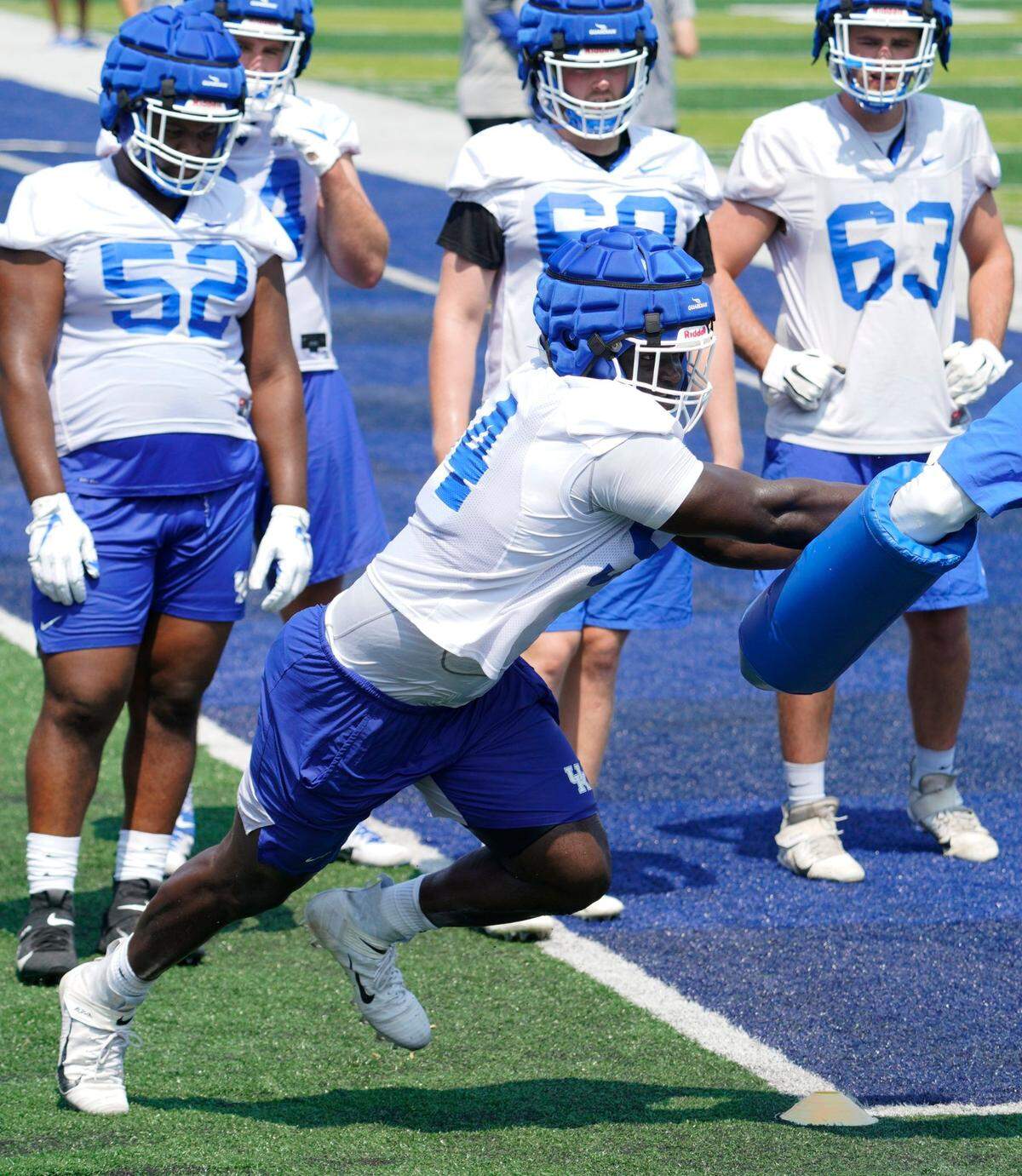
That’s in stark contrast to the experience of most students at the University of Kentucky, but Abadi-Fitzgerald isn’t like most students at the University of Kentucky. He’s not even like most players on the school’s football team, for which he plays.
When he was 12, Abadi-Fitzgerald immigrated to Florida from Nigeria, a country against which the United States has an active “reconsider travel” advisory. Dual citizens, like Abadi-Fitzgerald, are among the most targeted individuals for ransom-motivated kidnappings, which occur “frequently,” according to the U.S. Department of State. Even if home wasn’t nearly 6,000 miles away, the 6-foot-6 senior understands that it would be unwise to hop on the next flight to Lagos.
The continued blessing of Ebiegberi Abadi — with whom he gets to speak regularly — makes it easier, as does the pursuit of a promise he made her when he left their home.
“On my way here she told me to work hard and just be a good boy,” Abadi-Fitzgerald said with a laugh. “Be myself. Work hard in school and everything else. Those simple words, I took very seriously when I was young. I promised her I would work as hard as I could and was going to be the best person, the best version of me, and I was going to make her proud. So when I got here, my mission was to do that.”
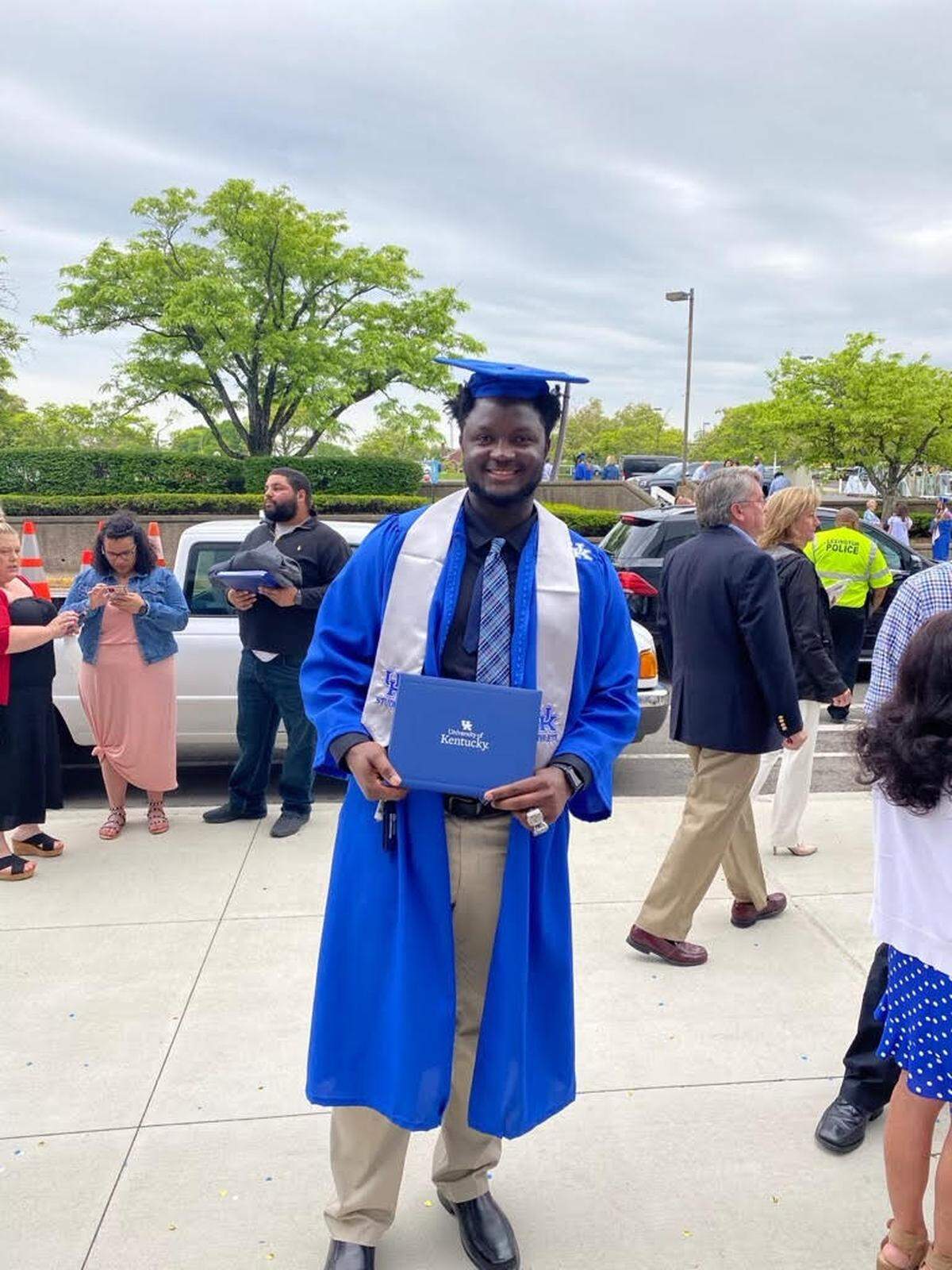
To date, Abadi-Fitzgerald has accomplished that mission. He graduated with a bachelor’s degree in communications in May, and has been taking graduate courses in design. After spot action the last few seasons, he became a starter for Kentucky’s defense coming out of spring camp and has re-assumed that role at the end of the Wildcats’ 2021 season. He’s one of a handful of players in program history who will be able to say they were part of five bowl teams.
Not every college football player is going to be a superstar like Josh Allen or Jamin Davis. Abadi-Fitzgerald has something in common with both of those former UK greats, though.
“When you look back at it years from now, when you’re a player and say, ‘Did I do the best I could? Did I develop as much as I could?’” UK defensive coordinator Brad White said. “He should be able to look back and be proud and say, ‘You know what? I did. I got better. From start to finish, I progressed.’ He’s probably playing the best football that he’s played right now, and that’s all you can ask of a player.”
Road to UK
The first vivid memory Steve Fitzgerald has of his adopted son comes from a physical education class he was teaching. Abadi-Fitzgerald, then 6-foot-2, had a classmate playfully draped over one of his shoulders.
“It was like he was an amusement park ride or something,” Steve said with a laugh.
Abadi-Fitzgerald and another Nigerian immigrant, Alaowei Talent-Fitzgerald, who was 14, were afforded educational opportunities in America based largely on their promise as basketball players. They originally lived together with a host family, a situation that eventually became untenable. The Fitzgeralds — Steve, his wife Teri and their six biological children — were eager to step in and help, but taking guardianship was tricky because Steve was their school basketball coach. Officially adopting the two was the only way to preserve their sports eligibility under Florida’s rules.
After consultation with and approval from both their parents — Abadi and Talent arrived in the U.S. together but are from different families — as well as their own children, Steve and Teri embarked on an adoption and citizenship saga that required two years of patience.
“The amount of paperwork was staggering,” Steve said. “And it was stuff that’s standard here but that, over there, a lot of this information wasn’t easy to come by. We were FedEx-ing it over there and just praying they’d send it back filled out properly.”
Teri interjected with a laugh. “And they didn’t always.”
A judge was sympathetic to their efforts, which were aided by an adoption lawyer Teri happened to hear about through a Christian radio station and an army of charitable community members, including a parent at their school who allowed them free use of his business’s FedEx account to send paperwork to overseas.
Abadi-Fitzgerald was in ninth grade by the time he was officially adopted. An uncoordinated athlete in middle school who barely knew on-court fundamentals had since transformed into a dominant high school post player, though ultimately not dominant enough to earn a Division I scholarship offer. That was a source of great frustration for the self-described perfectionist.
His second sport offered recourse. After briefly flirting with football as a freshman, Abadi-Fitzgerald didn’t return to the gridiron until his junior season, but that was only for one game due to an eligibility hiccup that didn’t get resolved until basketball season. He played in Dade Christian’s first football game that year, but produced enough film to pique the interest of then-Kentucky assistant Darin Hinshaw, who recruited Florida. Hinshaw kept tabs on him throughout his senior season, played at Victory Christian Academy, and extended an official offer in January, mere weeks before the 2017 signing period started.
Florida, Florida Atlantic and Florida International fought hard for Abadi-Fitzgerald’s signature at the end, but Kentucky’s long-standing interest and an “unbelievable” official visit — taken a couple days before a much less impressive trip to Gainesville — helped seal the deal in UK’s favor.
“He’s never regretted it for one second and neither have we,” Teri said. “Not for one second.”
Pressure
Abadi-Fitzgerald, like many foreign-born athletes who find themselves competing in front of stateside crowds, was subject to racist and xenophobic comments almost every time he took the field of play in high school.
“I’ve had to deal with a lot of people making jokes,” Abadi-Fitzgerald said. “Silly African jokes and people trying to mimic my accent and stuff. There were times when I definitely felt isolated.”
Going through those experiences alongside Talent-Fitzgerald — who’s become like a “blood brother,” he says — made them a little easier. The Fitzgeralds say anyone who spent five minutes with Abule would realize how ignorant assertions about his age — 6-2 sixth-graders from Nigeria tend to get profiled inappropriately — were.
That “passive bullying” was tough, but his perfectionism was tougher to overcome. An insatiable work ethic was instilled from an early age by Ebiegberi and his father, Rufus Abadi, a politician in Nigeria. Of Rufus’ 40 children — Ebiegberi is one of his four wives, Abule says — only three have had the opportunity to leave Nigeria to pursue schooling. Abule is the only one who’s come to the United States.
Talk about pressure to perform.
“It does put a little bit of pressure on me, but at the same time it’s like I’m obligated to make something of myself and not waste the opportunity that I got here,” Abule says. “I am one out of 40 of us here. ... Why did God bring me over here? I’ll never understand, but I trust Him and will keep doing what I’ve got to do to be successful.”
If not for his birth parents’ selflessness, Abadi-Fitzgerald says, he’d probably still be in Nigeria without much to do, his “God-given talents” wasted. If not for his adopted parents — “the nicest people I’ve met since I’ve got to America” — then he never would have ended up at UK.
His birth parents are unable to make the trip, but the Fitzgeralds will be in attendance for Saturday’s home game against New Mexico State, before which UK will honor its seniors. Abule doesn’t plan on returning to UK for a second ceremony as a “super senior.” He wants to see how his pro football opportunities shake out but already has a few job offers. He also has an entrepreneurial bent tied to his own personal growth: a soft-spoken, shy individual before coming to UK, he’s blossomed to the point of wanting to operate his own talk show.
“Everybody starts somewhere, and I’m eventually going to start somewhere before I move on to being my own man and owning my own business and that stuff,” Abule says. “I really do believe that regardless of what I do, I’ll be successful, because I’ve already set my mind to that success.”
Saturday
New Mexico State at Kentucky
When: Noon
TV: SEC Network
Radio: WLAP-AM 630, WBUL-FM 98.1
Records: Kentucky 7-3, New Mexico State 1-9
Series: Kentucky leads 1-0
Last meeting: Kentucky won 62-42 on Sept. 17, 2016, in Lexington.
This story was originally published November 18, 2021 at 9:51 AM.