Like it or not, booster collectives have arrived in college sports. Where is UK’s?
University of Tennessee boosters this offseason have made no secret about it: Their checkbooks are open.
Through “The Volunteer Club,” an initiative by Knoxville-based Spyre Sports Group, fans of any financial standing can make donations, 90 percent of which go directly to athletes (the other 10% covers overhead, i.e., the salaries of middlemen). Operations like that, which have come to be known as “collectives,” have popped up in college towns across the country as means to create name, image and likeness opportunities for athletes.
Kentucky’s athletes have benefited from NIL arrangements, but there isn’t an apparent fundraising arm through which boosters can directly pay them for their endorsement of a “business” that amounts to little more than a cleverly named fan club of a particular team. In many instances, the services provided by athletes to the collectives end up being a couple of public appearances. Sometimes, all athletes have to do is chat with donors for a few minutes over a Zoom call.
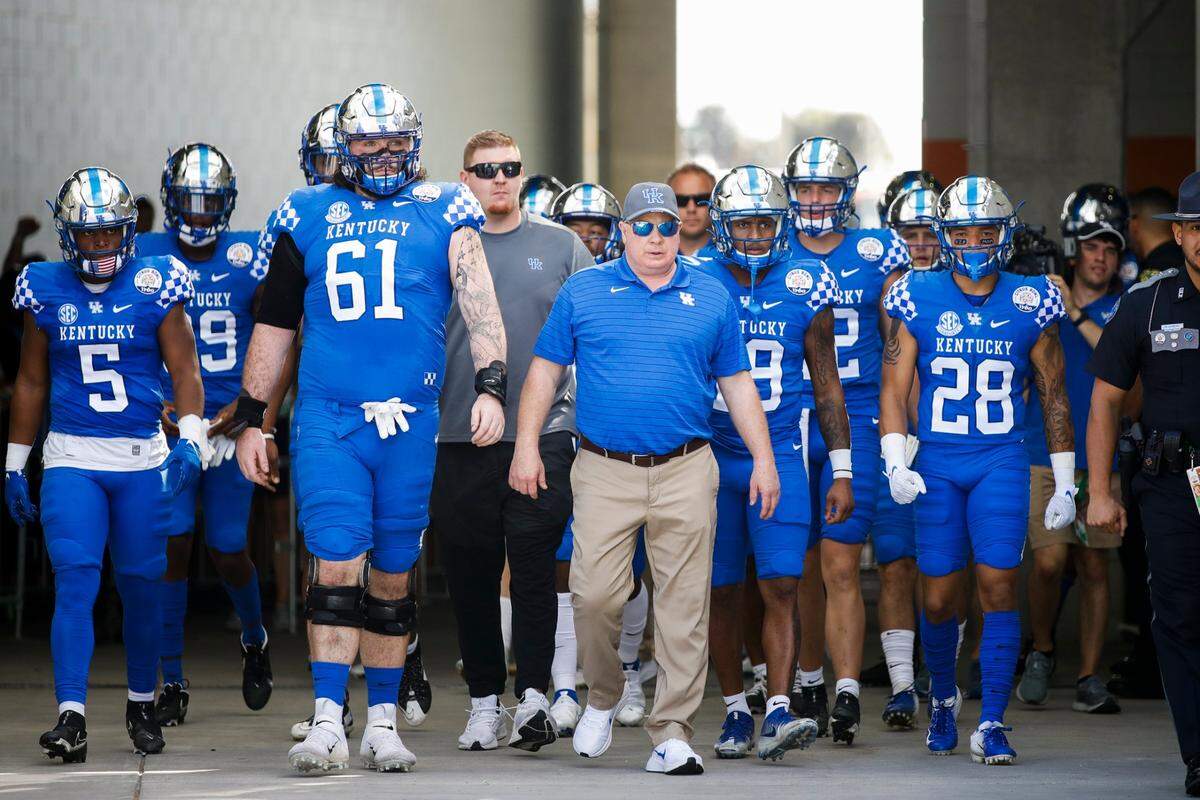
Collectives will affect UK on the recruiting trail whether its athletes are involved in them or not. UK football coach Mark Stoops says he would like to see federal guidance or intervention on what he called “the total pay for play that’s going on right now,” echoing a sentiment shared by Athletic Director Mitch Barnhart. Stoops would like for everyone in college athletics to get on the same page about the current reality.
“I think we all are a bit concerned about the ‘Let’s just put a collective together with $10 million and buy recruits, let’s buy 25 free agents a year,’” Stoops told reporters Wednesday. “Is that really what we got into this for? Or did we get into it to support the Chris Rodriguezes and other guys that have done so much for us and work really hard? You know what I mean?”
Kentucky’s ‘collective’
The creation of what was interpreted as a UK-centric collective — The 15 — was announced on Dec. 15 and received ample press coverage. It was unheard from since then until Friday, when a video was released updating interested parties on its development.
One of the two companies originally behind The 15, Lexington-based Virtus Brand, is no longer in operation. That company has been succeeded by Athlete Advantage, which is still based in Lexington and comprised of the same leadership. It was incorporated as Athlete’s Advantage LLC in Wyoming on Feb. 15. The other company, Big Blue Legacy, was incorporated on Dec. 16, also in Wyoming. It exists primarily to act as a separate entity from Athlete Advantage to hold and report accounts for The 15.
The 15, unlike other school-specific “collectives” geared toward streamlining NIL transactions, will not allow boosters to directly contribute money to a fund that’s then turned over to athletes. It intends to sign multi-year marketing deals with legitimate businesses, with the promise that their businesses will be promoted by an unspecified UK athlete. Athlete Advantage, acting as an agent, will then connect athletes with promotional opportunities that best fit their profiles and personalities. Athlete Advantage then executes the subsequent campaigns.
Athlete Advantage CEO Fred Johnson doesn’t want The 15 to be thought of as a collective, because of the negative connotation. Based on conversations he’s had while vetting the legality of their business, it’s also significantly distinct.
“It could not be any further away from what we’re seeing collectives across the country do,” Johnson said. “We’ve talked to national media people who cover name, image and likeness for college sports. We’ve talked to attorneys on the West Coast about it, and they’ve said they’re not seeing anything like this.
“Our vision is that this is what name, image and likeness should be. ‘Hey, we’re gonna have a bunch of rich donors put a bunch of cash into an account and then we’re going to have kids show up on Zoom and wave for 15 minutes and then give them $100,000.’ That’s not what we’re about. That’s not what we’re gonna do.”
Information about The 15 isn’t currently available on Athlete Advantage’s website but will be soon, Johnson says. Businesses interested in working through The 15 can contact Johnson at info@athleteadvantage.xyz.
Around the SEC
Spyre Sports President Hunter Baddour recently told The Athletic that its goal is to raise $25 million or more annually to fund NIL activities at Tennessee. He told the site that most of its athlete payments amount to “six-figure packages.” Those packages, or any of the sort, can’t be used as inducements while coaches are recruiting players, but it’s not difficult for high school prospects and potential transfers to become aware of what’s available to them through relationships with current players and others involved in the college sports ecosystem.
Nico Iamaleava is a quarterback entering his senior season in California, one of a few states that have passed legislation permitting NIL contracts for high school athletes. He committed to Tennessee last month, and is widely believed to be the player who entered into an NIL deal with an unspecified collective, also reported by The Athletic, that could be worth up to $8 million. That contract doesn’t call for that player to play for a specific school — that, again, would be an NCAA violation — but, if the paying party is a fan-supported collective like The Volunteer Club, it’s not hard to draw some conclusions.
“That is totally legal,” Stoops said. “And whether I want that or not, or whether our administration wants that, that’s not our choice. It’s legal. You see some universities and some SEC schools taking full advantage of that, and then you see others that are not because there’s only so much money to go around.”
It also doesn’t appear to be a conflict of interest for the collectives to enter into official partnerships with the universities they support; The Gator Collective, a Florida-centric operation, has done that. A collective supporting Alabama, High Tide Traditions, launched last week, the same week football coach Nick Saban called out the current NIL landscape. Within the SEC, collectives also exist in support of Auburn, Georgia, Missouri, South Carolina and Texas A&M. In most instances, donors can directly contribute money to an NIL fund, and some schools, including Florida and Tennessee, have more than one collective raising money for NIL activities, according to a tracker provided by Business of College Sports.
Major projects like the renovated indoor training facility for which Stoops successfully lobbied recently require significant financial contributions from donors who are now, at least at other universities, also being asked to fund operations that pay players. Collectives benefit schools’ athletic teams by being something of an NCAA work-around, but they also could put universities in direct competition with the athletes they serve for thousands and, perhaps millions, of dollars.
As schools approach the one-year anniversary of the NIL dam breaking, they’ll continue to have to navigate unsteady waters; collectives are just one of many consequences of giving athletes their due rights. The free market will just do what it does until a regulator with more weight than the NCAA steps in. Market forces have already prompted the passing of legislation in some states that allows for high school athletes to enter into NIL deals.
Whether one likes the rules as written is irrelevant; you still have to play by them.
“I’m always going to fight the fight,” Stoops said. “Whatever it is, we’re going to overcome it, we’re going to adapt and we’re going to be successful at it. This piece? We need a lot of people to get on the same page with this.”
This story was originally published April 18, 2022 at 6:00 AM.