
For colleges worried about losing their football coach, a former UK president had advice
The latest edition of college football’s coaching carousel has included the most expensive buyout ever paid to fire a coach, the retirement of one of the sport’s legends and an unprecedented cascade of player movement into the transfer portal.
But to date it has lacked any public threats of violence against schools looking to poach a coach.
That was not the case as Kentucky tried to fend off interest in coach Bear Bryant following the Wildcats’ 1950 Southeastern Conference championship.
“This contract was entered into with all the solemnity of a wedding in which the principals stood up with hands clasped and said for better or worse for 10 years,” UK president Herman Donovan said in a speech to the football team that December. “There was no preacher present for the ceremony but in the absence of a minister, squire Guy A. Huguelet officiated.
“Under such circumstances for the University of Texas, or any other university, to engage in flirtation with our coach with the intention of a union would be quite similar to a widower flirting with another man’s wife. As you know, here in Kentucky such conditions justify the husband of the lady in resorting to the use of a shotgun in dealing with the would-be suitor, and that is just what we propose to do.”
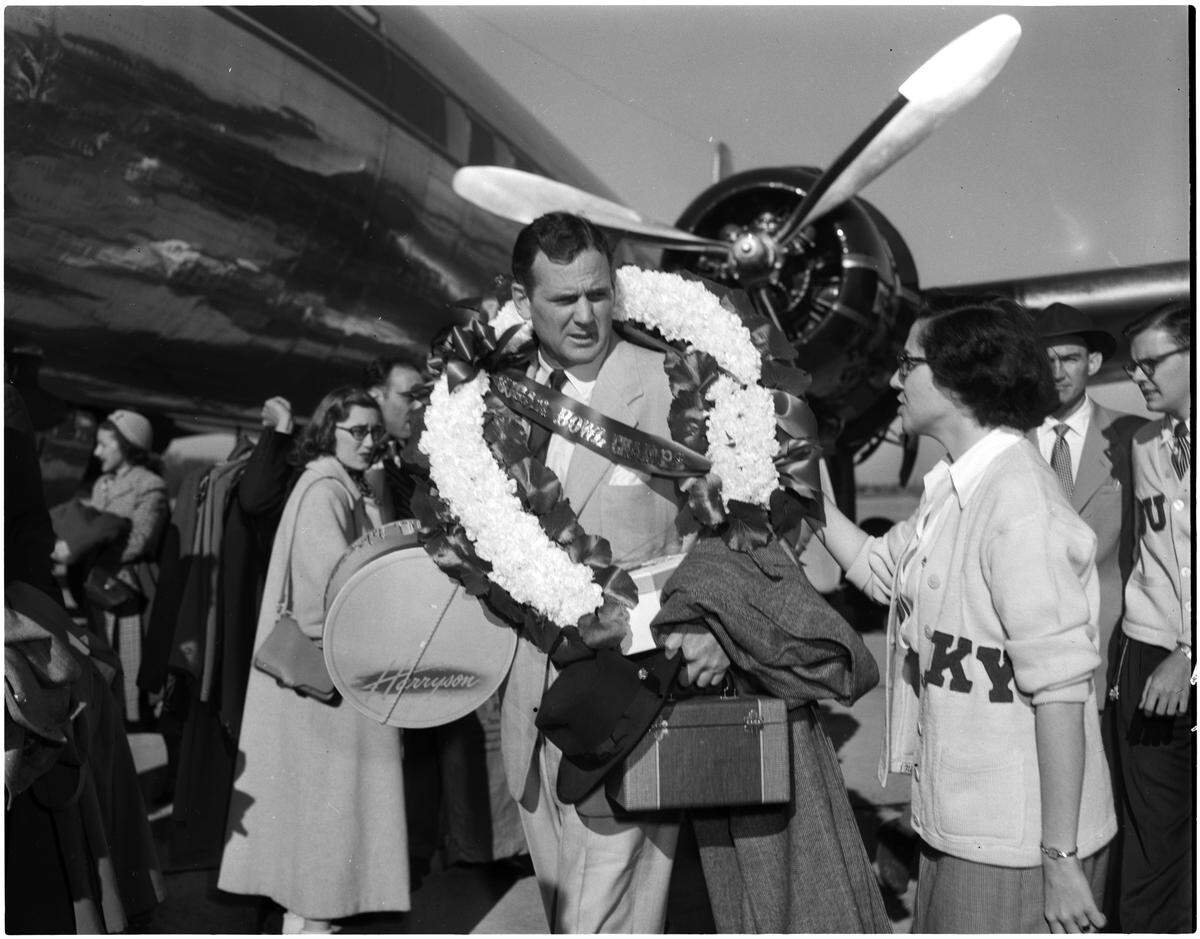
Donovan’s comments came shortly after Kentucky had accepted an invitation to the Sugar Bowl, where the Wildcats would face No. 1 Oklahoma. UK had won its first 11 games of the 1950 season before a 7-0 loss to Tennessee in the regular-season finale.
That success led to persistent rumors that Bryant was likely to leave Kentucky for another job.
In his speech, the text of which is included in the collection of Donovan’s papers housed by UK’s special collections library, Donovan directly referenced a report from The Tennessean in Nashville that Texas was likely to pursue Bryant for its open coaching job. According to a report in Dec. 8, 1950, edition of the Lexington Leader, Bryant had also been tied to the opening at Minnesota.
While the transcript of Donovan’s speech does not specify the occasion it was delivered, it matches media reports of Donovan’s address at the annual UK football banquet from December 1950.
“The coach himself did a masterful job of avoiding the subject entirely, skimming the sideline, as it were, and never flicking the chalk with even a single cleat to indicate what his personal intentions might be,” Larry Shropshire wrote in the Dec. 14, 1950, edition of the Lexington Leader. “And afterward, replying with some irritation to a query, he said, ‘No, I am not going to make any statement — unless I have to.”
Modern Kentucky fans need no reminder of what a coach sidestepping rumors of interest from other programs looks like.
UK coach Mark Stoops declined to address reports tying him to the Texas A&M job after an upset of Louisville in the 2023 regular-season finale. Just a few hours later Stoops was reported to be on the verge of leaving Lexington for College Station only to announce his return after a vocal portion of Texas A&M fans took to social media to voice their displeasure with the potential hire.
Regardless of what Bryant’s actual interest level was in other jobs after the 1950 regular season, Donovan made Kentucky’s stance clear.
He noted that when UK hired Bryant from Maryland with just one season of head coaching experience on his résumé prior to the 1946 season Bryant was up front about needing time to build the program into a contender.
“He outlined what he hoped to accomplish each year and said that it would take him five years to build one of the nation’s great football teams,” Donovan said in his speech. “An examination of Bryant’s schedule will show that he has kept up with his time table — he is right on time. The coach is a man of his word.”
That phrasing was unlikely a coincidence — Donovan titled the speech, “Paul Bryant – A Man of His Word” — as Donovan emphasized the commitment made when UK awarded Bryant an unprecedented 10-year contract.
Donovan told attendees of the banquet he only rarely sent Bryant a telegram after a UK win but always did after a loss.
“This policy saves me money because I seldom have to send him a telegram,” Donovan said. “Bryant knows I am for him, win, lose or draw. When we entered into a long-time contract with Coach Bryant we pledged him our whole hearted support in fair weather or foul, and we have been more steadfast in our support when the going was hard and fair-weather fans deserted him and the team.”
Just more than two weeks after Donovan’s speech, Bryant and the Wildcats upset Oklahoma in the Sugar Bowl.
Bryant would stay at Kentucky for three more seasons before accepting the head coaching position at Texas A&M on Feb. 4, 1954. During that span, Bryant turned down multiple other job offers — including one from Arkansas just a few weeks before he accepted the Texas A&M job — and a signed 12-year contract extension.
But Donovan’s hard-nosed approach to interest in his football coach mattered little in the end.
When Bryant accepted the Texas A&M job, Donovan declined to recommend that the athletics board release him from the remaining nine years on his contract until a suitable replacement could be found.
“To all who may be concerned, I wish to make the following points quite clear,” Donovan wrote in a statement after Bryant’s announcement. “One, Mr. Bryant is leaving the University of Kentucky entirely on his own initiative. Two, he consulted no one at the university before making his decision. My first notice of his intentions was to the effect that he had definitely accepted the offer at Texas A&M and that he was submitting his resignation. And three, Mr. Bryant has not asked for any modification in his contract nor has he complained in any way of the treatment received here or of the opportunities or facilities provided him.”
Two days later that final gambit failed as the board accepted Bryant’s resignation.
But that heartbreak was still more than three years away at the time of the 1950 football banquet.
“The team likes its coach,” Donovan said that night. “The students of the University of Kentucky like their coach. The board of directors of the University of Kentucky Athletic Association like their coach. The trustees of the university like their coach. The president of the university likes his coach, and the people of Kentucky like their coach.
“And the University of Kentucky does not propose to let any other institution take him away from us. We are expecting coach Paul Bryant to spend a long life in Lexington where he and his charming wife and children are loved and respected by all of our citizens.”
This story was originally published January 22, 2024 at 6:55 AM.