
UK football has rebuilt its offensive line, but will transfer haul lead to better play?
Mark Stoops can check off perhaps the most important task on his offseason Kentucky football to-do list.
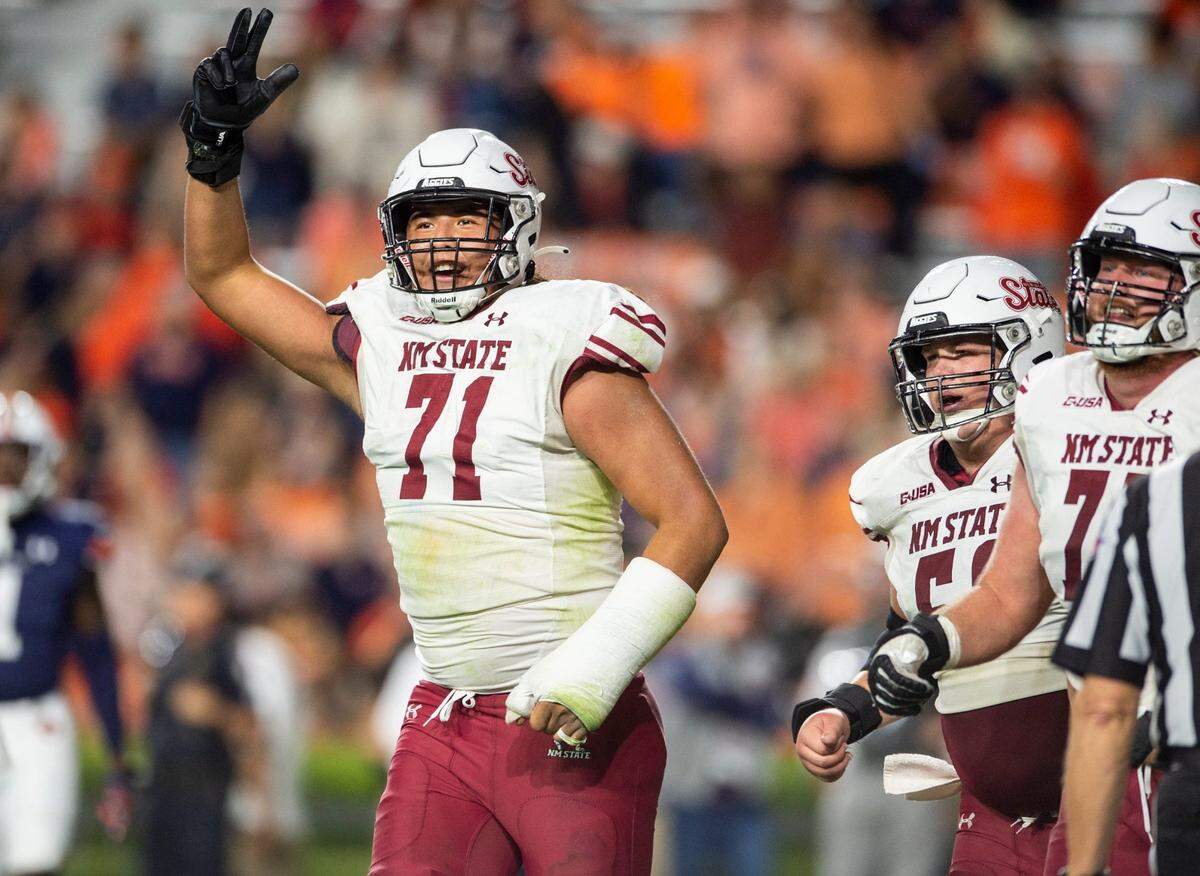
With the weekend commitment of New Mexico State left tackle Shiyazh Pete, the Wildcats offensive line makeover appears complete. Now, Stoops, offensive line coach Eric Wolford and offensive coordinator Bush Hamdan must start the work of proving their evaluation and transfer portal recruiting choices were correct.
The personnel on hand in Wolford’s offensive line room look dramatically different than it did for the regular season finale, before which Stoops acknowledged he was planning to look to the transfer portal to rebuild the position.
Gone are left tackle Marques Cox, center Eli Cox and right tackle Gerald Mincey, who all exhausted their college eligibility. Backups Dylan Ray, Courtland Ford, Koby Keenum and Ben Christman left via the transfer portal.
Kentucky signed five linemen in the December transfer portal, including four who are almost certain to start for the Wildcats in 2025 if healthy. Replacing Mincey is former Bowling Green tackle Alex Wollschlaeger. Replacing Eli Cox is former Western Kentucky center Evan Wibberley. Replacing Marques Cox is Pete.
UK returns starting guards Jalen Farmer and Jager Burton, but at least one of that duo is likely to be pushed to the bench after the addition of former All-SEC Arkansas guard Joshua Braun. New Mexico transfer Wallace Unamba will be counted on to replace Ray’s role as the top backup, capable of playing tackle and guard.
The four projected transfer starters each bring at least 1,000 career snaps and one full season of starting experience to Lexington. Of the five transfers, only Wibberley has multiple years of eligibility remaining, so the clear objective is to provide instant impact in 2025.
How do recruiting sites rank the new Kentucky linemen?
While the recruiting websites are still adapting to ranking players in the transfer portal era, at least one of Rivals, 247Sports and On3 rated Braun, Wollschlaeger and Pete as four-star transfer prospects. The offensive line additions look close to a best-case scenario for Kentucky given the need to spread the available NIL budget to fill myriad holes on the roster while keeping promising young playmakers in the fold, but will the makeover be enough to dramatically improve an offense that ranked 111th nationally in sacks allowed per game last season?
Stoops and his assistants are making a clear bet on their ability to identify previously overlooked talent to answer that question affirmatively.
Four of the five transfers come to UK from Group of Five conference programs. Only Braun has Power Four conference experience. Pete, Wollschlaeger, Wibberley and Unamba did at least face at least one Power Four foe at their former schools, but until they prove capable of making the jump in competition there will be questions about how their previous production will translate to the SEC.
Could Kentucky be a pathway to the NFL draft?
Of the 55 offensive linemen selected in the 2024 NFL draft, only 10 arrived at the program they were drafted from as transfers from four-year colleges. Of those 10, five transferred from other power conference teams.
Kentucky can at least look to last year’s draft for a handful of examples of players who transferred up from smaller programs to cement their status as professional prospects.
Guard Dominick Puni started his career at FCS Central Missouri before transferring to Kansas, where he started for two years before the 49ers drafted him in the third round. After four years at Cornell, center Hunter Nourzad used two years at Penn State to earn a fifth-round selection by the Kansas City Chiefs. Three other linemen who started their careers at FCS or Group of Five programs were drafted from power conference schools in the sixth or seventh rounds.
But the argument that small-school linemen need to prove themselves against better competition to earn the notice of NFL scouts is hurt by the fact that 11 linemen were drafted last year directly from non-power conference programs. NFL teams drafted linemen from Georgia State, UTEP, Louisiana, Connecticut, Yale, South Dakota State, EKU and Holy Cross in 2024. The Seahawks drafted tackle Michael Jerrell from Division II University of Findlay in the sixth round. The 2024 offensive line draft class also included picks from a Canadian university (Giovanni Manu, fourth round) and the NFL Academy in London, England (Travis Clayton, seventh round).
Perhaps the expected advent of revenue sharing for college athletes in 2025 and the additional NIL contracts available to transfers made another college season more attractive to UK’s transfer additions, but the likelihood is that if any of the incoming linemen were surefire NFL draft prospects, they’d be preparing for the 2025 draft now instead of starting classes at UK.
Of course, Kentucky does not need the transfers to be NFL draft picks for them to be an upgrade over the 2024 struggles. Marques Cox already proved a Group of Five transfer could thrive as a starter at Kentucky after transferring from Northern Illinois to UK in 2023 before the cumulative effect of several injuries appeared to take a toll on his performance in 2024.
What about the future after 2025?
For now, the offensive line rotation looks at least eight deep with sophomore tackle Malachi Wood, who filled in for an injured Mincey down the stretch, also returning. Since Pete, Unamba, Burton, Braun and Wollschlaeger all have just one year of eligibility left, 2025 will be an important developmental year if Kentucky does not want to have to depend on another massive transfer haul next winter. How Farmer, Wood, sophomore guard Aba Selm and the other eight returning scholarship linemen still on the roster progress will say much about the future of the position.
“I feel like, in my experience, it takes about two years to develop a high school offensive lineman to get him ready to play at this level in this league,” Wolford said in October.
Developing those high school signees still looks like the best hope for Kentucky’s offensive line returning to the heyday of the “Big Blue Wall,” but the transfers have at least provided some short-term stability and reason for optimism.