Kentucky high school basketball going to shot clock in 2027-28 season
AI-generated summary reviewed by our newsroom.
- KHSAA approved 35-second shot clocks for varsity basketball starting 2027-28.
- Cost estimates include $5,500 per gym and $3,000 annually for clock operators.
- Decision follows national trend despite opposition from member school survey.
The shot clock is coming to Kentucky high school basketball beginning in the 2027-28 season.
In a surprise regular-meeting vote Wednesday — after years of inaction on the issue and in a move that goes against a recent survey of its member schools — the Kentucky High School Athletic Association Board of Control approved the implementation of a 35-second shot clock as a requirement at the boys and girls varsity level three seasons from now.
“It’s about moving the game forward, and I just think it’s what’s best for the game,” said Damon Kelley, Paul Laurence Dunbar’s athletic director, who is a former basketball coach and the KHSAA board’s president-elect.
Kelley, a former West Jessamine boys’ basketball coach who led the Colts to the 2020 12th Region championship, made the motion to vote on the game-management device despite the KHSAA’s most recent triennial survey results on the issue that showed that 150 of the 252 responding schools did not favor it unless it was required nationally by the National Federation of High School Associations.
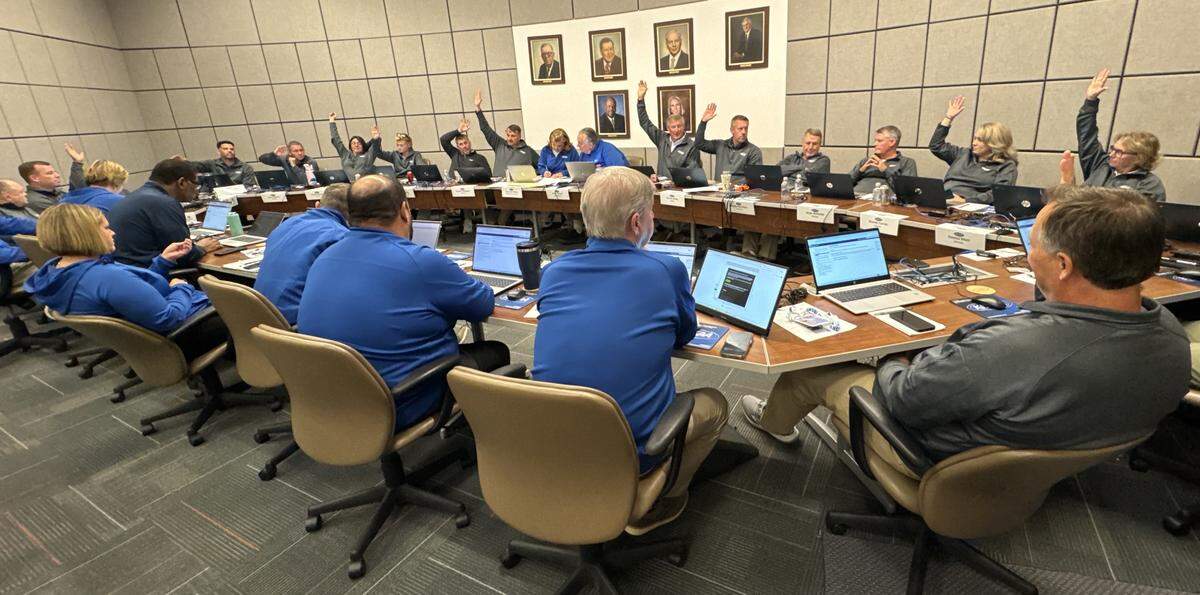
That rejection was among the concerns cited by Johnson Central assistant superintendent Noel Crum, who was among the minority voting against it Wednesday.
“I realized what you’re saying about the survey results …, but many times, those people are voting based on what’s best for them in that season,” Kelley said. “And we’ve got to make decisions that we think are best for, in this case, basketball moving forward.
Other arguments stated Wednesday and over the years have been the cost to put up shot clocks at every high school basketball gym in the state and the question of who would run the clocks and whether that person should be some sort of paid official.
Sacred Heart girls coach Donna Moir, a board member who has led the Valkyries to five straight Girls’ Sweet 16 state championships, said her teams have played in other states that have shot clocks and she doesn’t remember them being a factor. Other coaches concurred and said in their experiences at the AAU levels, the use of a shot clock is almost never a matter of controversy.
The cost of putting up shot clocks was informally estimated to be about $5,500 per school and, perhaps, about $3,000 per season to man it with a paid official if schools chose to do so, according to numbers talked about by other board members during their discussions. A mass purchase could discount the purchase figure, and volunteers could alleviate the ongoing costs, members said.
Rockcastle County girls basketball coach Chrysti Noble, who has coached for more than 30 years, told the Herald-Leader that she’s concerned how her school, and other smaller schools, will budget for the new equipment and the operational labor.
“You have to buy the new equipment,” Noble said. “You’re gonna have to find somebody to run the clock, to learn how to operate the clock. I just think that’s going to be really hard for some schools, including mine. Rockcastle, we do have 800 students, but we’re a very rural school. And you hear everybody’s budgeted, but, you know, everybody’s budgets are tight.”
Lexington Christian girls basketball coach Tim Bradshaw also noted the financial difficulties for some schools.
“Our perspective is we’re fortunate in a lot of ways,” Bradshaw said. “But I know that it’s not as easy for, maybe, smaller schools and whatnot, to be able to get those. That’s an expense, and then you’ve got to get somebody to work it and all of that. So, I think that’ll be a process, but hopefully in the next two years we can get enough time to prepare for it and get everybody on board.”
The shot clock would be set at 35 seconds per possession in accordance with NFHS guidelines.
The NFHS began allowing its associations to use shot clocks beginning in 2021. In the first year, there were eight states putting them in. At last count, 32 state high school athletic associations had implemented or planned to implement the shot clock.
Shot clocks have existed at the pro level since 1954. They’ve been in use at the NCAA level since 1985.
George Rogers Clark girls basketball coach Robbie Graham, who’s earned a state tournament berth in eight of the last nine seasons with the Cardinals, noted that student-athletes who participate in travel programs, or tournaments which opt to utilize the shot clock, are used to its inclusion. He also said that it’s a good way to prepare those with college basketball aspirations for the next level.
“I’m excited about it for several reasons,” Graham said. “A lot of kids in Kentucky want to play at the next level, whether it be Division I, Division II, Division III, NAIA or junior college, and I think it just kind of gets kids used to that. And a lot of the kids are already used to it playing AAU ball, so I don’t think it’ll be a huge adjustment for people. And our program, we play fast anyway, so it’s definitely not going to be an adjustment for us.”
Putting in shot clocks prevents the use of stalling as an offensive strategy and would help high school players better prepare for the college games, according to proponents.
“It’s going to come. Are we going to wait until we’re the last state to adopt shot clocks?” Manual athletic director David Zuberer asked before the vote. “It’s happening. We can put our heads in the ground if we want, but if we’re going to do what’s best for the kids, in my opinion, as a former basketball coach … the time is now.”
Shot clocks have already been approved for trial use by Kentucky schools for tournaments and showcases and were used at last season’s Louisville Invitational Tournament. And schools can begin using them this season, too, but not for district or postseason games.
“We’ll have to communicate the rules to them, because we haven’t been covering the shot clock rules in our clinics, because we don’t have a shot clock,” KHSAA commissioner Julian Tackett said. “If they’ve got to make equipment changes and etc., we’ll communicate with the schools and let them know the processes as far as what they’ve got to do and then what items we hear that they need to consider.”
In other action Wednesday …
More super regionals discussed
The board directed KHSAA staff to develop guidelines for all 16 regions by which they could request alterations to their postseason formats for basketball, baseball, softball, soccer and volleyball to create “super” regional experiments like the ones approved in recent years for 15th Region basketball and 6th Region baseball and softball.
In the latter instances, the super regional formats were allowed to solve participation issues among the respective region’s schools. The 15th Region has two three team districts, which made region tournament bracketing difficult. The 6th Region’s softball tournament had a district that often could not field more than two teams, resulting in the same problem.
On Wednesday, the board heard proposals to expand the 6th Region’s super regionals to volleyball and soccer and also revisited an idea offered by Henry Clay athletic director Kristian Junker on behalf of the 11th Region for a girls and boys basketball super regional.
No final action was taken, but if the guidelines are ready by the board’s next scheduled meeting in November, the door could open wide to new region tournament formats in several sports across Kentucky.
Regions would need approval from 2/3 of their member schools to make a super regional proposal to the KHSAA.
Lexington Legends seek to become regular state baseball site
Alan Stein of the Lexington Legends spoke of the independent professional baseball team’s desire to become a more permanent home to the KHSAA state baseball tournament.
“We have a permanent home in a professional facility that wants to be your partner,” Stein said.
When Stein helped found the Legends in 2001, he told the board he wanted to help support high school and other youth baseball levels. Legends Field was home to the state championship game from 2002 until 2021, but has been an alternate site after the University of Kentucky’s Kentucky Proud Park was built.
However, when UK is involved in the college baseball postseason, it can create uncertainty in the KHSAA tournament schedule. Stein said Legends Field could offer more stability in that regard.
Henry Clay baseball has temporary home
During Stein’s presentation, he confirmed Legends Field would host Henry Clay High School’s baseball team while its new school is being built. The Blue Devils baseball and softball fields were razed this summer to make way for construction. Their new fields won’t be ready for play until the 2029 season. The school is negotiating with Transylvania University to host the softball team.
Appeal for classing other sports offered
Simpson County schools superintendent Tim Schlosser asked the board to experiment with classing any of its undivided sports to see whether competition and participation levels could be improved in them by separating the small schools from the bigger ones.
“I feel like if we were to create a class system, it would create opportunities for kids across the state of Kentucky to have some success,” Schlosser said.
The KHSAA currently only has classes for football, track and cross country. Kentucky and Delaware are the last states in the nation to not class high school basketball.
More basketball changes offered during public comment time
Ken Trivette, board chairman of the Kentucky Basketball Hall of Fame, asked the board to consider completely revamping the state’s high school basketball alignment by reducing the number of districts from 64 to 32 to create what he believed to be a better system for creating and maintaining rivalries and generating postseason excitement.
This story was originally published September 17, 2025 at 4:51 PM.