
Horse Park falls into deficit in recent years
The Kentucky Horse Park had its biggest year ever in 2010, hosting the Alltech FEI World Equestrian Games with an array of new facilities and upgraded infrastructure.
The Games burnished the park's reputation for equine events, but it didn't help the bottom line. The park received a flat fee of $500,000, but that didn't make up for the park being closed nearly seven weeks that summer.
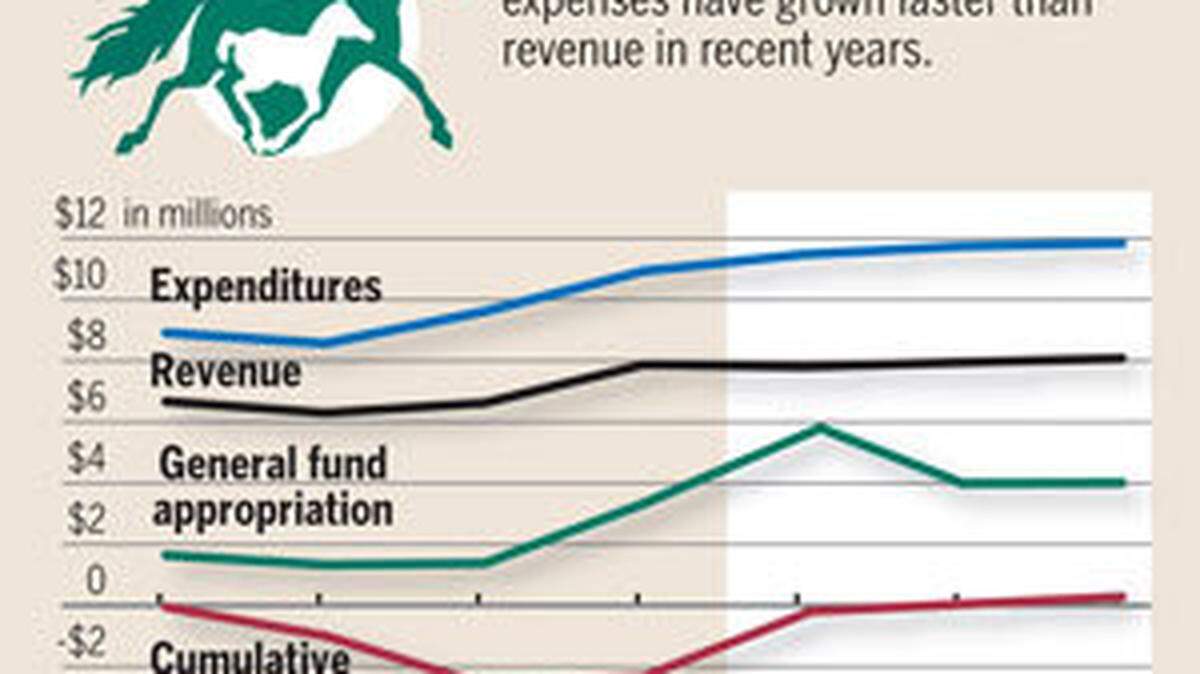
The pre-Games closing, along with declining attendance during the recession and soaring utility costs for a new indoor arena, have meant annual deficits for the park since 2008.
The deficit, which started at $47,000 in 2008, has ballooned to $3.6 million.
To right its books, the park will need an additional $3.5 million from the state General Fund this fiscal year, and an extra $3.2 million over the next two years, according to a recommendation in Gov. Steve Beshear's proposed budget.
Although the park has always received an annual appropriation from the General Fund, this year's recommendation is getting plenty of attention because most other state agencies are being cut as much as 8 percent.
John Nicholson, the park's executive director, will be in the hot seat this week when he appears before a legislative budget committee to explain why the Horse Park has had a recurring deficit, and why the public's perception of the Games' success hasn't brought financial success.
"It seemed like there was a plan that all things would be bigger and better" after the Games, said Sen. Bob Leeper, chairman of the Senate budget committee. "They're going to get a lot of extra scrutiny, as you have to do when you're cutting in so many areas. But it's only fair to let the principals explain themselves."
Rising costs
As Nicholson explains it, the park first was hit by the recession in 2008, when high gas prices and the economic meltdown meant that fewer people visited the park and fewer competitors took part in events. Overall, revenues fell by almost $150,000 between 2008 and 2009. A $47,625 deficit rolled over to the following year, when admissions and revenues rose slightly. But for the latter part of 2009 and the first part of 2010, $75 million in state-funded construction hampered events at both the new indoor arena and the upgraded outdoor stadium.
Later in 2010, before and during the Games, the park was closed to many regular visitors, campers and events. The number of equine events fell from 70 in 2009 to 57 in 2010. At the same time, utility costs nearly doubled.
In fiscal 2011, which included the Games, expenditures outgrew revenues by $3 million. The annual appropriation of $3.3 million from the General Fund managed to shrink the deficit to $2.3 million, which carried over to this fiscal year.
"It all combined for this temporary situation," Nicholson said of the governor's proposal for this year's additional $3.5 million appropriation.
The World Equestrian Games were a success for the state, Nicholson said, because it brought in $18 million in state taxes, according to one study, but they were "never designed to be a windfall for the park.
"What the World Games did for us is give us the potential for a great deal of activity and revenue for the future," he said. "That's being borne out by increased number of events."
In 2011, revenues from equine events almost doubled that from visitor admissions.
Nicholson said there are 87 equine events scheduled for the park in 2012 and 89 in 2013, including the Alltech National Horse Show, the Kentucky Spring Horse Shows, and the Adequan FEI North American Junior and Young Rider Championships, recently judged among the top 25 shows in the country.
"We have cut to the bare bone," said Alston Kerr, chairwoman of the Kentucky Horse Park Commission. "We have watched each and every controllable expenditure that we can control, we have less staff who work long hours, and we will raise the rates every year for rentals."
There are 74 full-time employees, 11 fewer than in 2007.
A bailout?
The Horse Park is in a unique situation in being a state agency that is allowed to carry a deficit from one year to the next, state budget officials say.
The Horse Park and the Kentucky State Fair Board, which also would get a state appropriation under Beshear's budget, are among the few state agencies that depend on tourism dollars, said John Hicks, deputy state budget director. (Kentucky's state parks receive about $30 million in state appropriations every year.)
"We expanded the physical plant in a recessionary period, but we haven't stabilized the budget with its new physical plant," Hicks said. "It is really about the ability to operate the park that was built there."
It's not clear what action legislators will take with Beshear's proposals for the park. If they don't agree with the appropriations, Nicholson said, he would have to get legal advice, because the park has already signed so many contracts for events next year.
"It's preferable to work through the situation and not resort to short-run actions that would diminish the purpose of the program," Hicks said.
In budget projections for the park, expenditures will continue to outpace revenues through 2014, but the deficit would be erased with another $3.2 million state appropriation, leaving instead a $281,000 surplus.
What's not clear is whether the park will ever be self-sustaining.
"I think we're on a course now that we can look to a point where we will have diminishing contributions from the General Fund," Nicholson said.
But he said that plan will require a private-sector hotel on the property that returns revenue to the park. A similar proposal fell through before the Games.
Still, sports marketing guru Jim Host says state appropriations pale next to the economic development that the park brings the state. He cited the 400 white-collar jobs that came with the 33 equine organizations now headquartered at the park.
"Once you start to measure all the economic impact of the park, it is far in excess in terms of state appropriation," he said. "I really think it's had a huge impact, and it will have a bigger impact once these new shows come in."
Nicholson said new events in 2011 added $44 million to the economy and generated $4.2 million in state taxes. In 2010, the total economic impact of Horse Park activities was $179 million, along with $17.1 million in state taxes, he said.
State officials and the FEI, the international equine governing body, have estimated that the Games meant between $200 million and $400 million in economic impact for the state, even though the Games themselves ended up in a deficit and brought little cash to the park.
The disconnect between economic impact and the day-to-day finances at the Horse Park is large and confusing to the general public, said Ken Troske, director of the Center for Business and Economic Research at the University of Kentucky.
He said the Horse Park's financial problems can be compared with lower-than-predicted tax revenues from the KFC Yum Center in Louisville, and future financing issues for the Rupp district in downtown Lexington.
"I think you can draw a strong correlation" among all three, Troske said. "All of it comes back to the fact that economic-impact studies are dumb. That doesn't mean we don't want to fund these programs, but what it does mean is economic-impact studies are not based on sound economic theory. They involve large amounts of assumptions, they don't measure what people think they measure, and they often lead to poor policy decisions.
"If people like the Horse Park, if people enjoy going there, if people in Kentucky find the Horse Park valuable and therefore are willing to pay to have a Horse Park, that's fine."
This story was originally published February 12, 2012 at 12:16 AM.