
Justify is 9th undefeated Kentucky Derby winner. Only one won the Triple Crown.
Thundering home in the mud at Churchill Downs a little more than a week ago, Justify won the Kentucky Derby in impressive fashion and became just the ninth undefeated victor in the race’s 144-year history.
This weekend, the Bob Baffert-trained colt will try to stay perfect with a win in the Preakness Stakes, and — if he’s successful there — the Belmont Stakes and an attempt at the Triple Crown likely awaits Justify three weeks later.
Of the eight previously undefeated Kentucky Derby winners, only one went on the win the Triple Crown. The other seven never found a place on that particular page in horse racing’s history books, for various reasons. Five never won again — and three of those never raced — after their grueling Triple Crown schedule ended.
Justify could end up as a horse for the ages, but the history of perfect Derby winners past proves just how difficult the next few weeks will be.
Nyquist
To find the most recent undefeated Derby winner, you need look back only a couple of years.
Nyquist — trained by Doug O’Neill — was the 2-year-old champ in 2015, capping the year with a perfect 5-for-5 record and a victory in the Breeders’ Cup Juvenile at Keeneland. He won the first two races of his 3-year-old campaign — the latter in the Florida Derby — and then took the Kentucky Derby as the 2-1 favorite for the eighth consecutive victory to start his career.
He never won another race.
Nyquist engaged in a fairly quick pace battle in the opening furlongs of the Preakness, took the lead into the stretch but was quickly overtaken by eventual winner Exaggerator — the Derby runner-up — and ultimately finished 3½ lengths behind him.
He finished fourth in the Haskell a couple of months later — Exaggerator also won that one — and was sixth in the Grade 2 Pennsylvania Derby a couple of months after that.
Nyquist was still being pointed toward the Breeders’ Cup Classic, but a minor injury sidelined his training and he was officially retired about a week before the race. He’s now standing stud at Darley’s Jonabell Farm in Lexington.
Big Brown
Seven years before American Pharoah ended the Triple Crown drought, it seemed a near certainty that Big Brown would be the one to do it.
Like Justify, he raced only three times — and just once against stakes company — before impressively winning the 2008 Kentucky Derby as a heavy favorite. Big Brown romped to a victory in the Preakness two weeks later and was a 1-5 favorite in the Belmont.
Big Brown was a big bust in New York, awkward in his first several strides out of the gate before veering into a horse on his outside in the opening turn. He raced wide from there, and it was clear before the field hit the stretch that he had no chance.
Jockey Kent Desormeaux pulled him up, and he didn’t finish the race, which was won by 38-1 shot Da’Tara.
Various theories have been floated for Big Brown’s performance: a hoof condition that disrupted training leading up to the Belmont, a dislodged shoe in the opening stages, his trainer Rick Dutrow’s admission that he had taken the colt off his monthly dose of the (legal) steroid Winstrol before the race.
Big Brown went on to win the Haskell and the Monmouth Stakes before suffering an injury while training a month later. That knocked him out of the Breeders’ Cup Classic, and he was retired with a record of seven wins in eight starts. He’s now standing stud at a farm in New York.
Barbaro
The son of Dynaformer won his only two races as a 2-year-old — both on turf — and was a perfect 3-for-3 in Florida before coming to the 2006 Kentucky Derby as a top contender.
Barbaro was the 6-1 second-choice — behind Sweetnorthernsaint — and devoured that Derby field, winning by 6½ lengths.
The undefeated star was a 1-2 favorite in the Preakness two weeks later, when disaster struck. Barbaro broke through the starting gate before the race was set to begin, was ruled fit to run and re-loaded into the gate, then suffered a devastating leg injury in the opening moments of the race.
He was pulled up by jockey Edgar Prado and underwent surgery of more than five hours the next day. Barbaro underwent a second surgery following complications a few weeks later and was diagnosed with laminitis shortly after that.
His convalescence became a national story, and for a while, it seemed he would indeed recover from his injuries.
The Derby champ was gradually improving before suffering another setback in January of the following year, and — after one last surgery later that month — he was euthanized on Jan. 29, 2007.
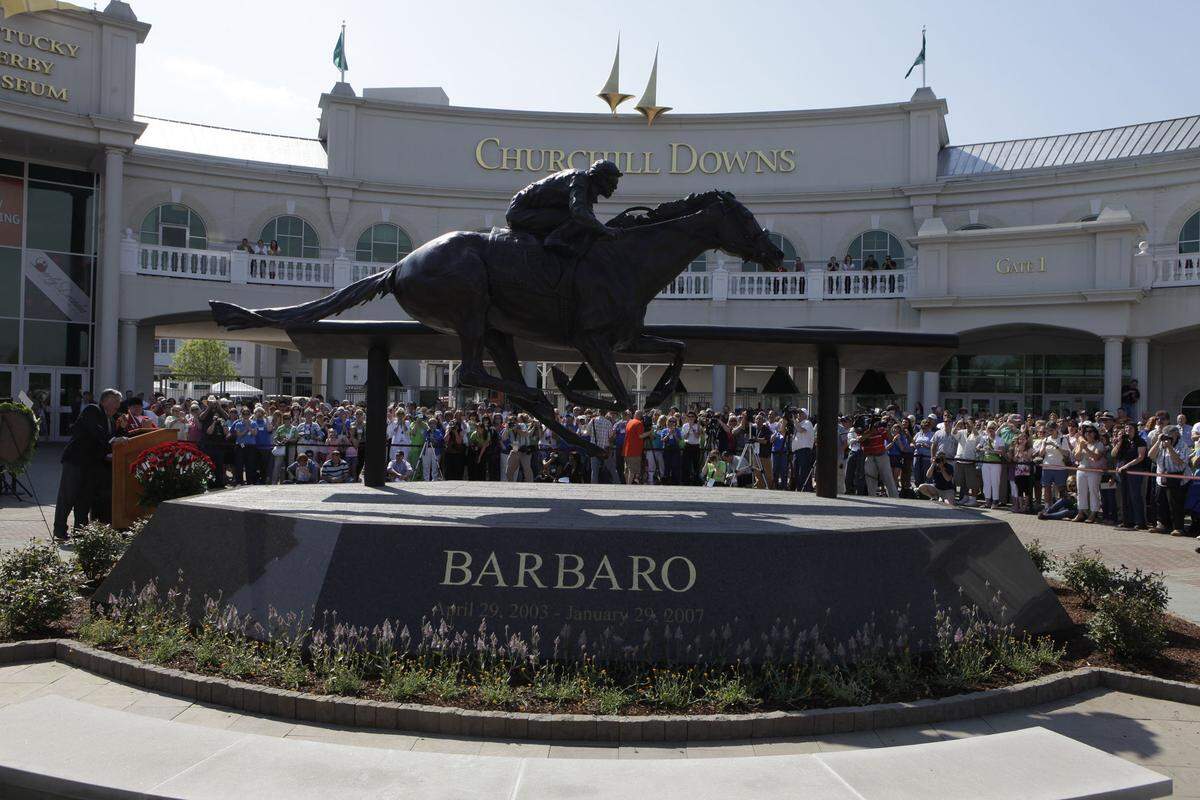
A memorial statue in his honor now stands outside Gate 1 of Churchill Downs.
Smarty Jones
Smarty was a perfect 6-for-6 — racing twice as a 2-year-old — before winning the Kentucky Derby as the 4-1 favorite in 2004.
The fan favorite romped two weeks later, winning the Preakness by 11½ lengths, and he went to Belmont as the odds-on favorite to win the Triple Crown.
For most of the race, it looked like he’d do it, taking the early lead and entering the stretch nearly two lengths ahead of 36-1 shot Birdstone.
The long shot ran him down in the final moments of the race, overtaking Smarty about 100 yards from the finish line. Birdstone, like Da’Tara four years later, was trained by Hall of Famer Nick Zito.
Smarty Jones never raced again, and he was retired a couple of months after the Belmont because of a chronic ankle bruising. He’s now at Calumet Farm in Lexington.
Seattle Slew
The only Triple Crown winner on this list, Seattle Slew was undefeated in three starts as a 2-year-old — all at Belmont Park — and went 3-for-3 as a 3-year-old heading into the 1977 Kentucky Derby.
He had won his first six races — including three Grade 1 stakes — by a combined margin of 34½ lengths, never winning by fewer than three lengths.
As the 1-2 favorite, he won the Kentucky Derby by nearly two lengths. Two weeks later, he won the Preakness as the 2-5 favorite, and three weeks after that he completed his Triple Crown run with a Belmont victory, also as a 2-5 favorite.
Seattle Slew’s next race — and first loss — came just three weeks after the Belmont Stakes, finishing fourth in the Grade 1 Swaps Stakes at Hollywood Park in his first trip to the West Coast.
That was the only time Seattle Slew finished out of the money, winning 14 of his 17 career races with two runner-up finishes. He was a highly successful sire and is buried at Hill ‘n’ Dale Farm in Lexington.
Majestic Prince
After winning the first seven races of his career, Majestic Prince was the 7-5 favorite in the relatively small eight-horse Kentucky Derby field in 1969, defeating Arts and Letters by a neck to become that year’s Derby champ.
Majestic Prince defeated Arts and Letters again in the Preakness — this time by a head — as the 3-5 favorite, improving to a perfect 9-for-9 on the track.
It was then reported that his connections had decided that they would skip the Belmont Stakes and a shot at the Triple Crown, which at that point had not been won in 21 years and had never been won by an undefeated horse.
As owner Frank McMahon revealed to Sports Illustrated, he was told by Majestic Prince’s trainer, Johnny Longden, that the colt needed a rest after his Preakness victory. McMahon said he wanted Majestic Prince to go to Belmont anyway, and he would put off the decision on whether to run him until closer to the race. Instead, Longden ordered a plane to send Majestic Prince back to his home base of California.
Majestic Prince never got on the plane, and McMahon had him sent to New York. There was intense pressure from the public and media at the time to run him in the Belmont, though McMahon said that had nothing to do with his decision.
Longden, a Hall of Fame jockey before his training days, said he thought Majestic Prince would win the race, but he continued to question the owner’s decision and said he was bothered by what it would mean for the colt’s long-term health.
“If he's tired he can't be any more tired than Arts and Letters,” McMahon told SI in the lead-up to the race. “And we haven't heard his people complaining, have we?”
Arts and Letters defeated Majestic Prince by 5½ lengths in the Belmont Stakes.
The second-place finish there was the first and only defeat for Majestic Prince, who never raced again after that day at Belmont.
Longden later said Majestic Prince had a tendon injury, and Hall of Fame jockey Bill Hartack — winner of five Kentucky Derbys — said he never should have run in the Belmont. “The horse was hurting,” Hartack said.
Morvich
An amazing 11-for-11 as a 2-year-old, Morvich came to Churchill Downs in 1922 with an unblemished record and unraced at the age of 3.
The 6-5 favorite for the Kentucky Derby, he won by 1½ lengths for his 12th victory. He never won again.
Morvich raced four more times as a 3-year-old — finishing second twice and out of the money in the other two starts — but he didn’t run in the Preakness.
The reason for that was simple: the Preakness that year was run on the same day as the Kentucky Derby, a time before the order of the Triple Crown races had been firmly established.
Sir Barton, winless in all six of his starts as a 2-year-old, had won the Derby, Preakness and Belmont three years earlier — and he’s now considered the first Triple Crown champion — but the term didn’t become common until Gallant Fox achieved the feat in 1930.
Regret
The first filly to win the Kentucky Derby, Regret was a perfect 3-for-3 as a 2-year-old, and — like Morvich — came to Churchill Downs for her first start at age 3.
She won the Derby by 2 lengths as the 5-2 favorite, but she was not entered in the Preakness, which was run nine days after the Kentucky Derby that year. (That Preakness was also won by a filly, Rhine Maiden, and 1915 remains the only year that fillies won two Triple Crown races).
Regret won her only other start as a 3-year-old and suffered her first loss the next year, finishing sixth in the Saratoga Handicap.
Still one of only three fillies to win the Derby, she had a career record of nine victories with one second-place finish in 11 starts before being retired in 1917.
Regret was buried at C.V. Whitney Farm in Lexington.
This story was originally published May 13, 2018 at 5:53 PM with the headline "Justify is 9th undefeated Kentucky Derby winner. Only one won the Triple Crown.."