Is this the one? Essential Quality could end a Blue Grass Stakes drought of 30 years.
Perhaps this will be the year.
In the three decades since Strike the Gold won both the Blue Grass Stakes at Keeneland and the Kentucky Derby at Churchill Downs, no other horse has pulled off the feat.
It has been quite the drought for a prep race that once sent its victors to the Derby winner’s circle on a regular basis. From 1963 to 1972, six horses won both races. The great Spectacular Bid did the same in 1979. Since then, only Strike the Gold, in 1991, has pulled off the double.
There have been three horses who ran in the Blue Grass — failing to win that prep race — and went on to win the Kentucky Derby, but the overall drought remains intact.
This year likely provides the best chance in more than two decades to end that skid.
Blue Grass Stakes victor Essential Quality — the undefeated and reigning champion of this 3-year-old class — comes into this week as the clear Kentucky Derby favorite, and he could do Saturday what no horse has done for 30 years.
Here’s a look at every Blue Grass winner since Strike the Gold, including what happened to each of them on Kentucky Derby Day and later in their careers.
Pistols and Roses (1992)
Pistols and Roses went off as the fourth betting choice at 13-1 in a Derby that was dominated by the presence of odds-on favorite Arazi, but a race that was won by Lil E. Tee, who provided jockey Pat Day with his only Derby winner. Pistols and Roses ran within striking distance for much of the race but faded badly to 16th out of 18 runners. Swelling was later found in his ankle. He went on to win two Grade 1 races.
Prairie Bayou (1993)
Prairie Bayou was the 4-1 favorite in the Derby but finished second to Sea Hero (who was fourth behind Prairie Bayou in the Blue Grass) after coming from the back of the pack while six-wide in the stretch. Prairie Bayou went on to win the Preakness (and 3-year-old champion honors) but he was euthanized after breaking down in the Belmont Stakes. His owner, John Ed Anthony, owns 2021 Derby hopeful Caddo River.
Holy Bull (1994)
One of the greatest Thoroughbreds of the past 50 years, Holy Bull finished a tiring 12th as the heavy Derby favorite, leading to (unproven) allegations that the gray colt might’ve been drugged before the race. He missed the Preakness with a mild infection and returned to win four Grade 1 races (and champion 3-year-old honors) later in the year. He sired 2005 Derby winner Giacomo.
Wild Syn (1995)
That year’s Blue Grass Stakes produced the winner and runner-up of the Kentucky Derby, but neither was Wild Syn, who finished 19th and last, eased late in the race after running with the leaders early on. Thunder Gulch — fourth in the Blue Grass — won the Derby at 24-1 odds, while third-place Blue Grass finisher Tejano Run, trained by Lexington’s Kenny McPeek, was second on Derby Day. Wild Syn never won another race.
Skip Away (1996)
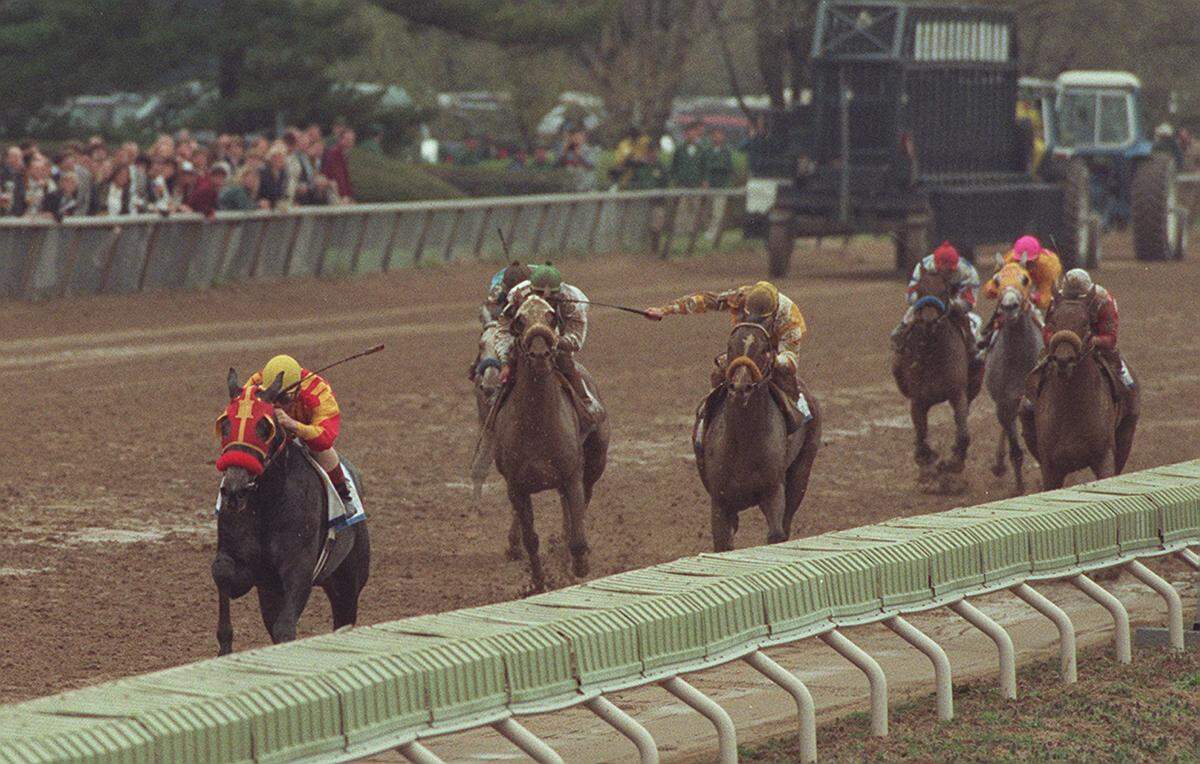
Another in an era of legendary Blue Grass runners, Skip Away set the stakes record time at Keeneland — winning in 1:47⅕ — before finishing a disappointing 12th while running wide from his outside post in the Derby, which was won by Grindstone. To illustrate the depth of talent in the Blue Grass field that year: runner-up Louis Quatorze won the Preakness, and third-place finisher Editor’s Note won the Belmont Stakes, while Skip Away finished second in both of those Triple Crown races before winning two Grade 1s to cap the year, earning 3-year-old champion honors. The gray colt went on to win the Eclipse Award for champion older horse the next two years and was Horse of the Year in 1998.
Pulpit (1997)
Pulpit raced to the early lead in the Kentucky Derby before fading to a fourth-place finish — as the fourth betting choice — in the 13-horse field. He suffered an injury in that race — just the sixth start of his career — and was retired to stud, becoming a top sire. His most notable offspring, Tapit, is a three-time leading sire in North America and the father of Essential Quality.
Halory Hunter (1998)
A year after basketball coach Rick Pitino left Kentucky for the Boston Celtics — and just 12 days after UK won a national title with new head coach Tubby Smith — the Pitino-owned Halory Hunter won the Blue Grass Stakes in Lexington. He came from the back of the pack on Derby Day to finish fourth behind Real Quiet. Halory Hunter suffered a severe leg injury in his final workout for the Preakness Stakes and was retired to stud.
Menifee (1999)
It’s difficult to come much closer to winning the Derby than Menifee, who unleashed a furious stretch run under Pat Day only to be beaten a neck by long shot Charismatic, galloping out past the winner after they hit the finish line. Menifee ran second behind Charismatic again in the Preakness and won the Grade 1 Haskell that summer before retiring later in the year.
High Yield (2000)
Pat Day won his fourth and final Blue Grass aboard High Yield, who ultimately finished 15th of 19 horses following a rough trip on Derby Day. He finished seventh in the Preakness and was retired a month later due to injury.
Millennium Wind (2001)
This was the third consecutive Blue Grass Stakes to send five of its runners to the Derby, but Blue Grass winner Millennium Wind finished 11th after racing near the leaders in the early going. The Derby runner-up to that year’s winner, Monarchos, was 55-1 shot Invisible Ink, who had run fourth in the Blue Grass.
Harlan’s Holiday (2002)
In a year with no clear Derby favorite, the honor went to Blue Grass winner Harlan’s Holiday, who went off at odds of 6-1 but never factored into the race and finished seventh for trainer Kenny McPeek. He finished fourth in the Preakness and was moved to trainer Todd Pletcher. Harlan’s Holiday was a Grade 1 winner at age 4 and ultimately a successful stallion.
Peace Rules (2003)
The Blue Grass winner was the second betting choice behind 5-2 Derby favorite Empire Maker and finished third after leading the race at the mile mark. Funny Cide, at 12-1 odds, won, with Empire Maker second. Peace Rules won the Grade 1 Haskell later that year and beat Funny Cide in the Grade 1 Suburban Handicap the following year.
The Cliff’s Edge (2004)
Trainer Nick Zito’s third and final Blue Grass winner was the fourth choice on the Derby board, working his way from the back of the field to an eventual fifth-place finish behind winner Smarty Jones. Blue Grass runner-up Lion Heart finished second on Derby Day, third-place Blue Grass finisher Limehouse was fourth, and Action This Day finished sixth in both races. The Cliff’s Edge finished second in that year’s Dwyer Stakes, Travers Stakes and Jim Dandy Stakes, but he never won another race.
Bandini (2005)
In a strange Derby season — punctuated by Giacomo’s win at 50-1 odds — Blue Grass winner Bandini finished 19th and Blue Grass runner-up High Limit finished 20th and last. Yet, Closing Argument, the third-place finisher in the Blue Grass finished second in the Derby at 71-1 odds. (The Derby exacta that year paid $9,814 on a $2 bet). Bandini injured his ankle in the Derby, ending his 3-year-old season.
Sinister Minister (2006)
Bob Baffert’s lone Blue Grass Stakes winner, Sinister Minister ran in second place for most of the Derby before fading to 16th in a race won by the ill-fated Barbaro. Sinister Minister ran mostly in allowance races after that, and his only two victories in 13 career starts came in the Blue Grass and his maiden win at Santa Anita Park.
Dominican (2007)
The first Blue Grass Stakes to be run on Keeneland’s new artificial Polytrack surface came on a cold, rainy day in Lexington, where Dominican upset heavy favorite Street Sense by a nose. Street Sense turned the tables on Derby Day, winning the race — and going off as the 9-2 favorite, despite his Blue Grass defeat — while Dominican finished 11th. Dominican ran 15 times after his Blue Grass victory, winning just once (in an allowance race). Street Sense, now a top sire, remains the most recent Blue Grass runner to win the Kentucky Derby.
Monba (2008)
A 30-1 Derby long shot despite his Blue Grass victory, Monba ran in the middle of the pack in the early going and never factored into the race, ultimately finishing 20th and last. Monba didn’t race again for nine months after the Derby and didn’t win any of his four races as a 4-year-old before being retired that summer. The even-money Blue Grass favorite that year was Pyro, who finished 10th in the race and eighth as the third betting choice in the Derby.
General Quarters (2009)
Owned and trained by Thomas McCarthy, General Quarters won the Blue Grass as a 14-1 shot before a 10th-place finish in the Derby, a race in which he steadied twice and never got comfortable. He finished ninth in the Preakness but returned to Churchill Downs on Derby Day the following year, winning the Grade 1 Turf Classic for his final victory.
Stately Victor (2010)
Co-owned by Jack Conway, the Kentucky attorney general at the time, Stately Victor provided a Blue Grass shocker at 40-1 odds, the biggest long shot to win in the race’s history. He was the longest shot in the field and won by more than 4 lengths. He ended up eighth in the Kentucky Derby and — in 18 races after the Blue Grass — he won only once more, a victory in the Ontario Derby in Canada.
Brilliant Speed (2011)
Brilliant Speed finished seventh in the Kentucky Derby and third in the Belmont Stakes, capping his 3-year-old season with a third-place showing in the Breeders’ Cup Turf at Churchill Downs. The Blue Grass was one of only three wins in 21 career starts, and Brilliant Speed is the damsire of Medina Spirit, this year’s Santa Anita Derby runner-up and a Kentucky Derby contender.
Dullahan (2012)
A Grade 1 winner at Keeneland as a 2-year-old, Dullahan returned to win the Blue Grass before a third-place finish in the Kentucky Derby (tying the best finish in 11 Derby starts for trainer Dale Romans, a Louisville native). Dullahan finished seventh as the favorite in that year’s Belmont Stakes. In the eight years the Blue Grass was run on Polytrack, he was the only race winner to finish in the top three on Derby Day.
Java’s War (2013)
Java’s War didn’t win another race in 12 career starts after the Blue Grass victory, finishing 13th in that year’s Derby and finishing fourth or worse in 11 of those 12 starts following the Blue Grass, including several allowance races. The Blue Grass runner-up that year, Palace Malice, went on to win the Belmont Stakes and is the sire of 2021 hopeful Like the King, who has been training at Keeneland in his lead-up to this year’s Derby.
Dance With Fate (2014)
The final Blue Grass Stakes to be run on the Polytrack was won by Dance With Fate, who finished sixth after a rough trip in the Kentucky Derby, which turned out to be his final race. Tragically, he was euthanized that July after he bolted and crashed into a fence during a training session at Del Mar.
Carpe Diem (2015)
The most recent of trainer Todd Pletcher’s three Blue Grass winners was Carpe Diem, a top Kentucky Derby contender who easily won at Keeneland as the 2-5 favorite before fading to 10th as the third betting choice in that year’s Derby, which was won by Triple Crown champion American Pharoah. Carpe Diem was expected to return in the Belmont Stakes, but he was pulled out of that race and later retired after the discovery of a knee injury.
Brody’s Cause (2016)
The winner of Keeneland’s Grade 1 Breeders’ Futurity as a 2-year-old, Brody’s Cause finished third there in the Breeders’ Cup Juvenile and returned to win the Blue Grass Stakes. He had a wide trip in the Derby, finishing seventh as a 25-1 shot. His final race was a sixth-place finish in the Belmont Stakes, and he was retired that fall. Luis Saez, the jockey of Essential Quality, also won the Blue Grass with Brody’s Cause.
Irap (2017)
In a field that featured top Derby contender McCraken and eventual Belmont Stakes winner Tapwrit, it was 31-1 shot Irap that stole the show and won the Blue Grass Stakes. Irap couldn’t recapture that magic on Derby Day — finishing 18th at odds of 41-1 — but he came back to win the Ohio Derby and Indiana Derby after that, then finished third in the Grade 1 Travers and second in the Pennsylvania Derby. Irap suffered a broken leg in the latter race and was pulled up after the finish and immediately retired. Despite surgery and efforts to bring him back to health, Irap developed laminitis and was euthanized four weeks later.
Good Magic (2018)
One of the best hopes to win the Blue Grass Stakes and Kentucky Derby in the past two decades came in the form of Good Magic, the 2-year-old champion in his class. The son of Curlin couldn’t catch eventual Triple Crown winner Justify on Derby Day, however, finishing second in the race. He won the Grade 1 Haskell later that year but was ninth as the heavy favorite in the Grade 1 Travers. An infection was discovered after that race, and Good Magic was retired. His first foal was born last January, and his first crop of offspring will be of a racing age next year.
Vekoma (2019)
Vekoma won the Blue Grass as a heavy favorite and ran near the leaders on Derby Day before finishing 13th. The young 3-year-old — he was a May 22 foal — got an extended break after that race and returned with a victory 10 months later. He then won two Grade 1 races and was the morning-line favorite for last year’s Breeders’ Cup Sprint at Keeneland before spiking a fever and being scratched from the race. Vekoma is now in his first year at stud. (Eventual Belmont Stakes winner Sir Winston finished seventh in the 2019 Blue Grass).
Art Collector (2020)
With the COVID-19 pandemic leading to the cancellation of last year’s Keeneland Spring Meet, the Blue Grass Stakes was moved to July and won by promising colt Art Collector, with the star filly Swiss Skydiver finishing second. Art Collector then won the Ellis Park Derby and was likely to be the second choice in the betting on Derby Day, but he suffered a minor injury and was removed from consideration the week of the race. He returned to finish fourth in the Preakness, a race won by Swiss Skydiver, with Derby winner Authentic coming in second. Art Collector finished a disappointing eighth in the Breeders’ Cup Dirt Mile back at Keeneland last fall. The 2020 Blue Grass champ is still in training and could make his 2021 debut at Churchill Downs later this spring.
Art Collector was the first Blue Grass Stakes winner to miss the Kentucky Derby since 1982, when Linkage won the Blue Grass but skipped the Derby — scheduled for three weeks later — to recover from the prep race and focus on the Preakness Stakes. Gato Del Sol, the runner-up of that year’s Blue Grass, won the Derby then skipped the Preakness (the first Derby winner to do so in 23 years). Linkage finished second in the Preakness as the heavy favorite, and Gato Del Sol finished second in the Belmont Stakes three weeks after that.
Kentucky Derby
When: 6:57 p.m. Saturday
Where: Churchill Downs
TV: NBC-18
Purse: $3 million
Distance: 1 1/4 miles
For: 3-year-old Thoroughbreds
Post-position draw: 11 a.m. Tuesday (NBC Sports Network)
This story was originally published April 26, 2021 at 7:00 AM.