
Revisiting D. Wayne Lukas’ first Derby win. From the Herald-Leader archives.
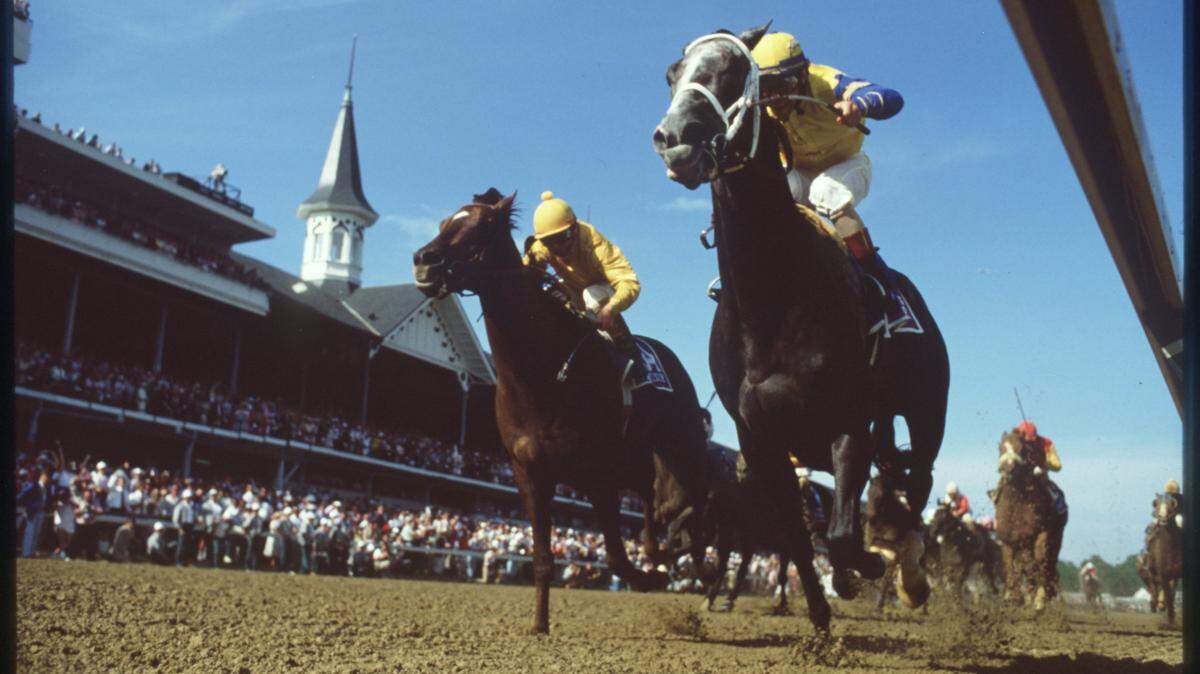
Editor’s note: Thoroughbred horse racing trainer D. Wayne Lukas died Saturday night at age 89. On his way to the Hall of Fame, Lukas trained four Kentucky Derby winners, seven Preakness Stakes winners and four Belmont Stakes champions. The late Billy Reed, himself a Hall of Famer, wrote about Lukas’ first Kentucky Derby victory, with the filly Winning Colors, for the Lexington Herald-Leader on May 8, 1988. Here is that story.
Only a few minutes before post time for the 114th Kentucky Derby, trainer D. Wayne Lukas eased into the track superintendent’s office just off the chute leading out to the Churchill Downs track.
Wearing his trademark tinted glasses and a dark blue suit, Lukas had just sent out the gray filly Winning Colors to test the colts in the world’s most famous horse race, the Kentucky Derby.
“She went out there perfectly dry,” Lukas said. “She danced all the way over, with the crowd raising hell and all, but she never turned a hair and went out there perfectly.”
He paced back and forth, sometimes stopping to glance at his program. Otherwise, he hid his butterflies well, especially for a man facing what was, arguably, the most important race of his illustrious career.
Surely even little old ladies in Dubuque, Iowa, have heard tell of D. Wayne Lukas, the former basketball coach and quarter horse trainer who exploded into thoroughbred racing nine years ago, and proceeded to corner the market on wins, earnings and Derby futility.
Going into yesterday’s race, he had run 12 horses in the last seven Derbies, never finishing better than third. No trainer in history had run more horses without smelling the roses.
He had tried everything — big horses and little ones, bays and grays, front-runners and late-kickers, colts and fillies, horses running alone and in entries.
Nothing had worked — but also, nothing had shaken his enormous confidence in himself, his system and his stable. Every year, on the day after the Derby, Lukas makes motel reservations for next year as he checks out.
His relentless pursuit of the roses, coupled with his enormous confidence and enormous success, has earned Lukas his share of critics and enemies, some of whom even contended that he would never win a Derby because he was too hard on his horses.
But those individuals didn’t happen to be at his barn on the morning after the 1983 Derby — a morning on which Lukas’ mood was a perfect match for the gloomy, cold, drizzly weather.
Once again he had come up short, this time with a three-horse entry (Marfa, Balboa Native and Total Departure) that had been the Derby favorite. As he worked around the barn, Lukas couldn’t help but second-guess himself.
He broke his train of thought when a writer friend introduced him to a little girl, maybe 11 years old, who was in love with horses, particularly a special filly named Landaluce.
Trained by Lukas, Landaluce was unbeaten in 1982 when she suddenly became ill and died, despite the efforts of the best veterinarians Lukas could find. When she took her last breath, her head was in Lukas’ arms.
So on that cold gray morning after the 1983 Derby, this slip of a girl met Lukas and didn’t mention what had happened the previous day. All she said was, “I loved Landaluce.”
At that, D. Wayne Lukas began to weep. He gently took the girl in his arms and hugged her, rocking slowly. This was the scene for a minute or so — a very long, very private, very touching minute.
Right then, the loquacious Lukas was more eloquent than he has ever been in any of his interviews. As he let out all the pent-up love and frustration and hurt, he spoke volumes about why he’s in the horse game.
“I knew then that I’d be all right,” Lukas would recall last week. “I knew then that the little girl’s love for a horse is what this game is all about — and what makes the hurt worthwhile.”
Now here he was five years later, standing in this little office outside the chute at Churchill Downs and fidgeting about another filly.
As he waited, Lukas kept his thoughts to himself. Just before the start, he exchanged a few comments with John Campo Jr., who was helping his father train Intensive Command.
“I got the only gray in the race,” Lukas said. “We’ll find her.”
“I know where I’ll be,” said the young Campo.
The start of the Kentucky Derby was only moments away, and now Lukas was left to review his feelings, his plans and his decisions.
Going into the year, as usual, the Lukas barn was brimming with Derby contenders. He had won last year’s $1 million Breeders’ Cup Juvenile with Success Express. He also had Tejano, Cougarized, Tsarbaby, Notebook and Dynaformer.
But as the year wore on and the prep races unfolded, Lukas gradually eliminated one colt after another as he began thinking more and more seriously about running Winning Colors in the Kentucky Derby instead of the Kentucky Oaks.
When Eugene V. Klein’s daughter of the imported stallion Caro went wire to wire while scoring a powerful 7 1/2-length victory over colts in the April 9 Santa Anita Derby, she earned her trip to Kentucky.
“I know I’ll probably be criticized for running a filly against colts,” said Lukas afterward, “but all the women in America will be screaming at me if I don’t. And I think they would be right. This was the most impressive Derby prep race of any horse I’ve ever had.”
So Lukas, typically, did what he felt was right, even though he well knew that only two fillies in 113 years — Regret in 1915 and Genuine Risk in 1980 — had been strong enough to beat the colts over a mile and a quarter on the first Saturday in May.
Even more audacious, he eventually decided to skip the Derby with all his colts — and never mind that Tejano had won more than $1 million, Notebook had run tough against the respected Forty Niner in Florida, and Dynaformer had thrown in a big win in New York.
The skeptics couldn’t help but wonder if Lukas was making the same mistake he made in 1984, when he became the first trainer to run two fillies in the same Derby. Sent off as the favorites in the 19-horse field, Life’s Magic finished eighth and Althea last.
But Lukas felt that Winning Colors was different. Bigger, stronger and tougher than his ‘84 fillies, Winning Colors figured to benefit enormously from the fact that fillies have to carry only 121 pounds in the Derby, 5 fewer than the colts.
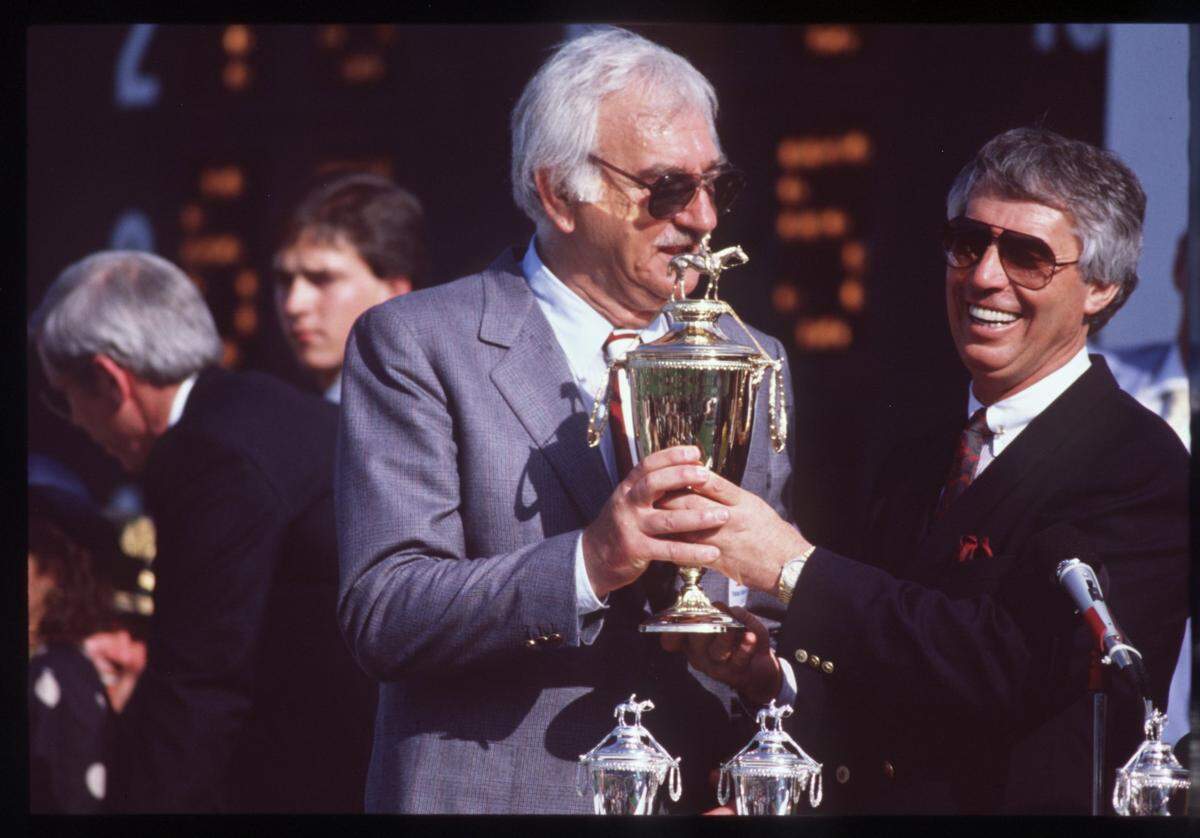
Now, finally, it was post time for the Derby, and Lukas moved closer to the television as the field sprang out of the starting gate late on what had been a hot, sunny afternoon.
As expected, Winning Colors went straight to the lead from her No. 11 post position. But instead of pressuring her into the first turn, the other riders were content to let her go while gaining position somewhere back in the pack.
Sweeping out of the turn and heading down the backstretch, the filly looked relaxed on the lead, just as she had in the Santa Anita Derby.
“Stretch your legs, baby,” Lukas said, letting his breath out slowly.
As the field left the backstretch and moved into the final turn, Lukas was so riveted to the TV that he began talking to jockey Gary Stevens.
Before the race, Lukas and Stevens had analyzed the day’s races and noted that horses opening big leads at the top of the stretch were holding on to win. That, they decided, would be their strategy.
So as the TV showed Winning Colors sweeping into the turn, Lukas said, “Go ahead, Gary. . . . Go ahead. . . . C’mon, Gary, c’mon.”
As the field turned for home, the filly had opened almost a 4-length lead on the charging Proper Reality, who was barely ahead of Forty Niner and jockey Pat Day.
Only an eighth of a mile from the finish, Lukas yelled, “Switch leads, baby,” meaning that it was time for Winning Colors to shift her lead leg, which usually helps horses shift into a higher gear.
As she galloped toward the wire, Forty Niner began to close ground. In the final strides, with the Claiborne colt getting ever closer, Lukas said, “Stay with it, Gary. . . . Stay with it, stay with it, stay with it.”
When Winning Colors hit the finish line in front, a jubilant Lukas spun, slapped a friend on the back and shouted, “My turn . . . my turn!” as he headed out the door and into the chute, where he ran into the arms of some of his grooms.
“Boss, boss, we won it!” screamed a groom, grabbing Lukas in a bear hug.
“Where’s Sherri?” asked Lukas, looking for his wife.
Here she came, tears streaming. After a hug and a kiss on the cheek for his wife, Lukas then whirled and hugged his son Jeff, also his top assistant and the trainer who worked with Winning Colors on a day-to-day basis.
Then he dashed out on the track, where he paused to give a couple of comments to reporters before heading on up the track to greet Stevens and the filly upon their triumphant return.
When the winning team finally drew near, Lukas reached across the rump of an intrusive stable pony to grab Stevens’ outstretched hand.
“What a pretty race,” he said, grinning broadly as the entire group began drifting toward the infield presentation stand.
And so did D. Wayne Lukas join the list of Kentucky Derby winners. Watching him smile, a fellow couldn’t help but remember a cold morning long ago when the trainer embraced a little girl and wept for dreams lost, hopes faded and chances gone.
But as Lukas today would be the first to tell you, that sort of heartache only makes it that much sweeter when it’s finally your turn to smell the roses in Kentucky on the first Saturday in May.