The time Michael Jordan was, legally, a wanted man in Lexington
It is not every day that a policeman pulls over one of the most famous people in the world.
That explains why, even now, Tommy Puckett can give you a moment-by-moment account of the wee hours of June 6, 1989.
Puckett, then a 37-year-old Lexington police officer, was working the overnight shift. Things were quiet in the city, so Puckett headed out to I-75 to run radar on passing cars.
He was perched at the 99-mile marker about two miles from the Clays Ferry Bridge when what had been an uneventful night was pierced by a red sports car screaming toward Puckett.
“After you’ve watched enough cars, you can kind of guesstimate the speeds,” Puckett said. “I was always pretty good up to about 80, 85 miles per hour. After that, I just called them ‘FFF’ — that’s flat, freakin’ flying. This one was definitely ‘FFF.’”
The car registered 94 mph on Puckett’s radar — 29 mph faster than the posted speed limit of 65.
Pulling out in pursuit, Puckett said he had to gun his police cruiser to around 120 mph just catch up. Even so, he was well into Madison County before he was able to pull over the sports car.
What had seemed a red blur when it initially raced past Puckett was a 1988 Ferrari Testarossa.
The vanity plate on its back read M-AIR-J.
Puckett had just pulled over Michael Jordan.
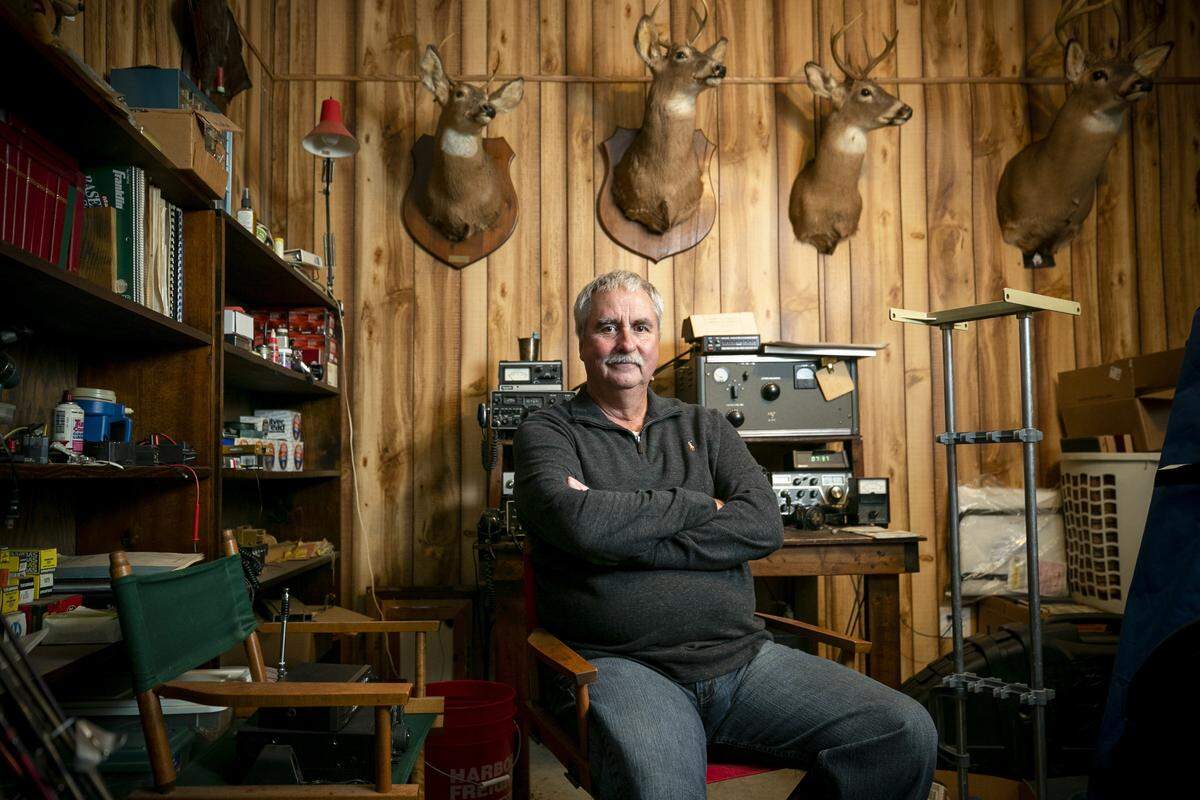
‘An absolute, perfect gentleman’
Over the past weeks, as the coronavirus pandemic and the efforts to contain it have shut down live sporting events in the U.S., the first six volumes of ESPN’s 10-part documentary “The Last Dance” about former Chicago Bulls star Jordan have consumed Sunday nights for sports fans.
Here in Lexington, Puckett, now 68 and retired, has his own Jordan story to tell.
Only days after the Bulls had been eliminated in the 1989 NBA Eastern Conference Finals by the Detroit Pistons, Jordan passed by Lexington while traveling from his home in Highland Park, Ill., to his native North Carolina.
That’s how the basketball star and the Lexington policeman both came to be stopped on the shoulder of south-bound I-75. Puckett approached Jordan’s car. The Bulls star, who would have then been 26, lowered his window.
“He was wearing a T-shirt and athletic shorts,” Puckett recalled. “I asked him for his driver’s license. He reaches in his pocket and there are all kinds of bills, fifties and hundreds, flying all around. But he was just trying to find his license. Well, he couldn’t find it.”
Through his radio dispatcher, Puckett said he tried “everything in the world” to verify that Jordan had an active driver’s license.
When that effort failed, Puckett wrote the NBA star two citations.
One was for speeding — he listed Jordan’s speed as 90 mph instead of 94 “so he wouldn’t lose his license,” Puckett said — and one for driving without an operator’s license.
Across a 35-year career in law enforcement, Puckett said he had a firm rule for traffic stops: If he gave someone a citation, they didn’t get a lecture; if he gave someone a lecture, they didn’t get a citation.
Jordan got both.
“I got him out of the car, and I will tell you, he was an absolute, perfect gentleman. Very polite, very, very nice,” Puckett said. “We got behind the car, and I just told him ‘You’ve put me in a bad spot. (Because of your fame), some people will think I should just let you go. Some people will think I should take you to jail.’
“But, I just explained to him, ‘Look, I am treating you just like I do everybody else.’ Then I explained how to handle the citations, and I let him go.”
A bench warrant for MJ
At the end of his shift, Puckett said he informed his sergeant that he had given the Michael Jordan a speeding ticket.
Other than that, Puckett said the only people he told were his wife, Karen, his mom, Joyce, and his best friend on the police force, Roger Black.
None of the latter three were sports fans. “All three asked the same question: ‘Who is Michael Jordan?’” Puckett said.
Almost no one would have likely ever known about MJ’s speeding ticket in Kentucky — had Jordan paid it on time.
He didn’t.
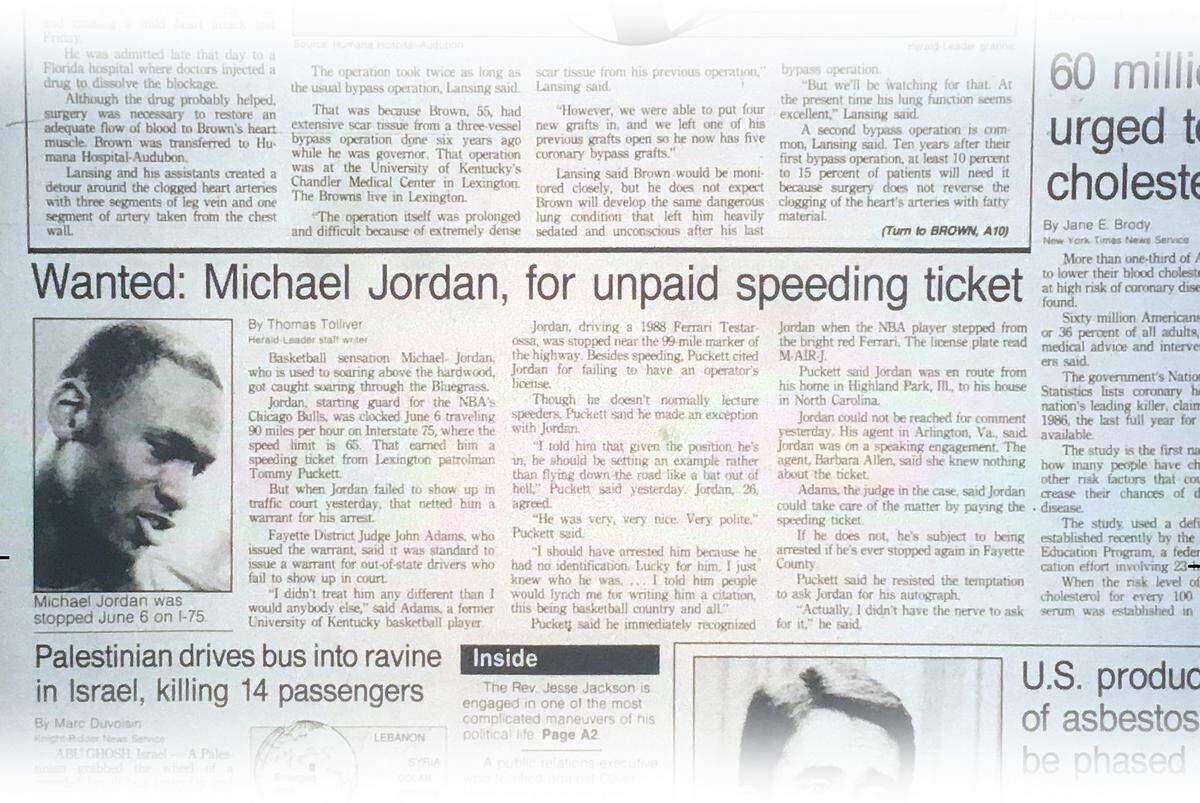
So on Thursday, July 6, 1989, then-Fayette District Judge John Adams issued a warrant from the bench for Jordan’s arrest.
“That was just a typical thing — if somebody was cited to court by an officer and they didn’t appear, then we would issue a warrant for their arrest,” said Adams, a 1960s-era University of Kentucky basketball player.
Covering the court’s proceedings the day the warrant was issued was then-Herald-Leader reporter Thomas Tolliver.
The headline on Tolliver’s front page story in the following day’s newspaper cut to the chase: “Wanted: Michael Jordan for unpaid speeding ticket.”
‘The phone lights up’
Once word of an arrest warrant for Jordan hit the media, the story went national in a big way.
Puckett said “the freakin’ phone just lights up. I made CNN, ESPN, the Los Angeles Times. I made The New York Times. Some of the headlines were like, ‘Nobody can stop Michael Jordan on the court, but Officer Puckett of the Lexington Police Department can.’”
One surmises that the publicity about the warrant served as impetus for Jordan to get the ticket situation cleaned up.
“What (Jordan) did, he immediately wired money in to pay the fine and asked for a week’s continuance, then sent in a copy of his driver’s license,” Puckett said.
Said Adams: “The fine was paid not long after the warrant was issued. Really, it was pretty vanilla, not much to it.”
If nothing else, “The case of Michael Jordan’s late-night speeding ticket” left Tommy Puckett with a hard to beat brush-with-fame story.
“You know how long ago that’s been?” Puckett said. “Well, I still know every bit of (that night) specifically.”
This story was originally published May 10, 2020 at 9:42 AM.