A Lexington doctor is on front line of NASCAR’s battle against COVID-19
When NASCAR returned to racing May 17 at Darlington Raceway, it ended a layoff of some nine weeks caused by the coronavirus pandemic.
For one Lexington doctor, NASCAR’s decision to resume competition created some sleepless nights.
Ryan Stanton’s “day job” is working as an emergency medicine specialist for Lexington’s Baptist Health.
The 43-year-old has a pretty cool side gig, however, as medical director for the AMR/NASCAR Safety Team. Stanton and his colleagues travel the country to NASCAR races to provide emergency medical care to drivers injured in accidents.
In the cursed year that has been 2020, Stanton and his team have added another vital responsibility.
This week, NASCAR returns to Kentucky Speedway for a five-race card — all without fans in the stands — that will culminate with the Cup Series Quaker State 400 on July 12.
As they have been doing since NASCAR revved back up, Stanton and Co. will be overseeing the screening process designed to ensure that no one with the coronavirus is allowed on-site in Sparta.
NASCAR will not permit a race participant to enter a racetrack until they have filled out a medical questionnaire and proven they are not running a fever.
It has fallen to Stanton and his associates to administer this system.
That’s why, as the days counted down to NASCAR’s return at Darlington, “I didn’t sleep very much the week before,” Stanton says. “The night before, I didn’t sleep at all.”
How NASCAR’s system works
Early in the coming week, every race team that plans to compete at Kentucky Speedway will have to submit a roster containing all the people it plans to bring to Sparta.
The day before team members are to arrive at the track, every name on those rosters will get a text message from NASCAR that contains a health survey.
“’Have you been diagnosed with COVID? Have you been around anybody diagnosed with COVID within the last 14 days?’” Stanton says, listing questions. “Then it goes through all the symptoms, have you had any of the symptoms consistent with COVID?”
The night before a race, Stanton reviews all the submitted survey forms that contain an affirmative reply.
“I call or text them,” he says of those who checked yes to a question. “The goal being that every single one of the charts have been clarified before we get to race day.”
On the day of the race, everyone entering the track gets an assigned time window to arrive for a temperature check administered with a no-touch thermometer.
Those whose health surveys were flagged and/or who have a temperature of 100 degrees or more “will get a secondary screening,” Stanton says. “Then I do an evaluation with an oral thermometer and a traditional examination to try to determine whether or not they can stay (for the race) or whether they need to leave.”
Since the resumption of racing, Stanton says only “a handful” of people have been denied entry to a track.
If someone is sent home for “a concerning symptom,” Stanton says, “they have to be cleared by a physician and have a negative (coronavirus) test to come back (to future races).”
Driver with a fever?
NASCAR’s plan seems designed to shield the stars of the sport from coronavirus risks.
At the tracks, the drivers “are not around their teams, they are only in their motor coach,” Stanton says. “Thirty minutes before the green flag flies, (the drivers) get directly in their cars. Their interaction with their teams is minimal.”
Before NASCAR announced Friday that seven-time Cup Series champion Jimmie Johnson had tested positive for COVID-19, I asked Stanton what would happen if Kyle Busch or Kevin Harvick or Denny Hamlin showed up at a track with a temperature of 103?
“NASCAR has said there is no special treatment. If our medical team determines you are a risk of bringing COVID in, you go home,” Stanton says. “The teams have to have a backup driver lined up.”
Met Dale Earnhardt
Stanton grew up in Johnson City, Tenn. He became a regular attendee at NASCAR races at nearby Bristol Motor Speedway.
Once, in that track’s infield, he spoke with Dale Earnhardt after the Intimidator’s team almost pushed his car over the foot of Stanton’s companion.
Now a married father of two daughters, Stanton started his career in Lexington at the University of Kentucky Hospital. UK had the contract to provide emergency medical services at races at Kentucky Speedway, which got Stanton’s foot in the door in NASCAR.
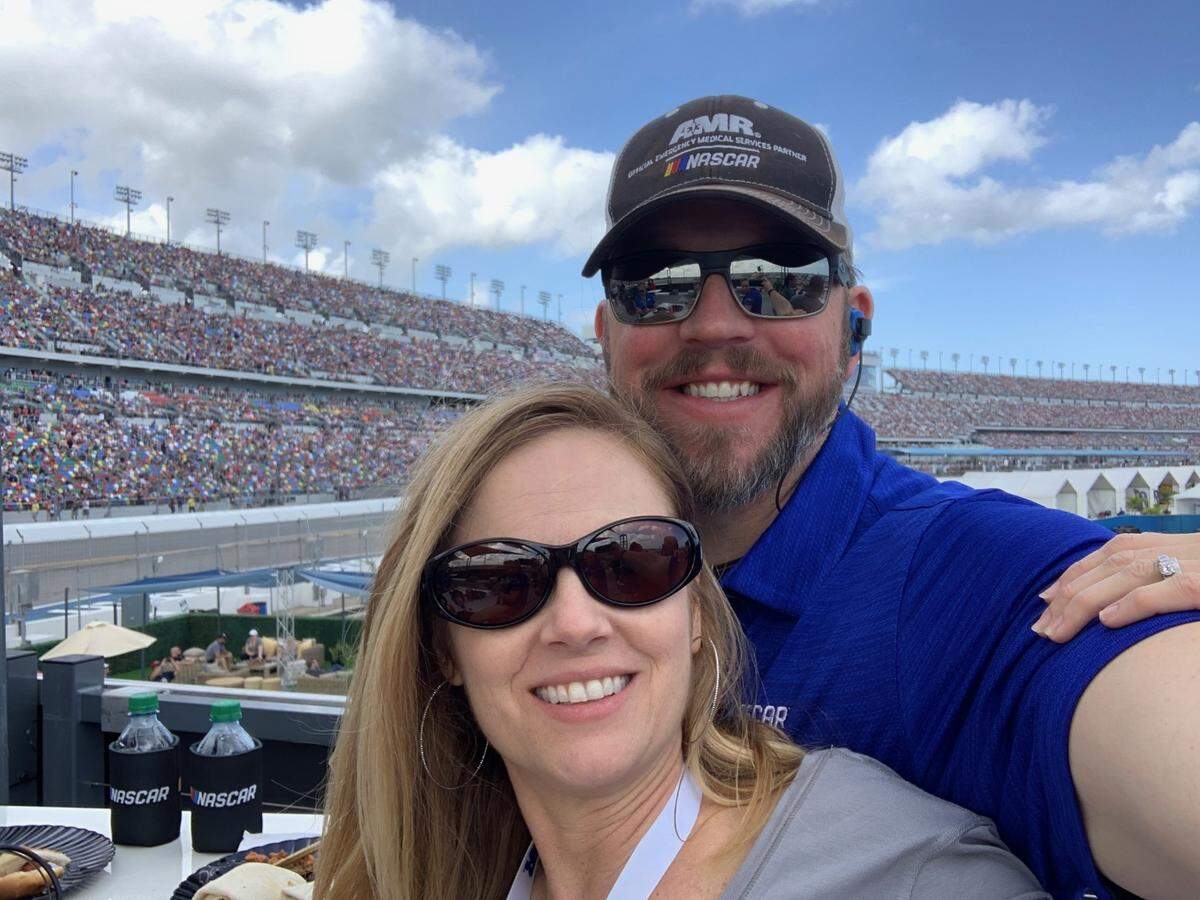
After Stanton left UK, he lost his spot at Kentucky Speedway but, through a friend, got a chance to work on the emergency medical team at Talladega Superspeedway.
When NASCAR entered into an agreement in 2017 with American Medical Response to provide a traveling emergency medical team, Stanton landed a spot.
This is his fourth year on the AMR/NASCAR Safety Team and his first as its director. The coronavirus pandemic has made 2020 a challenging time to assume leadership of the safety team.
That’s why, for Stanton, the most memorable moment of the 2020 NASCAR season so far has not been Ryan Newman’s terrifying wreck in the Daytona 500 nor Chase Elliott’s one-finger salute to Kyle Busch after their dust-up at Darlington.
For Stanton, this season’s high point came exactly two weeks after the May 17 return to racing — when there was no widespread coronavirus spread among the NASCAR community.
“That was our incubation period,” he says, “and when we didn’t have an outbreak, that was pretty exciting.”
The week ahead
At Kentucky Speedway in Sparta
Thursday: NASCAR Xfinity Series Shady Rays 200, 8 p.m.
Friday: NASCAR Xfinity Series Alsco 300, 8 p.m.
Saturday: ARCA Series General Tire 150, 2:30 p.m.
Saturday: NASCAR Truck Series Buckle Up In Your Truck 225, 6 p.m.
Sunday, July 12: NASCAR Cup Series Quaker State 400, 2:30 p.m.
TV: All races on Fox Sports 1