Even in pandemic, the money trail explains why SEC bailed on rivalries with ACC teams
Let’s stipulate that there are no good options for trying to play a college football season during a pandemic.
Nevertheless, the decision by the Southeastern Conference on Thursday to play all league games in 2020 and not maintain intrastate rivalry contests between SEC/ACC foes Florida-Florida State, Georgia-Georgia Tech, Kentucky-Louisville and South Carolina-Clemson was dispiriting.
The move interrupts three of the South’s most visible, continuous rivalries — Clemson and South Carolina have played 111 straight seasons; Georgia Tech and Georgia have played 95 years in a row; FSU and Florida 62 straight years — plus the commonwealth of Kentucky’s signature college football game.
To at least some degree, the culprit appears to be financial expediency.
With college football seasons being shortened because of the coronavirus, Power Five conference schools are en masse canceling scheduled games with teams from less prosperous leagues.
It appears that many of those major conference universities are also looking for ways to get out of paying their jilted foes the contract guarantees and/or penalties owed for game cancellation.
To escape those pacts, the Power Five schools likely either will have to rely on a clause known as “force majeure” — unforeseen forces that prevent the fulfillment of a contract.
Or some SEC universities apparently have stipulations in their game contracts that remove financial penalties for not playing if it is because a league changes its scheduling format.
The Southeastern Conference going to a 10 game, league-only schedule could meet that criteria.
However, the theory goes that if the SEC-ACC rivalry games had been played, it would have made it impossible for Southeastern Conference schools to use the “changes in league scheduling format” concept to get out of financially honoring the contracts with all other 2020 non-league foes.
As best as I can tell, SEC schools are on the hook to pay at least $38.375 million in guarantee money to football opponents in 2020 (that does not include three SEC “buy games” involving private schools for which I have not yet found figures).
At least six SEC schools owe scheduled opponents more than $3 million total in guarantees in 2020 — Auburn ($4.225 million), Tennessee ($3.6 million), Alabama ($3.55 million), Florida ($3.475 million), Mississippi ($3.35 million) and Texas A&M ($3.05 million).
(Arkansas, at $2.9 million in contractual guarantee money not counting an unknown figure owed Charleston Southern, is all but assuredly above the $3 million threshold, too).
From figures available on fbschedules.com, Kentucky owes $2.6 million in “buy-game” money for 2020 — $1.75 million to Kent State; $500,000 to Eastern Illinois; and $350,000 to Eastern Michigan.
However, according to USA Today, Kentucky’s contract with Eastern Michigan says the game can be canceled “without penalty in the event that either party’s member conference changes its scheduling requirements.”
None of this is to discount the medical considerations that went into SEC decision making about the 2020 football season.
By starting late (Sept. 26), the SEC buys time to study pro sports leagues and other college football conferences to gauge if its even possible to safely play during the coronavirus pandemic.
In making the schedule league-only, the SEC gains flexibility in case games have to be postponed and rescheduled due to COVID-19 outbreaks. The league can also ensure uniformity of testing and other medical protocols.
Even so, there also remains a very viable chance there will be no SEC football played in 2020.
If there is, though, there should have been a way to preserve the four season-ending, SEC-ACC intrastate rivalry games.
The ACC, in announcing a 10-and-1 scheduling format the day before the SEC went 10-and-no, left that door open.
By getting out of the gate first, the Atlantic Coast Conference outfoxed the Southeastern Conference and left the SEC to be the bad guy in the disruption of some of the south’s most-storied rivalries.
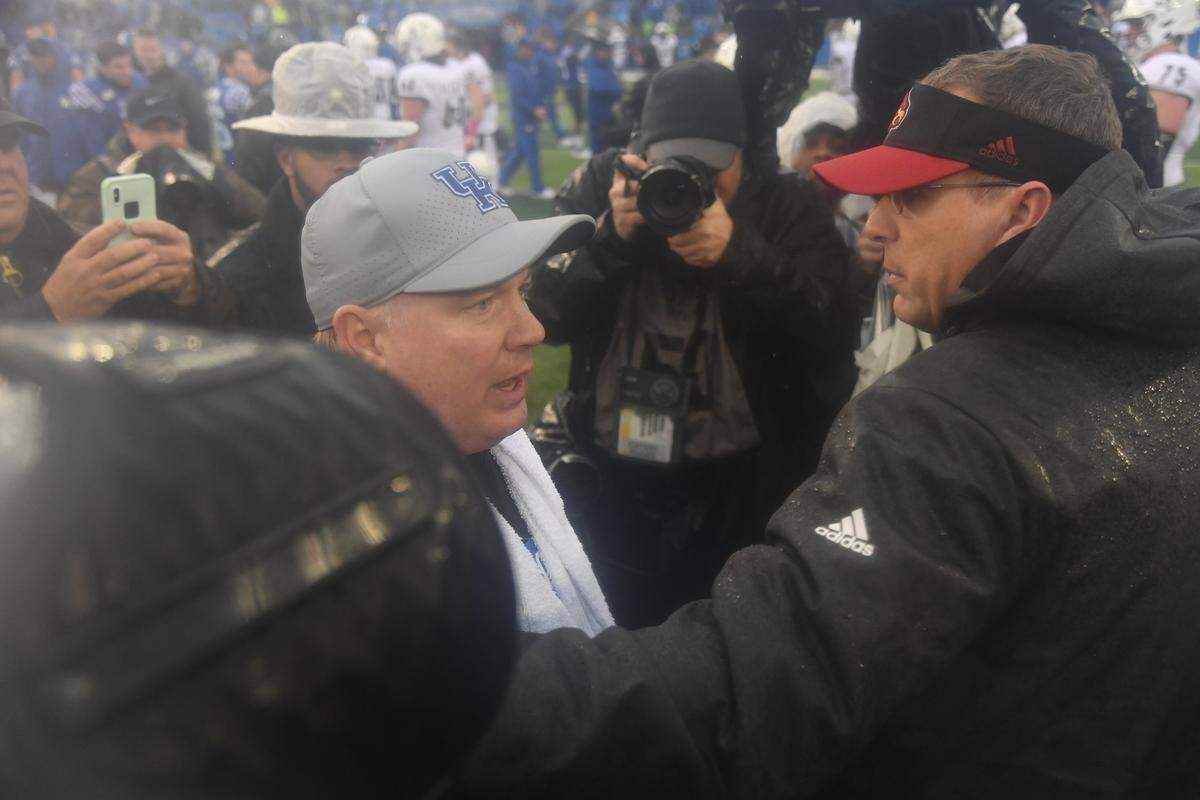
In our state, the formerly annual battle for the Governor’s Cup between Kentucky and Louisville is the commonwealth’s most consequential football series by far.
Louisville has only been in its current league, the ACC, since 2014. U of L has no logical or geographical rival in its new conference.
Kentucky is a charter member of its league, the SEC, but UK has struggled so — the Wildcats have lost 26 of 29 vs. Georgia; 33 of 35 to Tennessee; and 32 of 33 against Florida — against the league teams its fan base most yearns to beat, that it, too, doesn’t presently have a conference rival.
U of L is the one “move the needle game” in which Kentucky has enjoyed a modicum of success (11-15 since 1994, but winners of three of the past four).
In the process that led to the cancellation of the 2020 battle for the Governor’s Cup, I just wish the specter of SEC schools seeking to maintain the ability to break contracts with college football’s less fortunate did not loom so large in the background.