A new college football reality hangs over Kentucky’s rebuilding efforts
With SEC Commissioner Greg Sankey standing not 10 feet away, Georgia coach Kirby Smart decided to use the aftermath of the Bulldogs’ 22-19 overtime victory over Texas on Saturday in the SEC Championship Game to send a message to the league office.
Asked on the ABC broadcast by Laura Rutledge what benefits Georgia, as one of the four highest-seeded league champions, would derive from having a bye in the initial College Football Playoff, Smart said, “It means rest for a team that Greg Sankey and his staff sent on the road all year long.”
As Smart spoke, a cameraman shifted his lens toward Sankey. The stony look on the SEC commissioner’s face communicated more than 10,000 words ever could.
In actuality, Georgia played the conventional four-game SEC road slate in 2024. What Smart was presumably complaining about was the strength of the road opponents the league office assigned the Dawgs — games at nationally ranked foes Alabama, Texas and Mississippi in addition to Kentucky.
Though Georgia lost two of the three SEC road games it played vs. ranked opponents, the Bulldogs still won enough to play in the Southeastern Conference Championship Game for the seventh time in eight years.
Nevertheless, there was a nugget of truth contained within Smart’s whining. In this first season of both “super-conferences” and the College Football Playoff, a new reality related to in-conference scheduling has emerged:
With divisions having gone away in the power four conferences and teams no longer guaranteed to play league schedules of similar magnitude, most programs’ chances of success are reliant to a new degree on the strength of the conference schedule they are assigned to play.
One need only look at how five of the six teams that earned at-large bids out of power conferences to the 2024 CFP got there to see how much impact the variances in league schedules now carry.
From the SEC, Texas (11-2, 7-1 SEC) and Tennessee (10-2, 6-2 SEC) earned at-large bids to the playoff.
In this first Southeastern Conference season since 1991 without divisions, nine SEC teams had league records of 5-3 or better. Conversely, seven teams did not have winning league marks. Texas played six of the seven teams that did not produce winning conference records.
Georgia (11-2, 6-2) and Texas A&M (8-4, 5-3 SEC) were the only league teams the Longhorns faced in the regular season that had winning conference records.
It was similar for Tennessee. Of the eight league games the Volunteers played, two of them — vs. Alabama (9-3, 5-3 SEC) and Georgia — were against foes that posted winning conference records. UT’s other six SEC foes produced a combined league record of 13-35.
This “easier path” phenomenon is not exclusive to the SEC.
In its Cinderella season for the ages, Indiana (11-1, 8-1 Big Ten) played seven of its nine league games vs. foes that would go on to produce losing conference records.
The Penn State (11-2, 8-1 Big Ten) route to the playoff was not unlike IU’s. Of the Nittany Lions’ nine Big Ten opponents, six would post losing league marks.
Meanwhile, of the eight league games ACC newcomer SMU (11-2, 8-0 ACC) played, only two — road games at Louisville (8-4, 5-3 ACC) and Duke (9-3, 5-3 ACC) — were against teams that posted winning league marks.
Among the six at-large teams invited from conferences to the CFP, only Ohio State (10-2, 7-2) made the playoff by surmounting what one would deem a challenging league schedule.
Of the Buckeyes’ nine conference games, five were against teams that posted winning records in the Big Ten. Ohio State played all three of the other Big Ten teams — league champion Oregon (13-0, 9-0 Big Ten), Indiana and Penn State — that made the playoff.
The four remaining power conferences have expanded themselves to gargantuan sizes — 18 teams in the Big Ten, 17 in the ACC, 16 each in the Big 12 and SEC.
In these massive leagues, the teams that have to play many of the conference’s other strong teams get “beaten up.” The prime road to a playoff-worthy season, therefore, runs through your league schedule not being filled with a preponderance of your conference’s top teams.
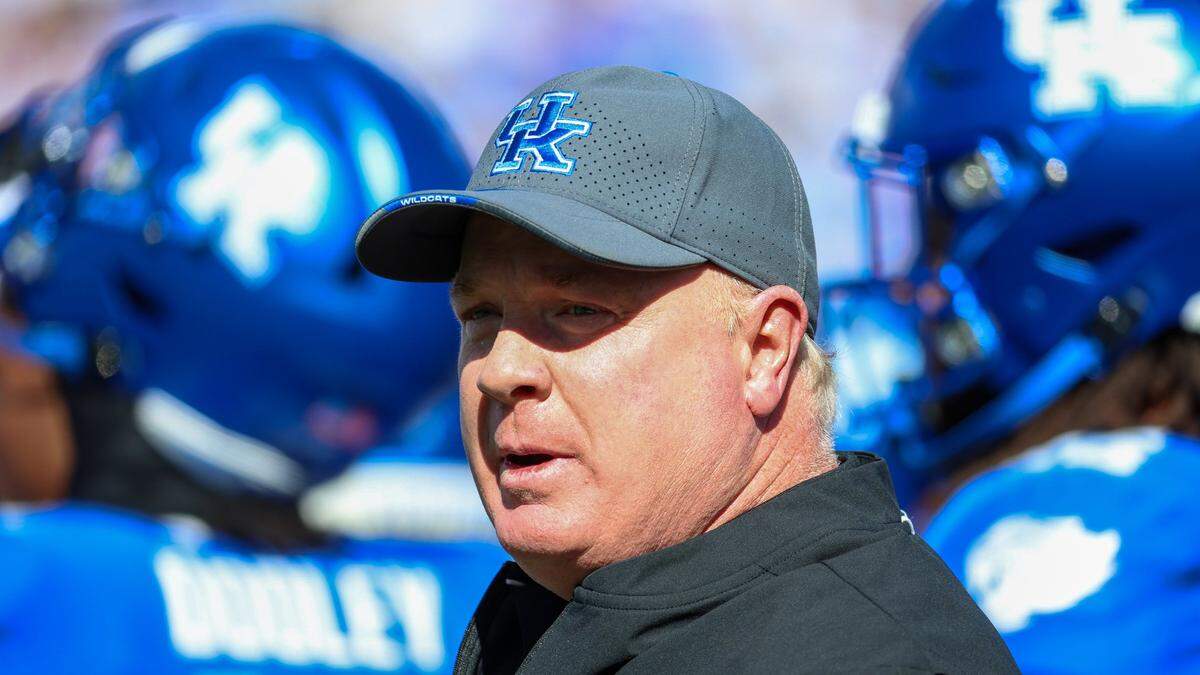
This new reality has implications for Mark Stoops as he attempts to get Kentucky football back to a winning season in 2025 after the Wildcats suffered through a 4-8, 1-7 SEC, slog in 2024.
The UK schedule in the first year of the 16-team SEC proved daunting. Of Kentucky’s eight SEC games, five came against teams that went on to both have winning league records and to win nine games or more overall.
UK played against all three SEC teams, Georgia, Tennessee and Texas, that made the College Football Playoff (a distinction the Wildcats shared with Florida and Mississippi State).
With the SEC having already announced plans to run the 2024 schedule back in 2025, albeit with the game locations reversed, the Cats will face the same bruising league slate in the coming season.
As Stoops undertakes the task of reinvigorating a UK program that went badly stale in 2024, the “easier path” phenomenon that helped five teams earn playoff bids in 2024 will almost assuredly not be available to the Wildcats in what will be a critical year for Kentucky football.