Nico Iamaleava’s exit at UT revealed nothing distressing about college sports
Contrary to the hyperventilating that has accompanied Tennessee’s parting of ways with starting quarterback Nico Iamaleava in what was apparently a contract dispute, the situation tells us nothing distressing about the state of big-time college sports.
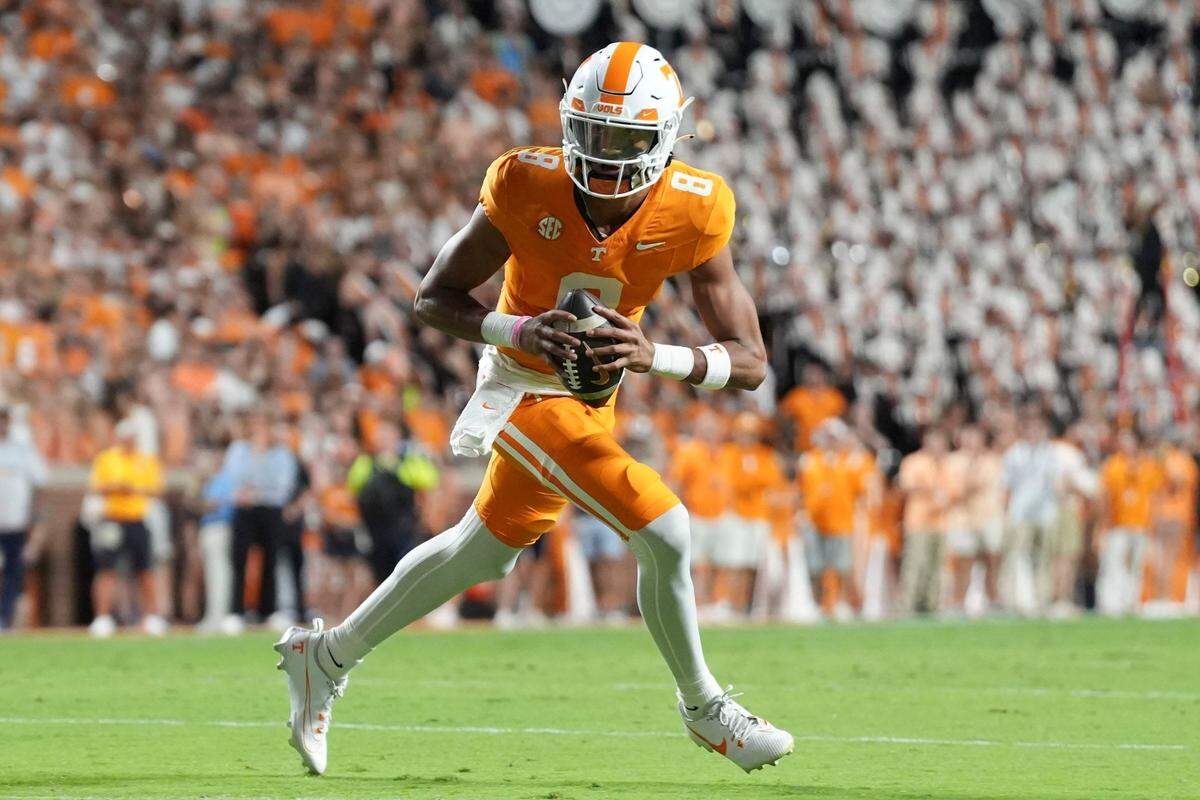
If media reports are accurate, Iamaleava — or, perhaps, more accurately, his representation — wanted his existing name, image and likeness contract with Tennessee football’s collective, Spyre Sports, increased over the reported $2 million a year he was scheduled to make for 2025.
When Iamaleava no-showed Friday’s team activities in what was perceived as a contract holdout, Tennessee coach Josh Heupel cut ties with the starting QB who led UT to last season’s College Football Playoff.
“There’s no one that’s bigger than the Power T and that includes me,” Heupel said.
For what it’s worth, I think Tennessee took the right action. Iamaleava’s level of play in 2024 — 2,616 passing yards, 19 touchdown throws vs. five interceptions — did not merit a significant boost in pay.
Of course, player holdouts for better contract terms are common in professional sports. For that matter, an employee and an employer parting ways after disagreeing over the former’s worth to the overall company is not unusual in “real life.”
Alas, in the context of big-time college sports, some continue to have a hard time accepting the enterprise for what it actually is — a big-money, professionalized endeavor.
Let’s be clear: Iamaleava holding out for more cash, players signing seven-figure NIL deals, and some college standouts earning more per season than end-of-the-bench pro players make is not what turned college athletics into pro sports.
This is what professionalized college sports:
▪ CBS and Turner Sports are contracted to pay the National Collegiate Athletic Association $8.8 billion, some $900 million a year, for the rights to telecast the men’s NCAA basketball tournament through 2032.
▪ ESPN is contracted to pay $7.8 billion, some $1.3 billion a year, for the rights to telecast the College Football Playoff through 2031-32.
▪ On July 1, 2023, the Big Ten Conference entered into a $7 billion media rights contract with Fox, CBS and NBC.
▪ For the 2023-24 school year alone, the Southeastern Conference’s total revenue was $839.7 million.
▪ Entering the 2025 season, there are nine college football head coaches — led by Georgia’s Kirby Smart with a salary of $13.2 million — slated to make $10 million a year or more.
▪ Led by Bill Self of Kansas at $8.803 million a year, there were 12 men’s college basketball head men at public schools (whose salary information is available) in 2024-2025 who made at least $5 million for coaching last season.
That the actual entertainers — the players — in a multi-billion-dollar entertainment industry are finally able to reap some of the bounty yielded by their labor is late-arriving economic fairness.
Of course, with the college players now having the same ability to break contracts, flee to the highest bidder and to switch schools with impunity that coaches have long deployed, the college sports hierarchy is desperate to wrest back the control it has lost.
It is hard to understand why more college athletes, their families and the athletes’ agents are not speaking out against the House Settlement. The proposed $2.8 billion agreement would settle three antitrust suits brought by former athletes against the NCAA for allegedly restricting their earnings.
If approved by U.S. District Judge Claudia Wilken, the plan would also:
▪ Allow a capped amount of revenue sharing to be paid directly from schools to their athletes going forward;
▪ Create a new NIL clearinghouse that will attempt to regulate and/or reject big-money deals paid to athletes by booster collectives.
The first proposal is a backdoor attempt to create a salary cap without collectively bargaining that restraint on pay with the college players. Proposal two is a straight-out infringement on the economic freedom of college players (and the boosters who want to pay them).
Answer me this: Who does it actually hurt if a local auto dealer is paying the star quarterback at Big State University $1 million a year?
The rationales for restricting college athletes’ ability to earn are usually put forward on “level playing-field” grounds.
Yet, it’s funny. Amid the constant lamentations about the threat to the level of competitive balance in college sports of “the rich getting richer,” this has been the reality so far in the NIL era:
Over the past three men’s basketball NCAA Tournaments, San Diego State, Florida Atlantic, Miami (Florida) (all in 2023) and Alabama (2024) have all made their first Final Four trips.
North Carolina State (2024) went to a Final Four for the first time in 41 years. Purdue (2024) went to a Final Four for the first time in 44 years. Auburn (2025) made a Final Four for the second time in the university’s history.
Meanwhile, among the 12 participants in the newly expanded College Football Playoff in 2024 were Arizona State, Boise State, Indiana and SMU — not exactly a who’s who of traditional pigskin titans.
In his apparent contract holdout, Nico Iamaleava overplayed his hand and paid a price. Economic freedom includes the right to make mistakes.
As a class, college athletes deserve to enjoy the same commercial rights that almost all other Americans exercise in their own careers on a daily basis — and nothing less.