Is the one thing that should worry UK men’s basketball fans already apparent?
AI-generated summary reviewed by our newsroom.
- Kentucky has shot 26.7% on 3-pointers through two exhibitions and a game, raising concern.
- Roster brought fewer proven scorers than 2024-25, leaving offensive questions.
- Sample size remains tiny: three games cannot confirm Kentucky’s shooting trend.
As Kentucky basketball sample sizes go, one regular-season game and two exhibition contests is miniscule. With so little information to evaluate, it would be silly to form any lasting opinions on Mark Pope’s 2025-26 Wildcats.
But ...
If you entered this incipient UK men’s hoops campaign with concerns about the outside shooting capacity of the 2025-26 Cats, you haven’t seen anything in the three contests that Kentucky has so far played against outside opposition to allay your worries.
After going 0 of 13 on 3-point tries in the second half of its 84-70 exhibition loss to the Georgetown Hoyas last Thursday night, UK opened its real season Tuesday night by going 2 of 16 on treys in the first half of what became a 77-51 victory over overmatched Nicholls.
“I just think our shot selection was a little bit off,” Kentucky guard Denzel Aberdeen said afterward in explaining the Cats’ errant first half outside shooting vs. the visiting Colonels.
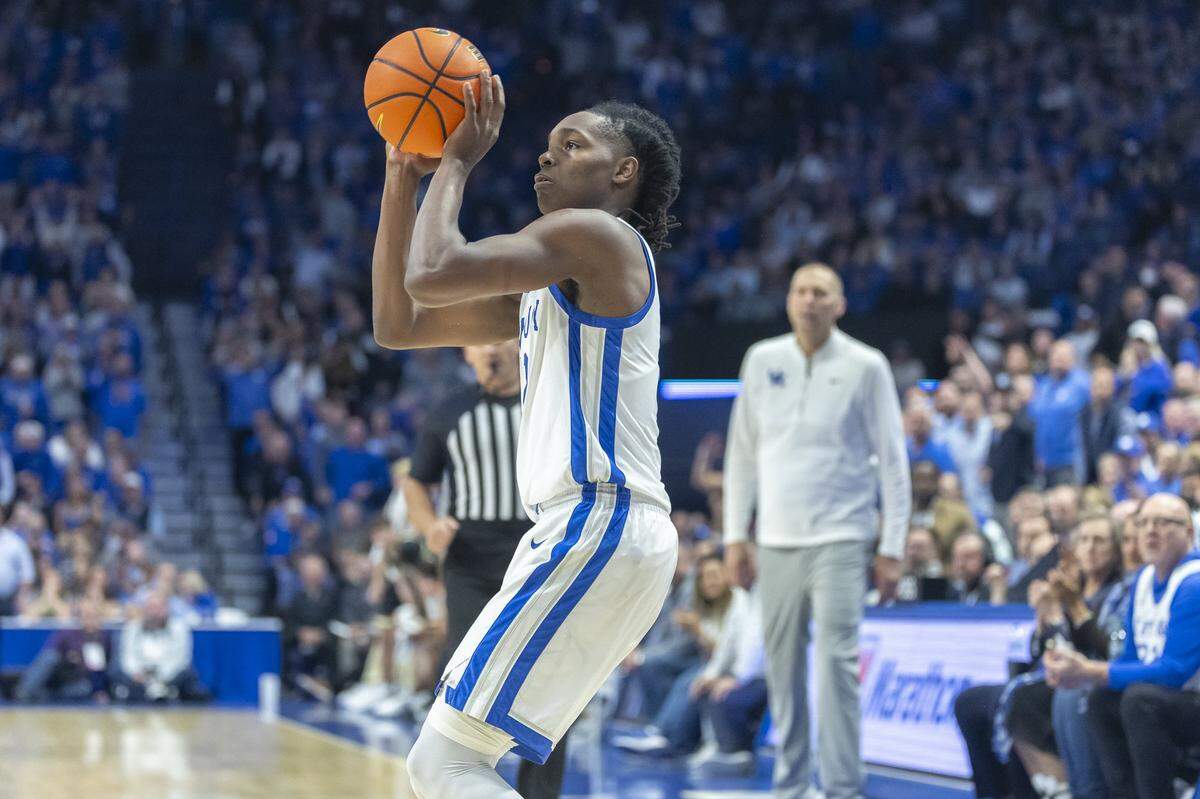
In the three contests — which also included the 78-65 exhibition win over No. 1 Purdue on Oct. 24 — in which we’ve gotten to watch the No. 9 Cats to date, Kentucky has shot an ice-cold 26.7% on 3-point attempts, 23 of 86.
On the plus side, history says a Pope-designed offense generally thrives.
In the five seasons (2019-2024) Pope coached BYU, the Cougars ranked in the top 50 in adjusted offensive efficiency in the Pomeroy Ratings four times, finished in the top 25 three times and inside the top 15 twice.
Last winter, in Pope’s first season as head man at his college alma mater, UK finished 10th in adjusted offensive efficiency. The Wildcats were seventh in the nation in scoring (84.4 points a game), 20th in assists (16.9 a contest) and 21st in fast-break points (14.03 a game).
Of particular note here, the 2024-25 Cats shot 37.5% from behind the 3-point arc.
Alas, it is a fact that Kentucky in its 2025-26 roster construction brought far less proven offensive production into this season than there was on Pope’s first UK team in 2024-25.
Of the nine players Pope signed out of the transfer portal prior to the 2024-25 season, seven had averaged in double figures in scoring for their college teams during the previous year.
Conversely, the 2025-26 Wildcats boast only two players who were double-figure scorers in college basketball last season — incumbent UK star Otega Oweh (16.2 ppg in 2024-25) and transfer point guard Jaland Lowe (16.8 for Pittsburgh last season).
Among current Cats who have taken at least five 3-pointers through the three games in which we’ve seen Kentucky play, only two — Oweh (37.5%, 3 of 8) and Collin Chandler (35.7%, 5 of 14) — are shooting better than 33 percent on trey tries.
Otherwise, Kentucky’s 3-point shooting percentages are arctic — Kam Willaims is at 15.9% (2 of 13), Aberdeen 20% (2 of 10), Jasper Johnson 29.4% (5 of 17) and Trent Noah 30% (3 of 10).
Due to the shoulder injury he suffered in Kentucky’s Blue-White scrimmage, Lowe, UK’s expected floor general, has yet to play.
Once the point guard returns (as soon as Friday night against Valparaiso?), his presence could lead to higher shooting percentages for his teammates by creating both better shots and more open spacing.
“Having Jaland back, the offense is going to be more comfortable,” Kentucky forward Mouhamed Dioubate said. “We’ve been practicing with Jaland all summer long; he was most of our offense. Once he comes back, I think we’re gonna get more, better looks, more open shots, and it’s gonna be more spatial in the court.”
One intriguing variable in evaluating the prospect that Kentucky will ultimately start making 3-point shots at an acceptably efficient rate this season is how much players tend to improve their offensive production merely by being plugged into Pope’s modern, five-out offensive system.
Of the eight transfers who formed the core of Kentucky’s 2024-25 team, only three — Oweh (plus 4.8 points a game), Lamont Butler (plus 2.1) and Koby Brea (plus 0.5) — raised their scoring averages at UK over what they had posted the prior year at their previous schools.
However, seven of the eight averaged more assists a game than they had the prior season; five raised their overall field-goal percentage; and four raised their 3-point field-goal percentage.
(I did not include Kerr Kriisa’s numbers in these tabulations due to the small sample size available since he played only nine games last season for Kentucky due to injury).
Bottom line is that it is vastly too early in the season to be worried about what has so far been Kentucky’s penchant for inaccurate 3-point shooting.
However, if you are among that faction of Kentucky basketball fandom which must have something to fret over, directing some small level of concern about the 2025-26 Wildcats’ capacity for regularly hitting outside shots does not seem premature.