The contradiction that has defined Mitch Barnhart’s UK tenure
AI-generated summary reviewed by our newsroom.
- Barnhart oversaw six NCAA titles; 21 UK athletes went on to Olympic medals (14 gold).
- Fans reacted with widespread anger over his $950,000 role and vague duties.
- University said the Sport and Workforce Initiative is part of a larger workforce effort.
There is much about Mitch Barnhart’s tenure as University of Kentucky athletic director that is objectively impressive.
Start with the combined 21 Olympic medals, 14 of them gold, won by athletes who had competed for UK in the past two Summer Olympiads in Tokyo and Paris.
Take the seven NCAA Division I ADs — three of them working in the SEC two in the Big Ten — who cut their teeth under Barnhart at Kentucky.
Since Barnhart was hired by UK in 2002, Cats teams have won six NCAA championships, four in rifle and one each in men’s basketball and women’s volleyball, and have finished as the national runner-up in women’s outdoor track and field, women’s volleyball, men’s basketball, men’s tennis and four times in rifle.
It is indisputable to say that, under Barnhart, Kentucky has been better at more different sports than it has ever previously been.
Yet if you go on Kentucky sports-oriented message boards, the level of happiness expressed at Barnhart’s impending departure is widespread.
Therein lies the contradiction of Barnhart’s long tenure as UK AD: What have been many laudatory achievements have not always seemed to be accompanied by reciprocal public appreciation.
On Friday, I attended a valedictory event for Barnhart in front of UK athletics staff at Memorial Coliseum. The UK AD reflected on his decision, announced Tuesday, to step down effective June 30 after 24 years as Kentucky athletic director. At the end of the program, Barnhart answered questions from reporters.
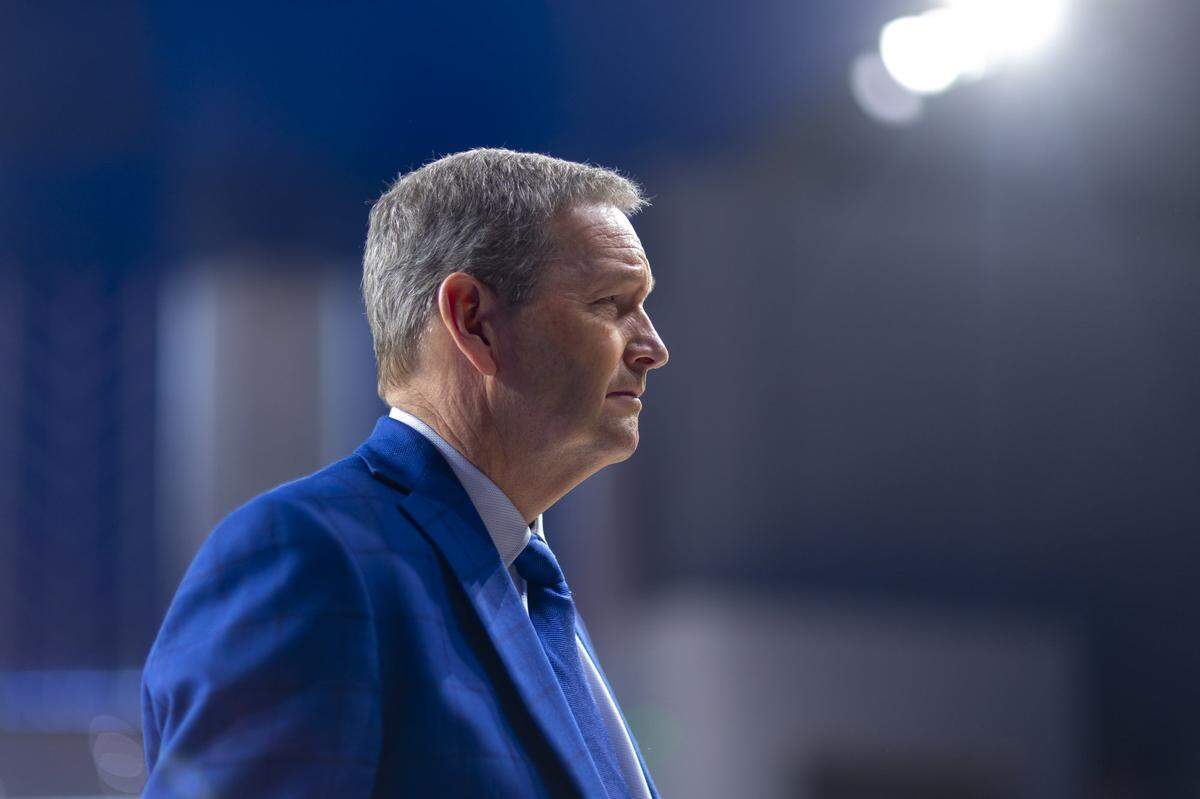
It was a warm event, with Barnhart’s family on hand and the outgoing UK AD reminiscing about successes and challenges in his time leading Kentucky athletics. His voice cracked when thanking his wife, Connie, for her support as well as when he mentioned the role his mentor, former Tennessee AD Doug Dickey, had played in the beginning of his career.
When he accepted the Kentucky AD job, Barnhart said, his plan was to only stay in Lexington for “a while.”
“In my mind, we were going to jump to the next gig, be here six, eight, 10, years, then move on to something else,” Barnhart said. “Well, we came for a while, and we stayed for a lifetime, because we love this place.”
On display at the event was a table containing the six NCAA championships trophies Kentucky teams had claimed under Barnhart. When I tweeted out a picture of that table, the replies on X can best be described as vituperative.
When I got home from the event, I had an email from a Kentucky alumnus with deep family ties to UK sports that contained a letter he had addressed to the University of Kentucky Board of Trustees pleading that the university “look outside Mr. Barnhart’s circle” in choosing the next AD.
After Friday’s program, I asked former UK President Lee T. Todd Jr., who hired Barnhart away from Oregon State in 2002, what he thinks explains Barnhart’s standing with the Big Blue Nation.
“I don’t know what their priorities are, but maybe they’re not the right priorities that I would view,” Todd said. “My goal when (Barnhart and I) talked first time (about coming to UK) was to have a clean program that was competitive across all sports, and we had that.”
Much of the venom presently directed at Barnhart is tied to UK’s announcement that he will transition from athletic director into a new role as executive-in-residence of a newly-formed UK Sport and Workforce Initiative with a salary of $950,000.
In our populist age, the news that Barnhart would receive such robust pay for a role of still-undefined duties unleashed the furies.
On Friday, UK publicists were insistent this is not a boondoggle (my word, not theirs) to benefit Barnhart, that the new Sport and Workforce Initiative will be part of a larger University of Kentucky effort to find ways to prepare its graduates to find jobs in an economy that is being rapidly transformed by new technologies.
Barnhart noted that his contract had given him the right to step down as AD and transition into an “ambassador” role at UK. He said in discussions about his future with Kentucky president Eli Capilouto, they agreed that the ambassador role was too undefined.
“(Capilouto) came back to me, and said, ‘We were working through these workforce initiatives in different parts of the campus. Would you be interested in having a sports initiative in that on that pathway?’” Barnhart said. “... And then I think what (Capilouto) did was, he put pen to paper as to what we’re trying to do and be a part of the workforce initiative to create jobs and to get young people on a path.”
Barnhart took spirited exception to the idea he will be paid handsomely for not working.
“All I’ve ever done in my life is work,” he said. “So this notion that this ‘golden parachute’ is falling from the ceiling and I’m going to sit in a rocking chair and eat hay is ridiculous garbage. That notion, (which) was started by two or three knuckleheads, needs to end. I’m excited about working. I’m not done.”
Suffice to say, the contradiction between how Mitch Barnhart is valued by UK compared to how he is valued by many UK fans is persisting to the end.