Born in the 19th Century, the KY Derby has become a 21st Century TV phenomenon
An event that traces its roots to 1875, the Kentucky Derby is as much a 2026 phenomenon as Ella Langley.
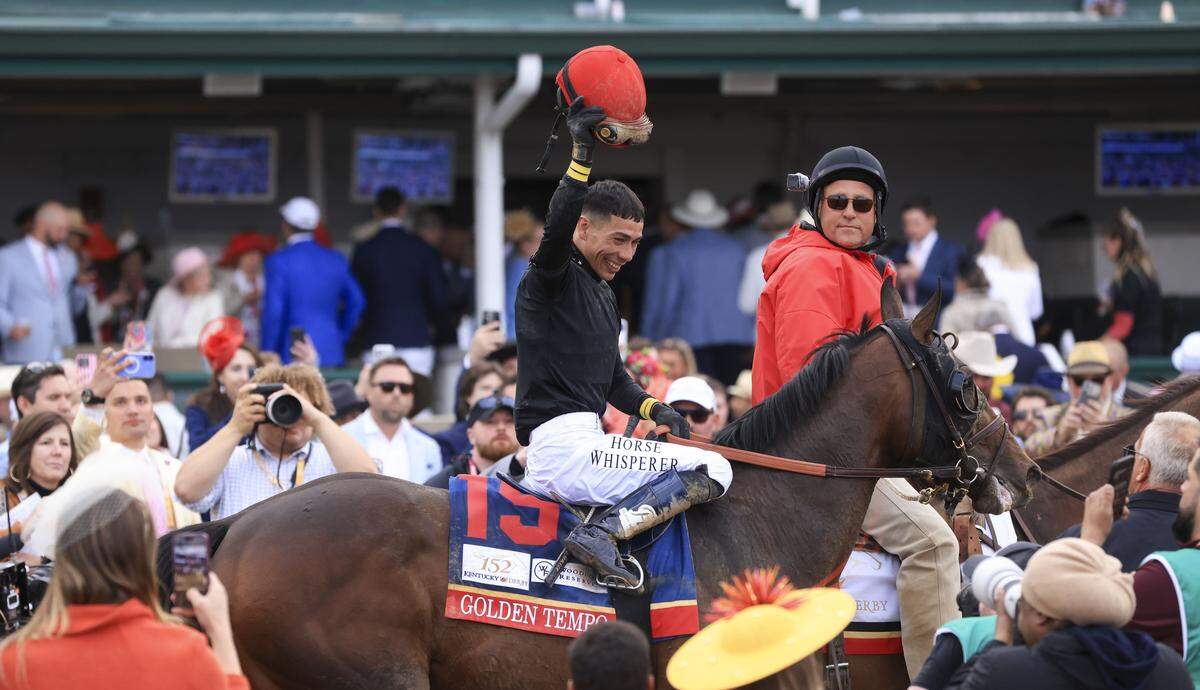
According to NBC Sports, the telecast of 23-1 shot Golden Tempo’s worst-to-first charge to victory in the 152nd Run for the Roses was watched by an average of 19.6 million television/Internet streaming viewers.
From 7 to 7:15 p.m. Saturday evening — essentially when the 2026 Derby was actually being contested — NBC Sports says viewership rose to 24.4 million. That was the most-watched quarter-hour of Kentucky Derby coverage since the network began broadcasting the race in 2001.
According to Sports Business Journal’s Austin Karp, one has to go back to 1983, when ABC Sports carried the telecast of Sunny Halo’s Derby triumph, to find a larger average TV audience (19.3 million) than in 2026.
In a particularly nice modern twist, the streaming audience for this year’s Kentucky Derby broadcast was a record 1.3 million. According to NBC, that was up 36% from last year — and is the all-time streaming record for a racing event on NBC Sports.
Put it all together, and somehow the longest-running, continuously-held major sporting event in the United States is proving to be as resonant a part of the 21st Century as Internet memes.
What makes the Kentucky Derby’s enduring popularity so fascinating is that, in multiple ways, it defies logic:
1.) The Derby is the marquee event of an underlying sport that is deeply troubled.
One of horse racing’s most-visible owners, Mike Repole, has all but declared war on what he sees as an insular leadership structure in the sport that he believes is holding back progress.
Meanwhile, in some of the largest states in the U.S., there are looming structural threats to horse racing.
In Florida, the future of Gulfstream Park remains uncertain even as an agreement is in place to continue racing there likely through at least 2030.
It is thought that the track’s owner, The Stronach Group, envisions more lucrative uses than horse racing for the 250 acres of land it owns in Hallandale Beach, Florida, upon which Gulfstream Park sits.
Racing in California is imperilled, it is widely thought, because the state has fallen behind other states which have used revenue from other forms of gambling to boost purses at racetracks. With that not available in Cali, the number of horses available to run in even big races has become sparse.
None of that even takes into account the animal welfare concerns that have sparked widespread criticism of horse racing as an institution.
2.) Horse racing’s roots are in an era when many Americans either worked in agriculture or were not far removed from having done so.
Now, according to the U.S. Department of Agriculture, fewer than 2% of Americans own a farm.
That reality would seem to make for a less-conducive environment than existed in the past for creating new horse racing adherents.
3.) The rise of computer-assisted wagering — high-volume, data-driven betting that can substantially shift odds just before post times — has become a major controversy.
Many who bet see CAW as creating an unfair playing field that works against “the little guys.”
Yet whatever the broader controversies in horse racing, the Kentucky Derby seems to defy gravity and float high above all such turbulence.
That is partially because NBC Sports presents the Derby as so much more than a sporting event. Its broadcasts highlight glitzy celebrities and hats and fashion coverage from Churchill Downs, too.
Much like the Olympics, the Kentucky Derby seems to yield an endless reservoir of heart-tugging feature stories that serve as a gate of interest into the event for the most casual of fans.
The large audience that tuned in to watch the 2026 Run for the Roses got compelling stories likely to bring them back in the future.
Golden Tempo trainer Cherie DeVaux becoming the first woman to condition a Kentucky Derby winner produced an absorbing storyline.
Jockey Jose Ortiz on Golden Tempo holding off his older brother, Irad Ortiz Jr., on Renegade at the wire as the sibling riders from Puerto Rico battled for their first Kentucky Derby win was a riveting plot point in its own right.
In the big picture, Jon Lewis of SportsMediaWatch writes “While it has always ranked among the most-watched events in sports, (Kentucky) Derby viewership is now surpassed only by football, the Olympics, and rare, one-off events like Game 7 of last year’s World Series.”
Lewis noted that the 2026 NCAA men’s basketball tournament championship game between Michigan and Connecticut drew the largest audience — an average of 18.3 million viewers — the event has had in seven years.
Yet the 152nd running of the Kentucky Derby easily did better than that.
For an event which began when Ulysses S. Grant was President of the United States, it is a fairly stunning level of 21st Century prominence.