
University of Kentucky computer science chairman, students decipher ancient Hebrew scroll
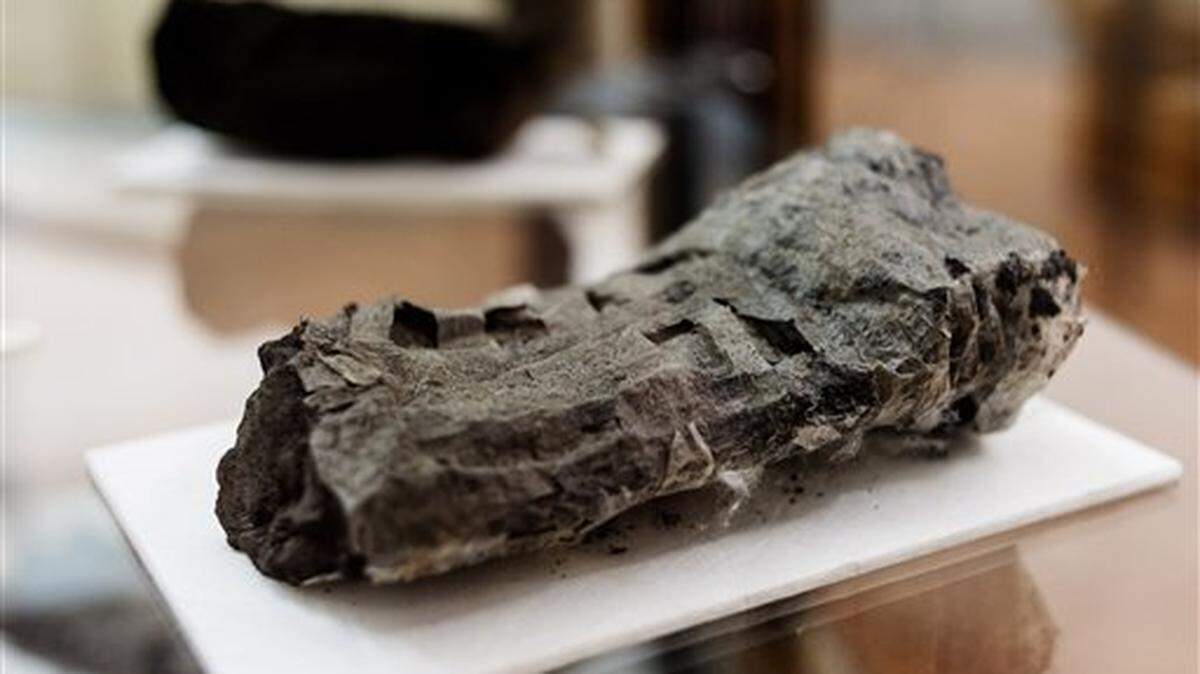
The most ancient Hebrew scroll since the Dead Sea Scrolls has been deciphered, thanks in part to students in the University of Kentucky computer science department, and its chairman, Brent Seales.
Digital-imaging software developed by Seales made it possible to read parts of a 1,500-year-old Torah scroll that was excavated in 1970, but at some point earlier had been badly burned. A research team at UK and Seales' software discerned the first eight verses of Leviticus from the charred, still-rolled parchment.
The rare find was presented at a news conference Monday in Jerusalem that was attended by the director of the Israel Antiquities Authority and by Israel's minister of culture and sports. Seales participated in the conference via Skype.
Israeli officials were "jubilant" about the technology that allowed them to read the scroll, Seales said. One official surprised Seales by calling this the most significant find since the discovery of the Dead Sea Scrolls, the ancient biblical texts found in the 1940s and '50s.
"That we're in the center of that right here at UK, I just feel really gratified by that," Seales said.
The scroll came from the Holy Ark of the synagogue at Ein Gedi, a settlement that burned to the ground. The cause of the fire isn't known.
Israel authorities have been in possession of the scroll for 45 years, but because it was damaged at the time of excavation, there wasn't any known technique for reading it, Seales said.
In February, curators in Israel had the scroll scanned inside a micro CT machine.
"It's similar to what you get at the doctor's when they look at your brain or your abdomen, and they can see all the way through your body, slice by slice," Seales said. "But it doesn't hurt you or damage you in any way, and that's the same technology (here) on a very small scale."
The data from that scan was then sent to Seales, who developed software to virtually unroll the scroll and visualize its text as it would appear on a flat surface.
"Even though the scan was done, it was still impossible to read anything," Seales said. "It was still real hard to read anything because every slice just shows a cross-section. I mean, it's like trying to read a rolled up newspaper by just looking at the cross-sections at the end of it."
So the software developed by Seales "makes the transition from the cross-sectional view to the surface view, which are the pages you want to see with the writing on them."
Seales developed the technology over the past 10 years with funding from Google and the National Science Foundation.
Seales said there might be more to extract from this scroll. This is also the first time in any archaeological excavation that a Torah scroll was found in a synagogue, he said. The Dead Sea Scrolls were found in a cave, not a temple.
Seales said work on the scroll "was student-driven" because he couldn't do the day-to-day tasks. "I'm their research director, so I design and tell them what to do."
Seales, who grew up in the Christian and Missionary Alliance Church, an evangelical Protestant denomination, said he has "high regard for Scripture and for its relevance today."
"These are texts that are venerated by people of faith, myself included," Seales said. "How joyful it is to open something up in my work and realize that God's name is in front of me in something no one has seen for 1,000 years. I mean, that's just great."
Seales and the UK team had previously attempted to reveal the secrets of papyrus scrolls stored in the library of a Roman statesman's villa in the city of Herculaneum, at the foot of Mount Vesuvius. That city was destroyed when the volcano exploded in A.D. 79.
The eruption — one of history's most famous — buried Herculaneum and nearby Pompeii under tons of superheated volcanic ash, killing the people but preserving buildings and contents.
Meanwhile, others are interested in using Seales' technology to resurrect a more modern text.
A group in California is seeking to read an original manuscript that was burned in the 1906 San Francisco fire that broke out after the devastating earthquake there.
Seales said the manuscript was written by a "famous author," but he didn't wish to identify the author.
He did say: "That manuscript is so fragile from the burn that it can't be analyzed, so they have contacted me and asked if anything can be done. That possibly could be our next project."
This story was originally published July 20, 2015 at 5:51 PM.