
Banking industry donates heavily to U.S. Rep. Andy Barr as he champions deregulation bills
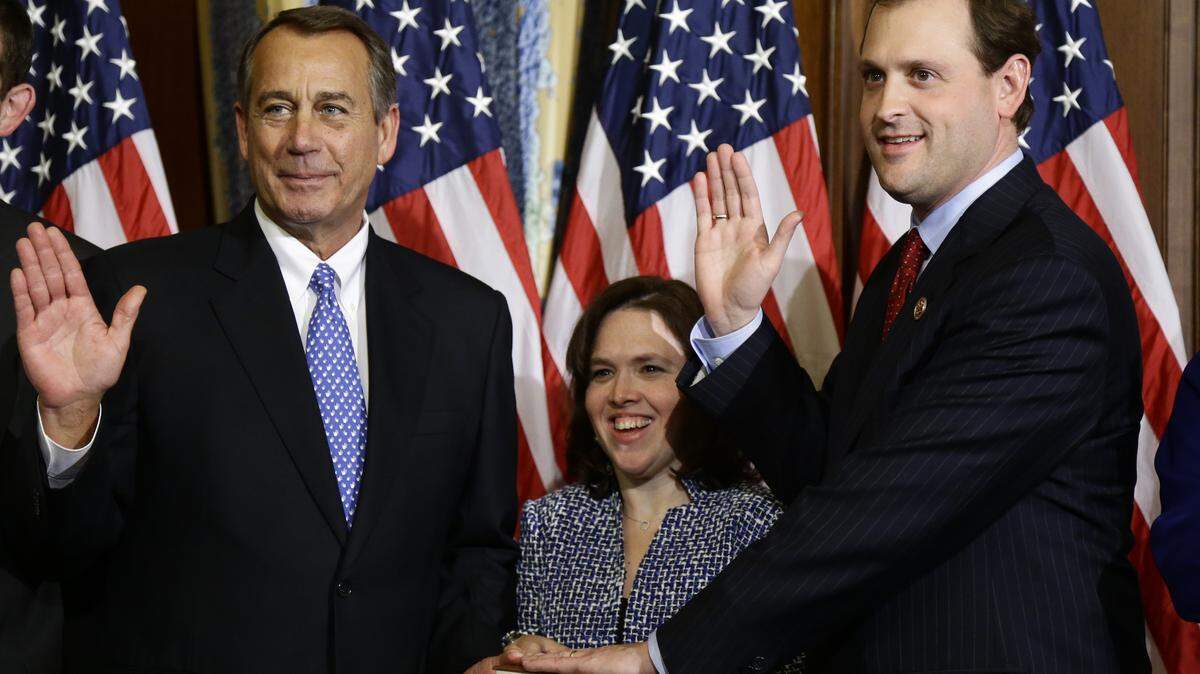
U.S. Rep. Andy Barr, R-Lexington, has emerged as a champion of bank deregulation during his freshman term in Congress.
It's an arcane subject with relatively few followers in his Central Kentucky district. But Barr, with a seat on the House Financial Services Committee and Wall Street donors backing his re-election on Nov. 4, is sponsoring several bills to loosen the Dodd-Frank Law, a package of banking reforms enacted after the 2008 economic collapse and recession.
For Barr, a 41-year-old lawyer, his bills are about "making sure that American companies on Main Street and all across this country have access to reliable, affordable capital to grow their businesses and create jobs," as he described it April 29 in a House floor debate.
The banks appreciate him. Twenty-one percent of his $2.08 million in campaign donations as of June 30 came from the banking, securities, finance and insurance industries over which his House committee holds jurisdiction, according to an analysis by the Center for Responsive Politics. Barr has received more than three times as much campaign money as his Democratic challenger, Elisabeth Jensen, who runs a Lexington educational nonprofit.
"Being on the Financial Services Committee is widely known as a good way for congressmen to raise a lot of money from the banks, and it looks like Mr. Barr is doing just that," said economist Marcus Stanley, policy director at Americans for Financial Reform, a nonprofit in Washington that opposes Barr's bank deregulation bills.
"There is literally an army of banking lobbyists in Washington who are billing $1.5 million a day when Congress is in session, knocking as many holes as they can in the restrictions on how banks can make money. The Financial Services Committee is where a lot of that happens," Stanley said.
Asked about his banking industry donations on Friday, Barr responded: "You know, I'm not going to apologize for supporting policies that promote the free enterprise system, that promote job creation and that promote healthy capital markets in this country."
The Volcker Rule
In April, the House passed Barr's H.R. 4167, which he calls "The Restoring Proven Financing for American Employers Act." It would exempt a kind of investment known as "collateralized loan obligations" — if they were issued before this year — from the Dodd-Frank Law's so-called "Volcker Rule," meant to stop banks from putting their federally insured deposits into risky investments.
A handful of major American banks own tens of billions of dollars in CLOs, which are mostly commercial loans, typically used to raise money for leveraged corporate buyouts. The loans are bundled and sold to investors. Corporations like CLOs because they create another market for debt, making it easier and cheaper for them to borrow money. Investors like CLOs because, if all goes well, they pay a decent return.
However, federal regulators last December said CLOs issued before 2009 tend to be riskier, with a dollop of bonds, equities and other assets mixed in with the commercial loans. Some critics refer to these CLOs as "mini-hedge funds." Banks need to sell their older CLOs with mixed assets no later than July 2017, regulators say. Newer CLOs that are purely loans should be exempt from the Volcker Rule, so banks can keep those.
But banks that own older CLOs don't want to be forced to sell them. Barr's bill, which would let them keep older CLOs, is getting lobbying support in Congress from 16 of the world's biggest banks, banking trade groups and financial corporations, including Citigroup, JPMorgan Chase & Co., Bank of America, Morgan Stanley, Wells Fargo and Credit Suisse Group.
"It is not sensible to cause banks to lose value on their investments through precipitous sales unnecessary for safety and soundness reasons," the American Bankers Association wrote to House members in April before they voted on Barr's bill. "This legislation would address the potential for severe disruption in the market for CLOs that were offered before the regulators issued a final Volcker Rule."
The entities lobbying for Barr's bill together collected $158 billion from taxpayers through the 2008 federal bank bailout to save them from failure, repaying it over the next few years, according to an analysis by ProPublica, a journalism nonprofit. The same entities had given Barr's campaign a cumulative $66,650 as of June 30. The U.S. Chamber of Commerce, which also lobbied for the bill, earlier this year spent $175,000 on television commercials to promote Barr in his district.
"Kentucky is under attack," the Chamber said in its 30-second ad. "Andy Barr is fighting to protect Kentucky from Washington overreach."
'Harassing job creators'
On Friday, Barr said the Dodd-Frank Law is "a disaster for our economy" that either should be repealed or overhauled.
The law buries small community banks under inflexible lending and investment restrictions that cripple them while allowing Wall Street banks to continue growing "too big to fail," Barr said. The Consumer Financial Protection Bureau, the federal agency that enforces many of the law's regulations, is "harassing job creators and making life harder for American consumers to access credit options," he said.
"We're now in the fifth year of Dodd-Frank, and here's the bottom line," Barr said. "The law imposes 398 new regulations that added more than $21 billion in cost, 60 million paperwork-burden hours, and we're only a little more than halfway through the 398 regulations."
Barr's Democratic opponent says she supports stronger bank regulations to avoid a repeat of the 2008 financial system collapse. "This is exactly what's wrong with politics in Washington," Jensen said Friday. "Andy Barr has taken tens of thousands of dollars from the big Wall Street banks that sent the economy into a tailspin and then got taxpayer bailouts. Now he's trying to protect the banks from reasonable regulations that make it less likely they will wreck the economy again in the future."
Barr is sponsoring two other bills this year that would create exemptions in another Dodd-Frank rule, this one setting stricter income requirements for home mortgage borrowers and restricting banks from selling certain types of loans that saw higher default rates during the housing crash. Barr says the rule is too inflexible. Neither bill has received much outside attention; one made it to the Senate in May.
Barr's CLO bill, also awaiting Senate action, enjoyed bipartisan support in the House. The House Financial Services Committee voted 53 to 3 on March 14 to send it to the House floor. Collectively, committee members have received $10.4 million in campaign donations from the banking and securities industries during this election cycle, spread evenly between Republican and Democratic lawmakers. The House passed it on April 29 by voice vote, without objection.
"Today we have the opportunity to correct, in a strong, bipartisan way, an egregious example of regulatory overreach," U.S. Rep. Scott Garrett, R-N.J., said in support of Barr's bill during the House debate. "For no reason that has been coherently stated by anyone, the banking regulators responsible for implementing the Volcker Rule have included provisions in their final rule that will literally cripple the market for collateralized loan obligations."
'Get around the rule'
However, banking watchdog groups and other critics, including former Federal Reserve Chairman Paul Volcker, for whom the Volcker Rule is named, say Barr's bill is a defensive overreaction by an industry that wants to keep gambling with taxpayer money.
"This constant effort to get around the rule limiting banks' investment in hedge funds, on behalf of a few institutions who apparently want room to resume the financing practices that got us into trouble in the past, really should end," Volcker said in April, just ahead of the vote on Barr's bill. "My sense is that the CLO market has recovered within the boundaries of the existing rule."
Three big banks — Citigroup, JP Morgan and Wells Fargo — together own about $70 billion in CLOs, or nearly three-fourths of all bank-held CLOs, according to a February report by Better Markets, a nonprofit promoting stronger financial regulations. Smaller community banks seldom invest deeply in this product.
When banks sell their older CLOs, there will be buyers, such as insurance companies, pension funds and foreign banks, leaving the market intact and the liquidity of capital unaffected, critics say. Also, responding to banks' protests, the Federal Reserve earlier this year postponed enforcement of the CLO ownership restrictions from the original date of July 2015 until July 2017.
"Let's be clear: CLOs are not being killed. They are being limited in a very small way only to target (banks owning) the most risky CLOs," said U.S. Rep. Mike Capuano, D-Mass., during the House debate in April.
"We have a crisis that we have to solve. A handful of people will not be allowed to risk my mother's investment. That is what we are crying about," Capuano said. "I have heard this all before, and it didn't turn out too well in '08. A little limitation is good for the American system."
Several of Barr's campaign donors who are lobbying for his CLO bill declined to comment last week, including Citigroup, JPMorgan and the Wall Street financial advisory firm of Cadwalader, Wickersham & Taft. Cadwalader hosted a campaign fund-raising luncheon for Barr at its New York office on March 24, a month after a Cadwalader partner, Neil Weidner, spoke to lawmakers in favor of an early draft of Barr's CLO bill.
"Without significant changes to these regulatory initiatives, we are deeply concerned about the sustainability of the CLO industry," Weidner testified Feb. 26 before the House Subcommittee on Capital Markets. Weeks later, he donated $2,600 to Barr's campaign.
Cadwalader, which works for many of the nation's largest banks, won about $19 million in legal contracts from the $700 billion federal bank bailout in 2008. It later was criticized by the bailout's special inspector general, who questioned nearly $2 million of the firm's fees and expenses, citing vague billing that made it impossible to determine "whether these charges were reasonable and therefore allowable."
Worried bankers
During the House debate in April, Barr said the Dodd-Frank rule on older CLOs would hurt Kentucky businesses.
The congressman gave two examples: Lexington mattress maker Tempur-Pedic, which he said "used CLO financing" in 2012 to acquire another company, Sealy, and hire 200 more employees, and "a small community bank" that might have to lay off employees and hit customers with higher fees and interest rates if it's forced to sell its CLO investments and if it loses money on the sale.
"So getting this issue right and fixing the problem is important to community banks," Barr said. "It is important to U.S. employers and businesses on Main Street. It is important to a whole lot of jobs that support families in Kentucky and around this country. And here is why: collateralized loan obligations, or CLOs, have proven to be a critical source of funding for U.S. businesses over the last 20 years."
Tempur-Pedic didn't directly use CLOs to finance its $1.3 billion takeover of Sealy two years ago, company officials said last week. But CLOs made the deal easier. A slice of the company's debt was sold to investors through a CLO, "providing capital liquidity for us" and giving Tempur-Pedic access to a lower interest rate on that part of the debt, said Dale Williams, the company's chief financial officer.
Williams said he doesn't know if the Volcker Rule setting a three-year deadline on American bank ownership of older CLOs would have prevented Tempur-Pedic from getting cheaper debt.
"I'm not a banker, but I spend a lot of time talking with bankers," Williams said. "I'm pleased with Congressman Barr's legislation because I know there was concern in the banking community that, without it, the rules were going to hurt liquidity."
The "small community bank" that Barr mentioned in the House was First Federal Savings Bank in Elizabethtown. Frank Perez, the bank's chief financial officer, wrote to Barr in March to express his support for the CLO bill.
In an interview last week, Perez said most community banks aren't much invested in CLOs, leaving that product to big banks. However, he said, because he was comfortable with them, First Federal Savings owns $35 million in CLOs, or 10 percent of its investment portfolio. About 5 percent of the bank's CLOs hold assets other than commercial loans, making them risky enough, under the Volcker Rule, to require the bank to sell them.
What worries banks is the prospect of a "fire sale," Perez said, with tens of billions of dollars in CLOs getting dumped on the market at once, which would drive down prices. The Federal Reserve's decision to give banks until 2017 to sell "alleviates some of our concerns" because his bank's older CLOs should mature around that time, he said.
"If I had to sell my $35 million CLO portfolio right now and take a — let's be modest, say a 10 percent loss, that's $3.5 million, right? That would be significant to us," Perez said.
"Look, I'm OK with regulation," he said. "I think we need to be regulated. Bankers want to protect their customers, too. I just want people to think about unintended consequences. Our concern here was with a rule being passed about CLOs in 2013, after we had already bought them."
This story was originally published September 13, 2014 at 6:33 PM with the headline "Banking industry donates heavily to U.S. Rep. Andy Barr as he champions deregulation bills."