
‘Coronavirus doesn’t discriminate. Racists still do.’ Ky. poet rages in new book
As he does every April, former Kentucky Poet Laureate Frank X Walker set a daunting task for himself this year: to write a poem every morning during National Poetry Month and post it on his Facebook page, often mere minutes after making his final revisions.
Some years, Walker had felt hard-pressed to find subject matter for so many poems written so quickly. But 2020 was different. The horror of the coronavirus pandemic — including how it was disproportionately affecting Black communities in obvious and more subtle, insidious ways — brought the poet into his writing studio each morning brimming with ideas and, often, bristling with anger.
“I heard a lot of younger writers say they’re so traumatized by the pandemic that they can’t write, but that’s inconceivable to me,” Walker says in an interview at his studio (where he also makes visual art) in Lexington’s East End. “For me, writing has always been a release valve. I go to the page angry and just write till I’m not angry anymore.”
At the end of April, Walker continued his poem-a-day practice, posting what he called NatPoMo “bonus” poems through May — only to find a fresh round of painful inspiration late that month in the form of the videotape of a Minneapolis police officer’s killing of George Floyd and the subsequent worldwide protests. To the alarm of his wife and editor, Shauna M. Morgan — “She thought I was nuts, and that people would see how raw and unfinished the poems were,” he recalls — Walker kept the daily release valve open through June and into July, by which time he realized he had a full-length collection of poems on his hands.
At some point, Katerina Stoykova, senior editor of the Lexington-based poetry house Accents Publishing (which had published two earlier collections by Walker), sent him an email about one of his Facebook poems, to which he casually responded: “There might be enough for a book here if you’re interested.”
She was. “I knew right away that I wanted to publish it,” Stoykova says. “Not only is Frank very engaged with this material, the whole world is engaged with it, too. For me, this book is a time capsule of a year that’s been transformative on so many levels for so many people.”
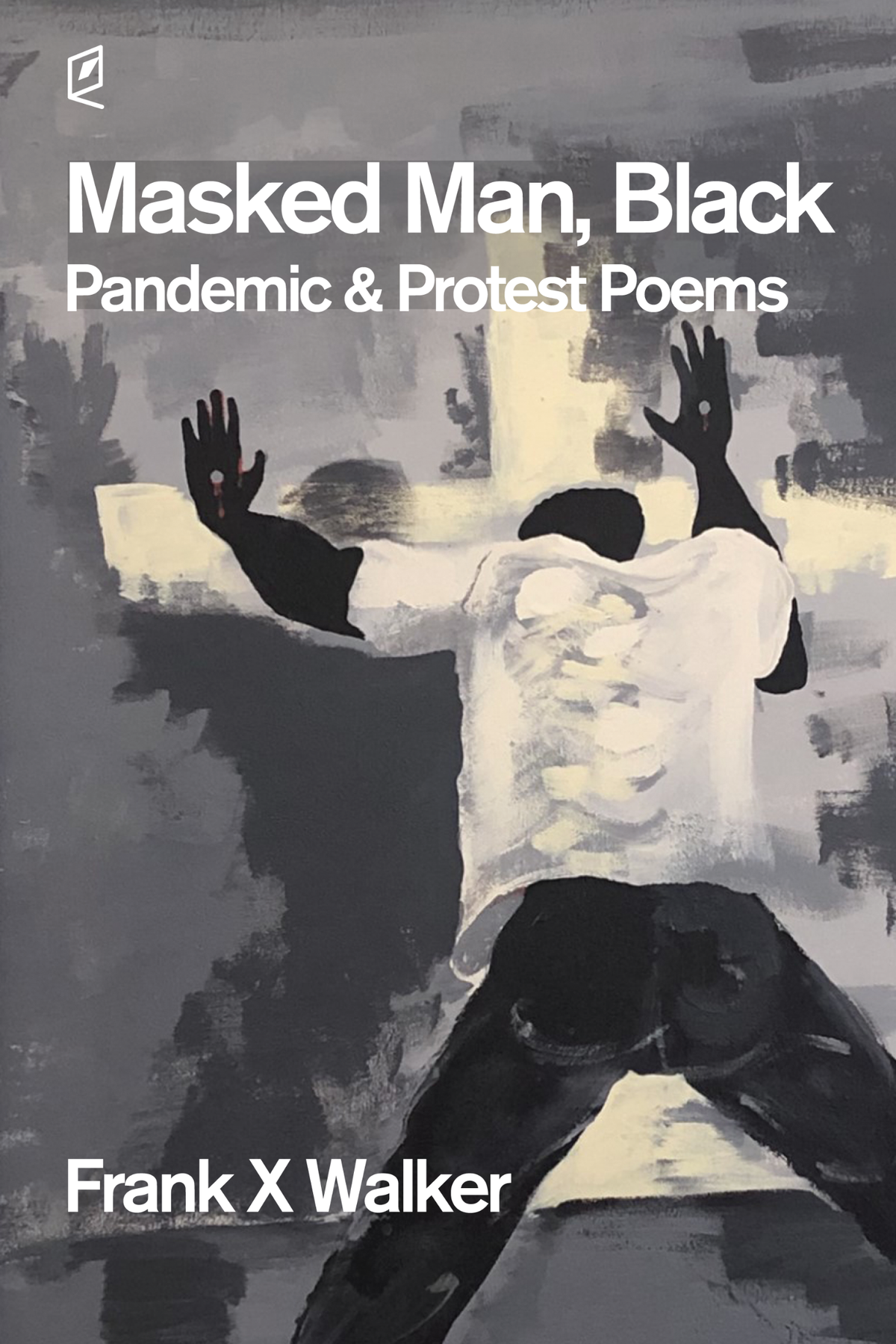
The resulting volume — “Masked Man, Black: Pandemic & Protest Poems,” just released by Accents at lightning speed only six months after its first poems were written and barely two months after the publishing agreement was reached, featuring “Fit the Description,” a 1992 painting by Walker, on the cover — is a remarkably timely response to this extraordinary, still-unfolding era. The book can be purchased at Accents-publishing.com for $16.
“Yes, he wrote the poems quickly, but the moment calls for that,” says Morgan, an associate professor of literature and creative writing at Howard University, who helped polish the poems for book publication and wrote the collection’s introduction. “These poems have really been a balm for people, a way to engage with poetry that’s crying out like they are.”
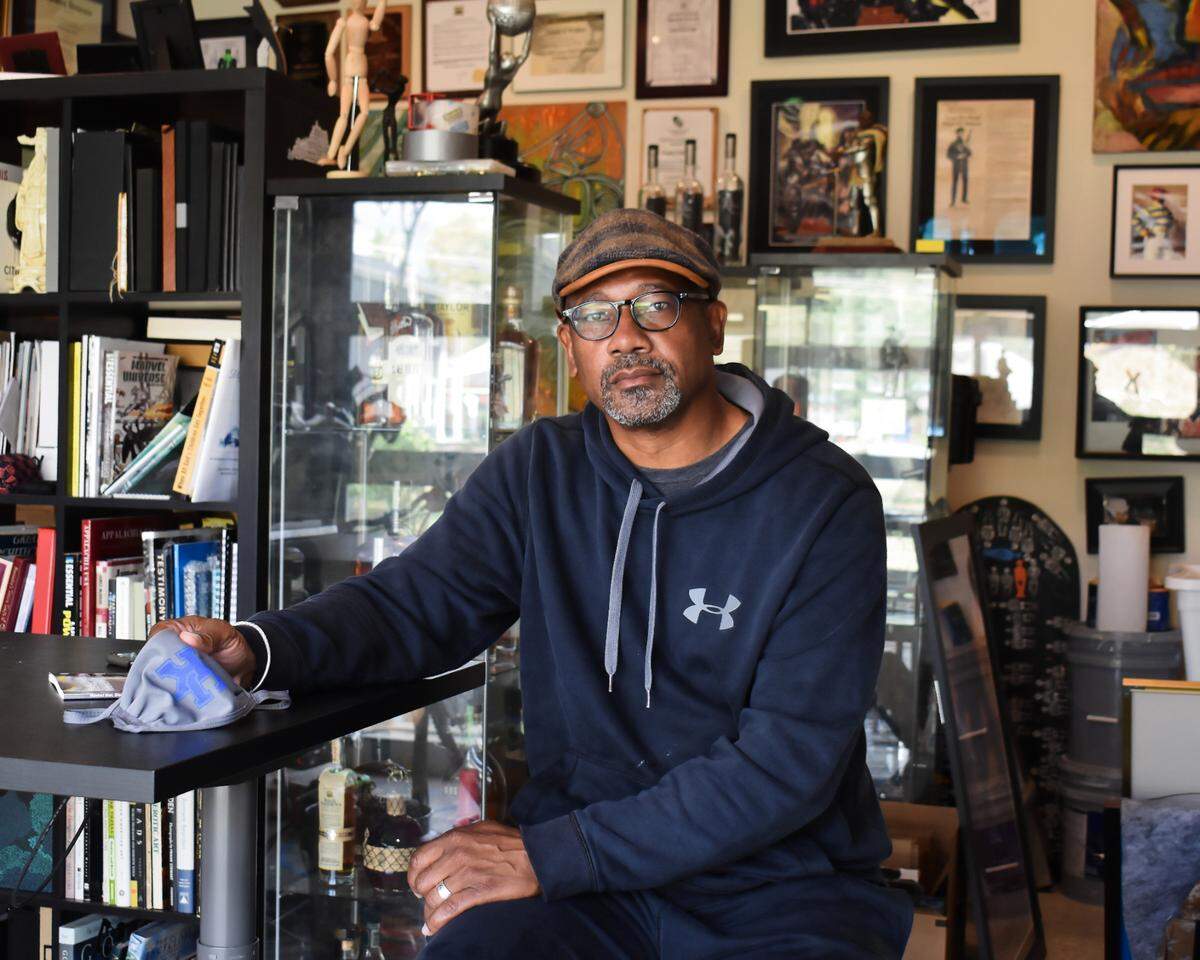
‘Masked Man, Black’ takes no prisoners
Although it can be romantic and hopeful, celebrating family love and quarantine activities such as gardening, “Masked Man, Black” mostly takes no prisoners. By turns outraged and mournful, politically scathing and darkly funny, the poet calls out politicians (in particular President Trump, whose public statements about the pandemic constitute the bulk of a poem called “Mendacity”); Amy Cooper, the white woman who called 911 and made false accusations against a Black male birdwatcher in New York City’s Central Park; and the addressees of poems called “To the Man Who Wore a Klan Hood to the Grocery Store” and “To the Man Spewing Spit and Vitriol in the Trooper’s Face,” among others.
Walker even holds poetic fire to the feet of his own extended family. In a poem called “Easter Prayer, 2020 A.C.” they are taken to task for insisting on a holiday gathering while refusing to wear masks because they don’t initially believe the pandemic is real. If those gathered together must pay the ultimate price for their lack of caution, the poet prays, “Let this be the best meal they ever ate, Lord. // And take them all on the same day, so that they / may offer comfort to each other in the hospital / and allow the rest of us to endure only one / drive-through service.”
By far the most controversial of the original Facebook poems, which Walker chose to include in the book, is “To the White Women Who Formed a Line Between Black Protesters and Police,” written shortly after the referenced event in Louisville. “Thanks, but you owed us that,” the poem begins, then goes on to assign at least some responsibility for the raising and moral instruction (or lack thereof) of white supremacists:
Almost every slave ship captain,
Confederate officer, Grand Cyclops,
Tulsa-rioter, lynch-mobber,
redliner, gerrymanderer, biased judge,
killer cop, and impeached president
started out as your baby boy.
Walker expected to be criticized for the poem, he says, and so he was. “(B.S.), Frank,” feminist activist and writer Landra Lewis, of Berea, shot back on Facebook. “White women were property too, and attacking allies is self sabotage. Keep the anger where it belongs, on patriarchal white men. . . . Blaming women in general is no better than racist white people blaming all ills of society on black people.”
It’s “a difficult poem, a swallow,” Walker concedes now, but points out that the poem does acknowledge that many white women are abused by their husbands and perhaps overruled by them in the child-raising process:
Maybe you lost the battle
for their souls to their fathers
who used your neck to sharpen
their canines and bicuspids.
Even so, Walker doesn’t back down from his main point. “I’m just saying, have you noticed that all these men who have terrorized us all these years, they happen to have white mothers?” he says. “Is there a correlation? Does it start with how you’re raising them? I don’t think you come out of the womb saying, ‘I want to be an abusive policeman.’”
Poems with satire
Perhaps the most harrowingly effective poems in the book are the ones that deploy a device more associated with “Saturday Night Live” and late-night comedians like Trevor Noah and Stephen Colbert than with contemporary American poetry: Satire, albeit that of the darkest possible kind.
“Offensive Captain” recasts Minneapolis police officer Derek Chauvin as a football quarterback, calling a play in a huddle: “WE-WILL-CALL-IT-SELF-DEFENSE. / ’TIL. HE. CAN’T. BREATHE. On three. / BREAK! (Clap).”
And in the book’s most memorable tour de force, “Mrs. Butterworth, Uncle Ben & Aunt Jemima,” Walker uses a classic joke structure (the three iconic characters from the title begin the poem by walking into a bar) to connect the ongoing re-examination of racist stereotypes in American product marketing to the long history of white supremacist violence. After the three icons are gunned down for allegedly resisting arrest and being “Delicious While Black,” their imaginary offspring provide a chilling postscript:
Butterworth’s daughter said here’s to progress,
we might finally get an anti-lynching bill.
Ben’s son said I’d rather they abolish
qualified immunity. Jemima’s kid said you know
they abolished slavery once,
then they hung my mama on that box.
“Pow! Kick in the stomach,” Walker says now. “One thing I’ve learned in my family is how important humor is as a kind of medicine. Without humor and satire, all the trauma that we’ve been participants in, mostly as victims, would be too much. And I didn’t want the book to be totally heavy all the time.”
The least funny piece in the book, the title poem, is also the one in which the circumstances of the pandemic collide with the techniques historically used by many Black people to survive in a racially hostile environment.
Evoking “We Wear the Mask” by Paul Laurence Dunbar (1872-1906), his classic poem about Black pain hidden behind a false front of contentment (“We wear the mask that grins and lies, / It hides our cheeks and shades our eyes”), Walker’s “Masked Man, Black” evokes his own early-pandemic experience of walking into a store wearing a mask and being viewed as a potential threat. “The coronavirus doesn’t discriminate,” the poem ends. “Racists still do. // Peel off mask no grins no lies.”
“I’m making the point that we are not smiling anymore,” Walker says. “We are not grinning. The mask is off, and this s— hurts. It hurts.”
‘Masked Man, Black: Pandemic & Protest Poems’ reading
Who: Poet Frank X Walker will discuss his book of poems with Katerina Stoykova, senior editor of Accents Publishing
When: 7 p.m. Nov. 18
Where: A public event on Zoom. More information: Facebook.com/events/2712094479119789
This story was originally published November 17, 2020 at 6:00 AM with the headline "‘Coronavirus doesn’t discriminate. Racists still do.’ Ky. poet rages in new book."