
Is Buddy Guy soft-spoken or a blues hurricane? See for yourself at Lexington concert.

At the onset of the wonderful 2021 documentary “Buddy Guy: The Blues Chase the Blues Away,” the vanguard guitarist looks contemplatively to a clouded sky and recalls how the first sound that registered in his soul as music was the singing of birds.
A distant chorus of birdsong then blends with the sound of Guy’s playing — in this instance, a slow, unaccompanied and somewhat rustic deconstruction of the monstrous guitar attack he is known for. But the desired effect is achieved. We are reminded how earthy and elemental the muses are that Guy follows and how dedicated he remains to the preservation of the music they make.
“Funny thing about the blues,” Guy comments a few minutes later in the film (a project directed by Devin Chanda, Matt Mitchener and Charles Todd that premiered as part of PBS’ “American Masters” series last July.) “You play ’em because you got ’em. But when you play ’em, you lose ’em.”
Hence, the inspiration not only for the film’s title, but the very philosophy that has guided the guitarist’s career for well over six decades. It helped move Guy from his sharecropping family in Lettsworth, La., to the blues metropolis of Chicago in 1957.
Such a philosophy sat alongside the guitarist as his talents went largely underappreciated until an entire generation of younger British rock stars enamored of American roots music hailed Guy as a stylistic champion of modern electric blues beginning in the mid 1960s.
That philosophy also seems to guide Guy today, where, at age 85, he sits as the last surviving pioneer of a ’50s and ’60s blues revolution piloted by the likes of Muddy Waters and B.B. King. Indeed, the present-day interview segments within “The Blues Chase the Blues Away” present Guy as something of a sage — a quiet, retiring artistic presence seemingly bemused by the attention he has received (much of it coming during the latter half of his career.)
Still, he remains devoted enough to make sure the inspirations passed on to him by the likes of Waters and others are, in turn, accepted, acknowledged and revitalized for a succeeding blues generation.
Just ask some of the guitarists who have been invited to sit in with Guy through the years.
“It was a wonderful thing,” said Christone “Kingfish” Ingram, one of the most heralded blues artists to emerge in the past decade, prior to a recent Lexington performance at Manchester Music Hall. “That’s because each time I figure out or just learn something from him. Like watching him take a stage and command a stage, even when I’m up there with him. I’m in awe. The way he sings a certain line or the way he may play a certain lick. You can hear the experience. You can tell the music is authentic. There’s no fakery about it for sure.”
“Getting to jam with Buddy Guy was a dream come true, one of the greatest things I’ve ever experienced as a guitarist,” said Greg Martin, longtime guitarist of The Kentucky Headhunters, who sat in with Guy at a Louisville concert in February. “It was like a validation. All the years I’ve put into studying blues guitar and the genre wasn’t wasted. Getting to stand onstage toe to toe with Buddy was another facet of my ongoing blues education. He is a true master, the last of the original Chicago electric blues guitar greats.”
All of this suggests that the offstage Guy is altogether different from the one who comes to life in performance.
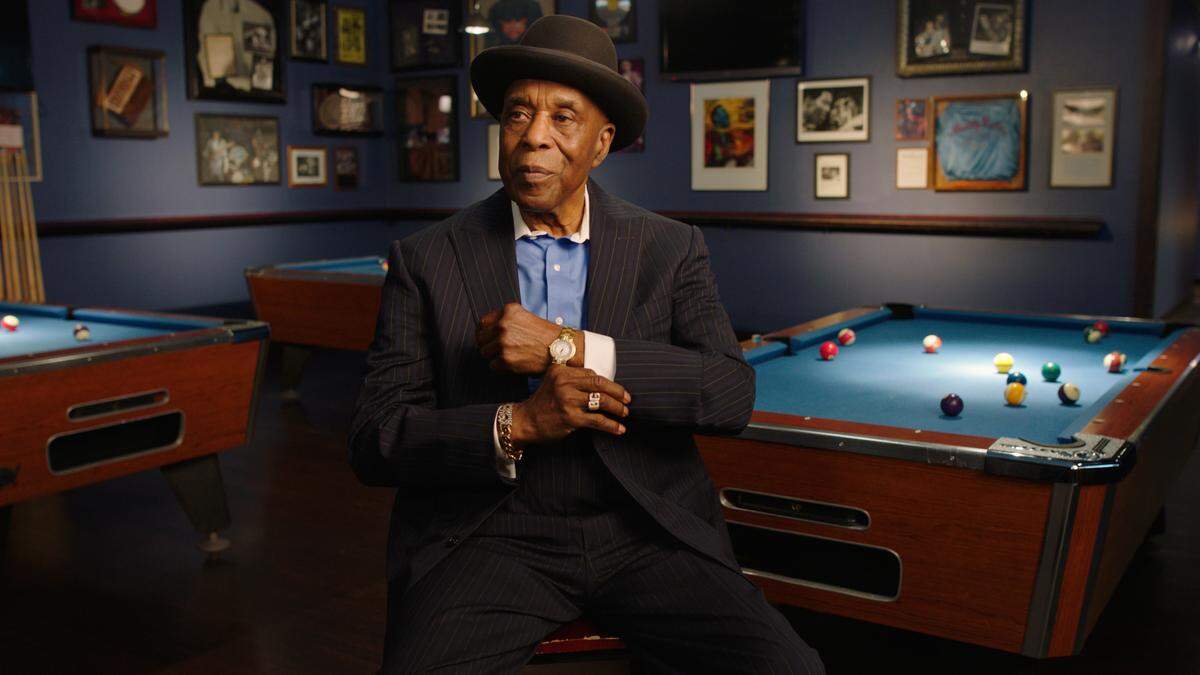
As “The Blues Chase the Blues Away” reveals, Guy is soft-spoken in conversation, a natural reflection of a shyness that got him fired from one of his first club gigs while still living in Louisiana (he refused to face an audience of 20 or so as he played.) But on record and onstage, the full gusto of his musicianship is revealed.
There, Guy is a hurricane with a howling electric charge matched by a wholly extroverted stage persona. No wonder he was accepted as readily by rock artists and audiences as by his blue contemporaries.
That result is what Guy refers to in the film as “that messed up sound.” It’s now half of a dual imprint of his musical voice. The other part – the one that never gets as much notice as his guitar work – is his singing. Reared on gospel, Guy testifies in a major way through his vocals. They possess the fervency of Solomon Burke and the soulful zeal of James Brown but still rests in the blues cradle of the artists he admires. Guy just knew how to take their sound and rocket it further to the heavens.

“Muddy, Lightnin’ (Hopkins, another of Guy’s blues idols) hung the moon,” he comments in the documentary. “But I could go to Mars.”
Guy’s Chicago migration hardly translated into immediate success. His initial recording tenure with the city’s famed blues label, Chess Records, discouraged his wilder, rockish sound. And for many years, he had to supplement his evening club shows with a day job.
Fortunes eventually changed when a league of white British rock artists — The Rolling Stones, Eric Clapton, Jeff Beck and the like — began to vocally champion Guy enough to where American fans took notice.
Among them was the late Texas guitarist Stevie Ray Vaughan, whose infatuation with Guy’s music helped introduce a vast portion of white American audiences to the latter’s playing. The attention snowballed into a 1991 album that ended a near decade-long recording drought for the guitarist. Its title seemed to be a credo for where Guy’s career stood: “Damn Right, I’ve Got the Blues.”
The record triggered a career renaissance that would earn him eight Grammy Awards in the ensuing years and, eventually, a level of artistic respect and acknowledgment usually bestowed on blues artists after they die.
“Somebody was interviewing me a few months ago and said, ‘I need to talk to somebody who knew you from way back when to get some information on you,’” Guy told The Los Angeles Times last year prior to the premiere of “The Blues Chase the Blues Away.”
“I said, “Well, you need to go to the graveyard, then, ’cause everybody older than me is gone.”
Buddy Guy
When: March 27, 7:30 p.m.
Where: Lexington Opera House, 401 W. Short St.
Tickets: $95.50 through ticketmaster.com.
COVID policy: Proof of a negative COVID-19 test (72 hours before the event) or vaccination (14 days past final vaccination shot) will be required for admission. Children under 12 may be required to take a COVID-19 diagnostic test 72 hours prior to the show. Mask wearing will be encouraged. Details at ticketmaster.com.