
‘Nothing but happiness:’ Orchestra showcases new generation of traditional Cuban music
When the Buena Vista Social Orchestra convened for its inaugural performance in August, few in attendance knew what to expect. Steven Machat did.
Having assembled the entourage with bandleader Jesus “Aguaje” Ramos, he was sure the group’s ability to present a multi-generational performance of the very traditional dance music of Cuba would connect with a North American audience — in this case, one gathered in Farmingville, New York.
“That was first time they ever played together,” Machat said. “My wife looked at me and said, ‘What’s going to happen here?’ I said, ‘I know in my heart that they can play together. I just know it.’ And it was fantastic.”
If the band’s name seems familiar while its current identity as an artistic unit might not, that’s because it is an outgrowth of the Buena Vista Social Club. That collective of veteran Cuban musicians, bandleaders and vocalists championed music of a truly bygone era — one dominated by boleros, danzóns and cha cha chas. The troupe and its songs gained new generational appeal in Wim Wenders’ Oscar-nominated film of the same name, “Buena Vista Social Club.”
The 1999 documentary was, in essence, a life preserver for traditional Cuban music and, more importantly, several cherished practitioners who held to it through the country’s tumultuous political shifts. Those artists were already elders when American music journeyman Ry Cooder scouted them out for the movie. By the time Lucy Walker filmed a follow-up, “Buena Vista Social Club: Adios” in 2017, those artists were engaged in a final tour that concluded in Havana. Ramos was part of the latter venture.
While nearly all of the original roster of artists from the Buena Vista Social Club have either retired (including cancion/guaracha vocalist Omara Portuondo, who is now 93) or passed away (son music/bolero singer Ibrahim Ferrer, who died in 2005), trombonist Ramos has carried on Cuba’s music in a variety of joyous rhythmic ensembles, several of much have toured the United States previously. It was around the time of the tour that the “Adios” film chronicled that Machat met Ramos.
A longtime entertainment producer, music publisher and record label chieftain, Machat was also an avid global music enthusiast. He helped Peter Gabriel establish WOMAD (World of Music, Arts and Dance), a now acclaimed international festival, over 40 years ago. Machat has also worked extensively with numerous world music artists, including famed African saxophonist and French Cameroonian native Manu Dibango, best known for the 1972 worldwide hit “Soul Makossa.”
Machat met Ramos while visiting Cuba to explore its music and culture. Plans began to form for a new band that would carry on the legacy of the Buena Vista Social Club. It nearly reached fruition when COVID hit.
“This tour we’re presenting now has taken us seven years to put together,” Machat said.
The band introduced this year as the Buena Vista Social Orchestra was different in design from the Buena Vista Social Club, but not in purpose. The earlier group was primarily a vehicle for the elders — artists long established in their homeland, but largely unknown to mainstream audiences outside Cuba. The Orchestra uses a quartet of similarly longstanding players, but also gives prominence to an entirely new generation of singers and instrumentalists.
Ramos serves as director/conductor, as well as trombonist. His core group of veteran players includes bassist Fabian Garcia, pianist Emilio Senon Morales Ruiz and percussionist Luis “Betun” Mariano Valiente Marin. The bandleader’s daughter, Lorena Lazara Ramos Diaz (also a trombonist) is part of the contingency of new generation players in the Orchestra that include vocalist Geidi Chapman and percussionist Antonio Remigio Rubio Borayo, some of whom are nearly 50 years younger than the elders.
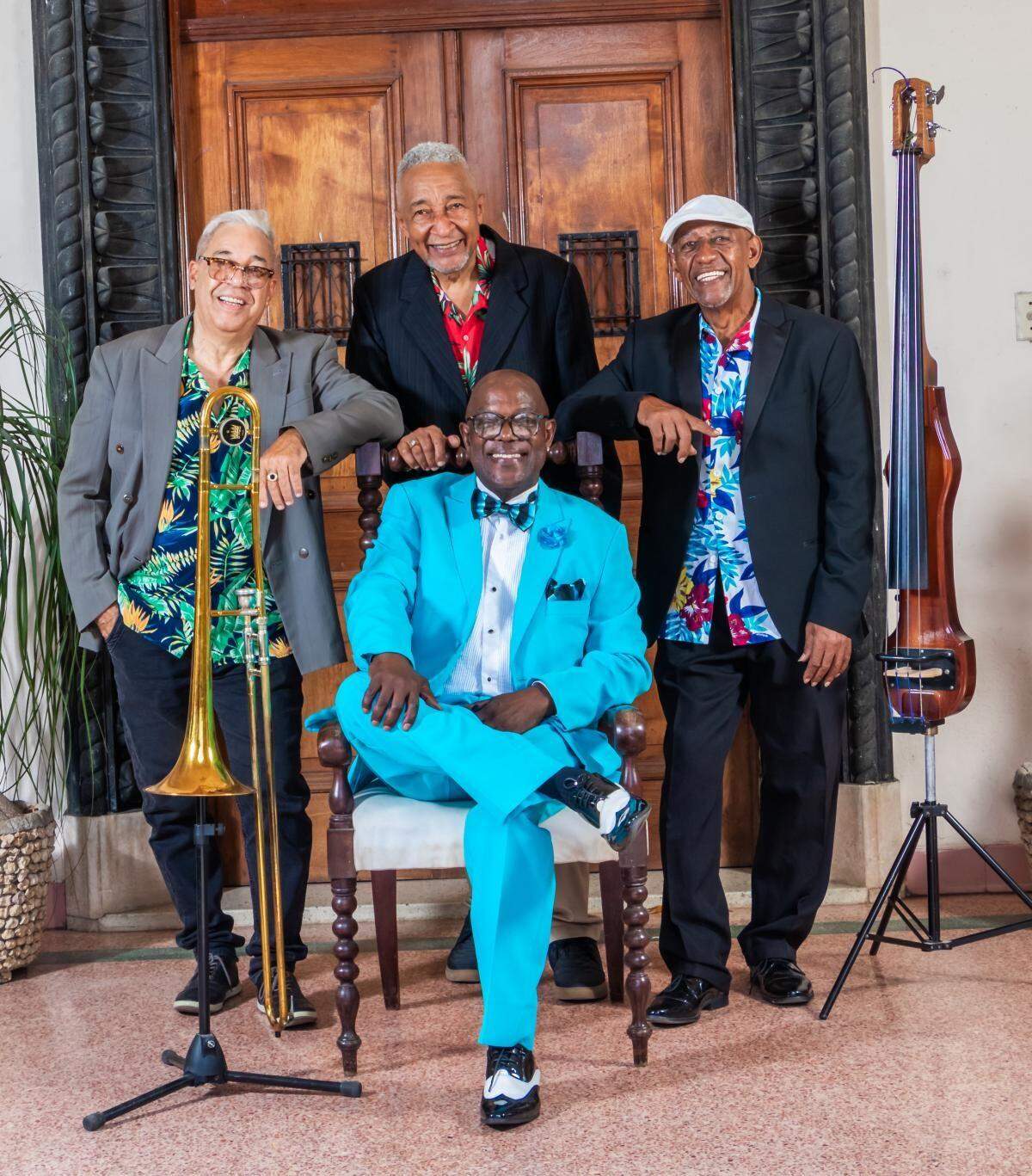
The music, though, all comes from the same amalgamation of sounds and styles — guajira, son and changüí, among them — that gained prominence in Cuba with a bright mix of percussion, horns and singing during the 1940s and ’50s. While Cuban music’s charm throughout the world since then has been diluted through displays of various cultural stereotypes, Machat said presenting such traditions in an unfiltered manner has been readily connecting with audiences.
“They become one. The band plays, the audience reacts. We give, they take. They give, we take. It’s like an entire organization of energy just working together. The audience starts singing with them. It’s really, truly beautiful watching audiences of all ages take to this music. I feel so honored to be able to present it.”
While the musicians of the Buena Vista Social Orchestra represent multiple generations, the band itself is still a new entity. A variety of projects are underway to extend the broad introduction its fall tour is making. Two recordings have already been released, “Greatest Recorded Performances, Vol. 1 and 2” with a new album on Machat’s SSK label in the works. Similarly, a film of concerts from the current tour is also planned. A follow-up tour will later return the Orchestra to the United States in 2025.
“We’re coming back,” Machat said. “We’re going to be in Europe in March and April. I’m planning on having them back here in June or July to spread the word. We’ve got the movie being filmed from the Oct. 19 performance in Miami. Plus, I’m planning on going into a studio to do some recording before they go home in November.
“But these recent shows have been wonderful. There’s nothing but happiness when we leave. The band is as happy as can be. The audience is as happy as can be.”
The Buena Vista Social Orchestra
When: Oct. 30, 7:30 p.m.
Where: Lexington Opera House, 401 W. Short St.
Tickets: $39.50- $59.50
Online: ticketmaster.com