
Punching bag, nightmare, memorial, hope: How Lexington artists were inspired by COVID
The coronavirus pandemic haunts us all these days, but for Lexington-area artists, that haunting is inspiring a fresh rush of art-making.
In works that express our fear and anxiety, sadness and anger, loneliness and longing, about two dozen local artists contacted for this article are articulating our collective nightmare, giving it imaginative shape as only they can.
Bringing the virus to life
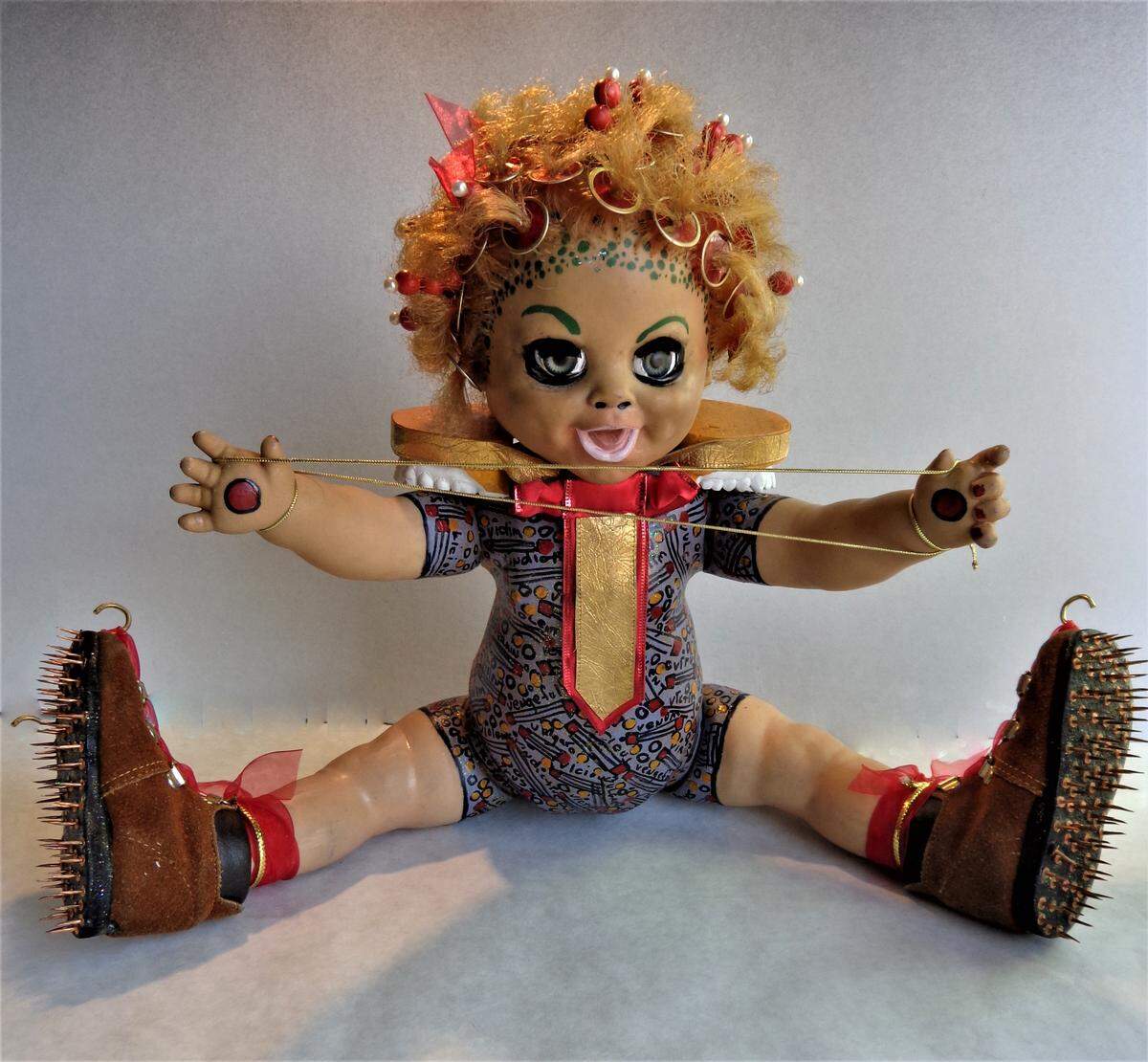
It springs to nasty, malevolent life as Vi (short for “vicious,” “violent,” “vile” and, yes, “virus”), artist Lucinda Chapman’s leering devil-doll with disease-carrying Little Orphan Annie curls, needle-spiked boots and military-style epaulets stamped with what appears to be a dental casting of human teeth.
“I poured all my fears into making this art,” Chapman explained. “I read a lot of science fiction and have long thought our world was headed for a self-correction. I had this doll in my studio which was already pretty scary, and I thought I could do something with it. I know it’s creepy, but I think if you do art that’s just simply pretty, you’re wasting everybody’s time.”
The pandemic is barely less threatening in Melanie O. Wisdom’s cartoon for her granddaughters, in which a sharp-toothed, glasses-wearing microbe tries to tempt them outdoors. “Can Kyla come out & play?” it calls. “Where is Maddy?”
“The little one (Kyla, in grade school) cries to go out and play with her friend,” Wisdom says via email. “The other (Maddy, in junior high) has always been on the go. This has been extremely hard on them both.”
The virus squiggles like some scaly creature from the deep — or out of Greek mythology — in Tom Monarch’s “Pandora’s Virus.” It manifests as a dread-inducing portal in an inky mass in Chuck Fowler’s “Virus No. 1”; as what might be a bomb threatening to detonate in Linda Carey’s “Coronavirus Superheroes”; as a queasily linked network of menacing molecules in Debra Kay Guess’s “Tracing My Contacts.”
It also takes a serious beatdown, symbolically, from photographer Don Ament in his short video “Punching Corona in the Face.” “It’s absolutely not high art, but it hopefully expresses a certain feeling I’m having,” Ament says of the video, in which he unleashes a fury of pandemic-fueled aggression on a punching bag decorated with images of the coronavirus.
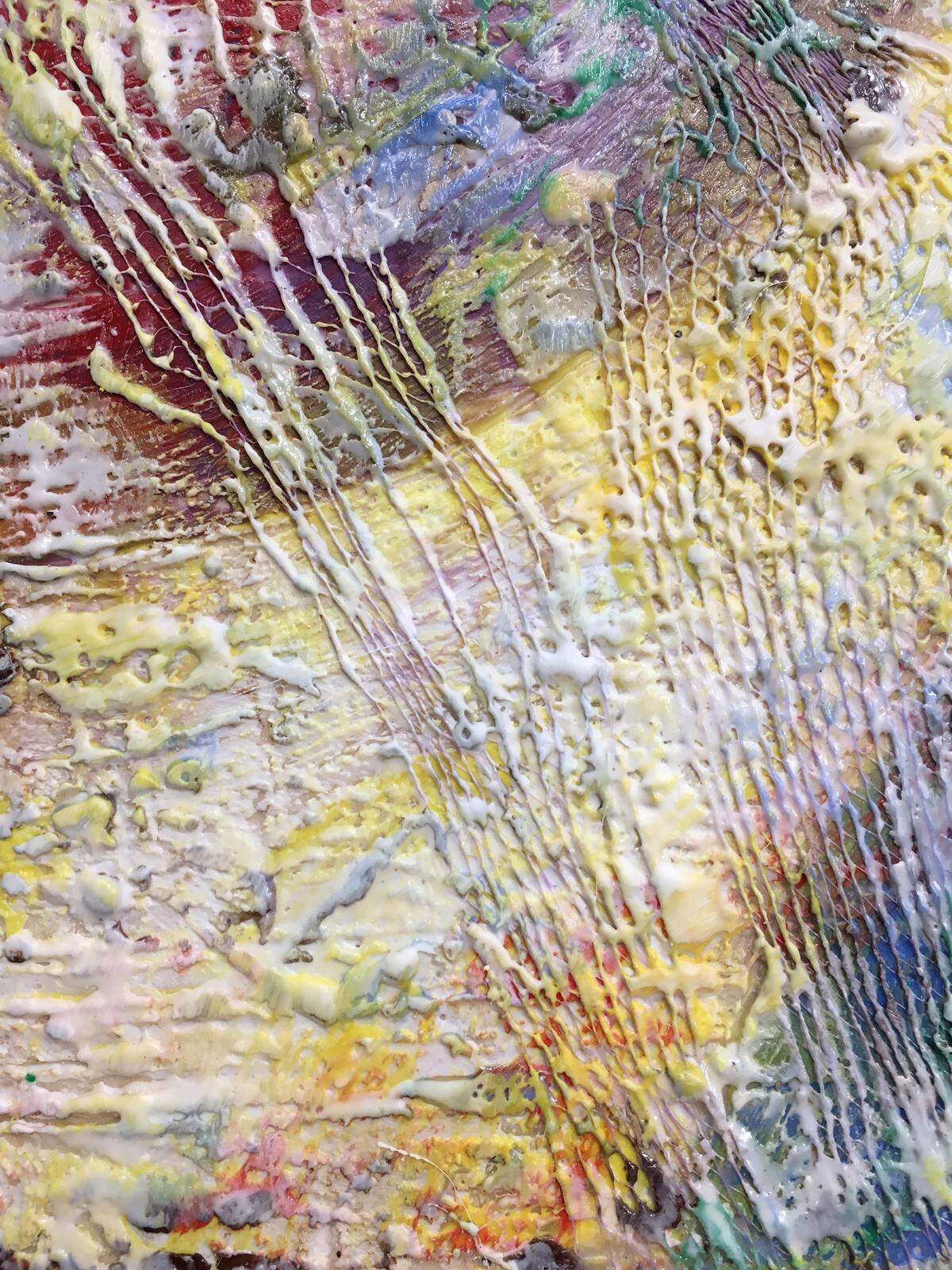
%20by%20Lennon%20Michalski.jpg "The Complication Without Medication (work in progress) by Lennon Michalski.jpg")
In “The Complication Without Medication,” a work-in-progress by abstract painter Lennon Michalski, the virus and its war on the human body are represented by different strands of swirling color.
“I’m trying to use color and design as symbols for the virus and how it’s attacking healthy parts of the body,” Michalski says. “The blue in this piece is what we would call healthy, with the reds and yellows being considered as the virus or sickness. I have these architectural designs with appendages reaching down, assembling structures (and) referencing the war between health and illness.”
But how does it make you feel
In pieces by several other local artists, the virus isn’t present at all, not directly. And yet it looms ominously large in works that radiate the gamut of emotions — most, but not all, negative — that we experience in this time of quarantine, social distancing and an uncertain future.
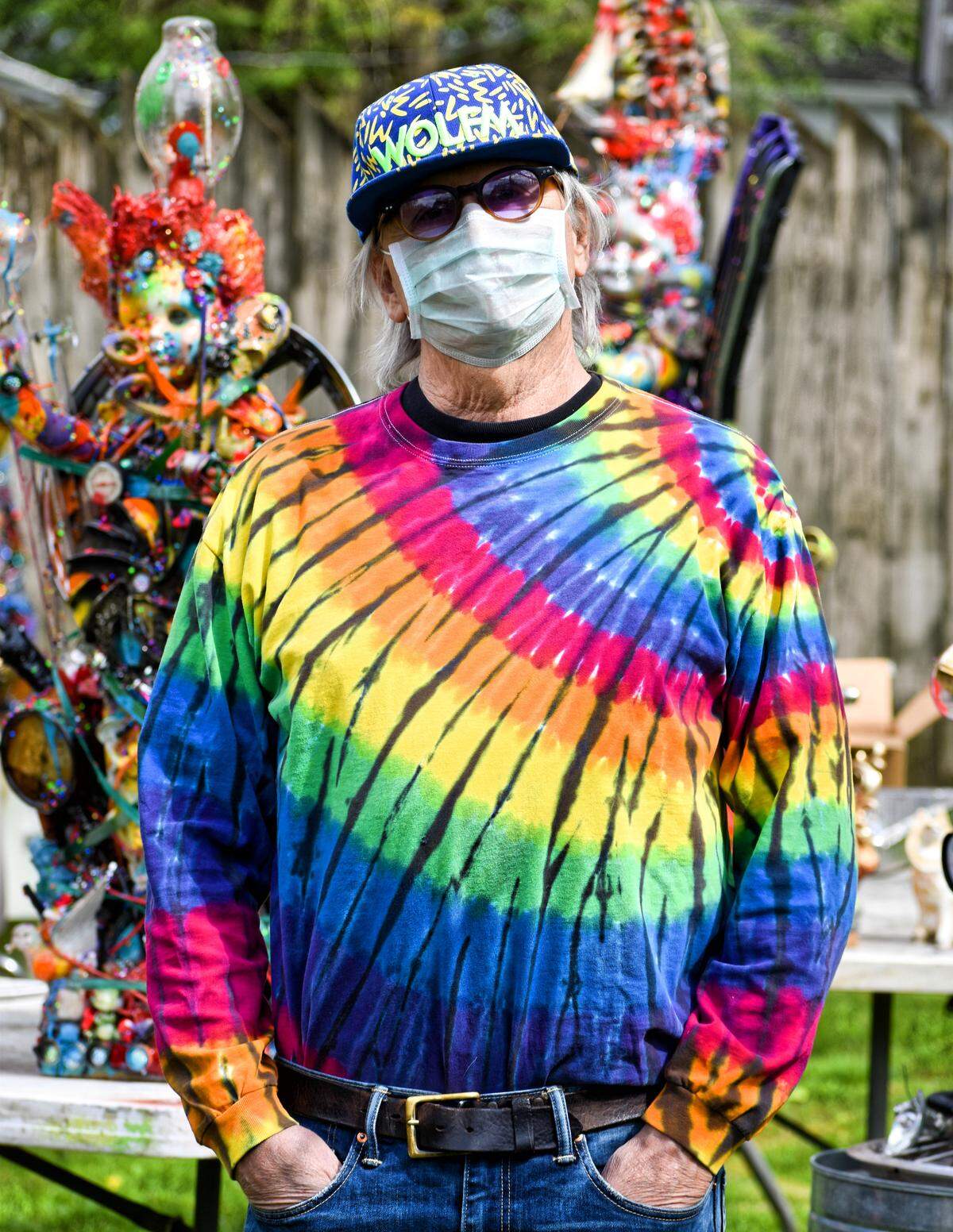
“Every day it’s driven home that we don’t know if the people we saw last week we’ll ever see alive again,” says Robert Morgan, who lost his good friend and fellow Lexington artist Carleton Wing to Covid-19 on April 2.
In response, Morgan has been working on a series of sculptural portraits in his signature style — assembled with found materials such as halogen lights, car parts and computer motherboards, all of it splashed with bright paint and encrusted with unexpected finery — depicting the absent friends and personal heroes he can no longer see, for the time being or for eternity.
“What I’d really like to emphasize with these new pieces is the difficulty of this isolation, especially in the creative community,” he said through a homemade facial mask in an interview in his backyard studio. “Here I am working on portraits of people that are close, near and dear to me, and yet I’m forced to live in isolation from those people. . . . Every night I wake up in the middle of the night and wonder if I’m going to see people again. ... It causes me to deeply reflect on what they do mean to me.”
Finding connection in isolation
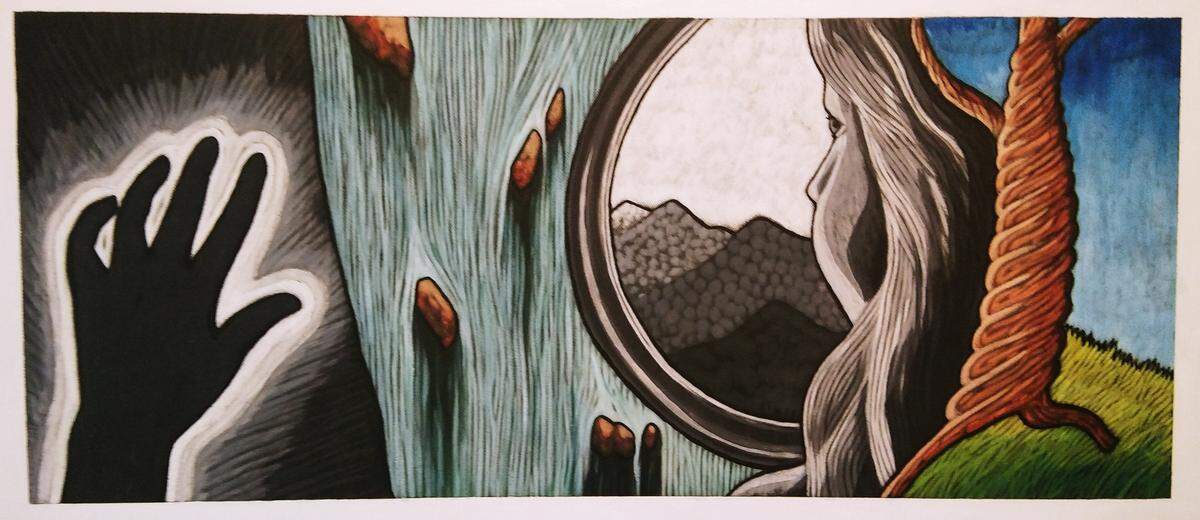
The dilemma of living without easy, in-person access to one’s family, friends and co-workers is at the core of several new works by local artists, including Cheryle Walton’s “Reaching,” depicting a woman staring out at a world she can no longer touch. “We are all reaching at this stage,” she says.
Similarly dark themes surface in “Isolation,” a portrait of loneliness by David Harover; in “Melted Feelings,” a study in emotional meltdown by Diana Suhail; in “Angel of Fear (Self-Portrait)“ by Patti Edmon; and in Ren Robinson’s “The Hostage Situation,” in which a lone woman is held literally in the grip of fear.
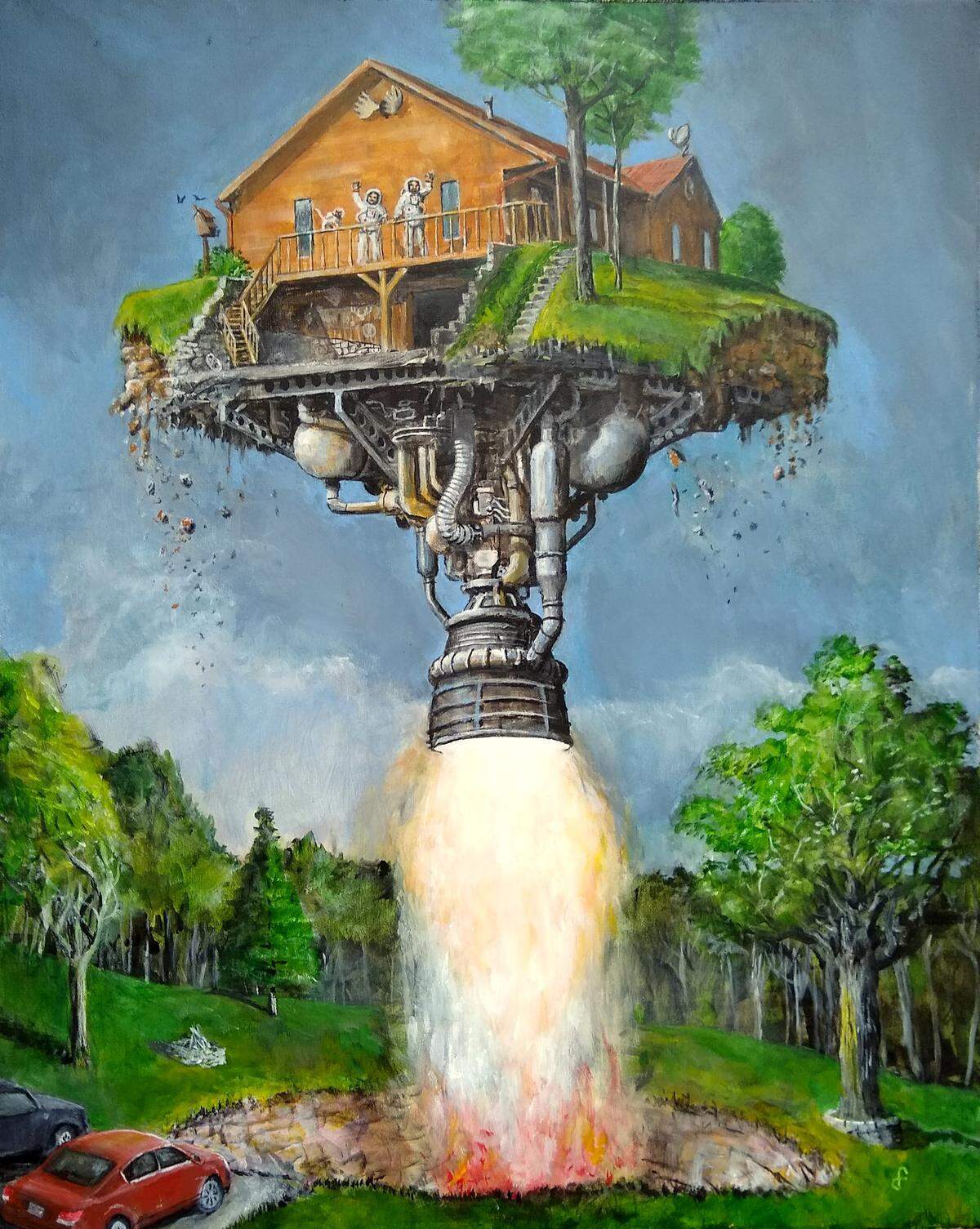
And in Damon Farmer’s tragicomic “Deep Spacial Distancing,” the artist imagines himself, his wife and their cat blasting off into outer space — “staying home yet still traveling,” he says, “and achieving extreme social distancing.”
Some artists have chosen to focus on this period as a time of contemplation, re-centering and potential for growth. Examples include Deborah Slone’s serene “Nesting,” Lakshmi Sriraman’s abstract ”Emergence” series and Kasandra McNeil’s naturalistic painting of a corner of her living room, “Morning Quarantine.”
Melissa Hall’s “Reverie,” which combines photography and encaustic (wax) painting, is part of a collaborative project she’s working on (remotely) with three out-of-town artists. “I had in mind the creativity that can grow from a period of unrest and uncertainty caused by the pandemic,” she said. “I used my photography as the base of the work; its hopefulness peeks through the chaos and tumult brought to the work by the paint.”
Another artist working in encaustic, Marta Elam Dorton, has been producing a series of untitled works that express ideas about the importance of connection with others, and oneself, in a time of disconnection.
“When I’m working I go into a space of watching forms develop, solving problems that arise and playing with colors,” she says. “It’s a mental space of wonder and wander, like a leisurely drive through a green forest. I go to a place of calm and peace. This state of mind is delicious and one that I want to duplicate as much as possible.”
Some recently created works, such as Monica Pipia’s “Just Soap and Water” and Michelle Newby Armstrong’s “Good Health = Common Wealth,” reinforce positive public-health messages.
Beyond the pandemic
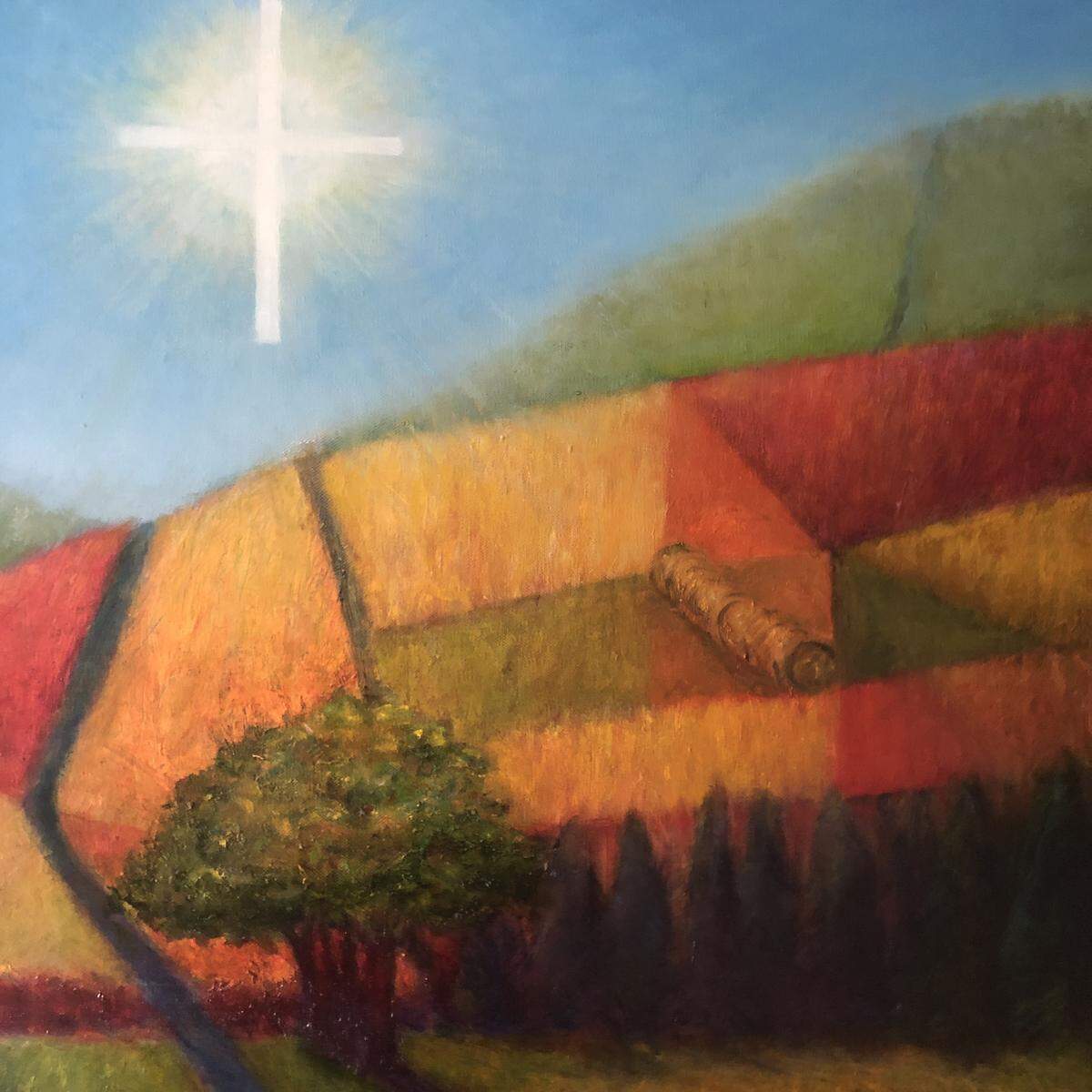
And some artists are looking past the present moment at better times to come, in this world or perhaps the next. In Cate Wagoner’s painting “Kentucky Quilt,” for example, a cross appears in a blue sky above an agrarian landscape.
“This was done in my hope that rural Kentucky, often with scant resources, will be protected and blessed,” Wagoner says. “The cross in the sky is also a remembrance of those we have loved and lost. When I was painting it into the sky, it seemed to paint itself.”
And in Arturo Alonzo Sandoval’s “Moving Toward the Light,” an ongoing series of highly reflective tapestries made of handwoven shower curtains and Mylar, the artist has turned to the Book of Revelations and its mention of the “seven spirits of God” for inspiration.
“I’m working with vertical and horizontal elements, repurposing shower curtains that have these holographic patterns,” says Sandoval, who was scheduled to have a joint exhibition with Carleton Wing beginning last month. “Each piece relates to a creative spirit, one of the seven spirits in Revelations. In the end it’s a vision of glory, of the kind you would see in the presence of God.”
%20by%20Arturo%20Alonzo%20Sandoval.jpg "Moving Toward the Light (series in progress) by Arturo Alonzo Sandoval.jpg")
This story was originally published May 12, 2020 at 10:26 AM.