
Aboriginal artist's message is unmistakable
Richard Bell's art makes a big, bold statement before you even walk through the doors of The Art Museum at the University of Kentucky.
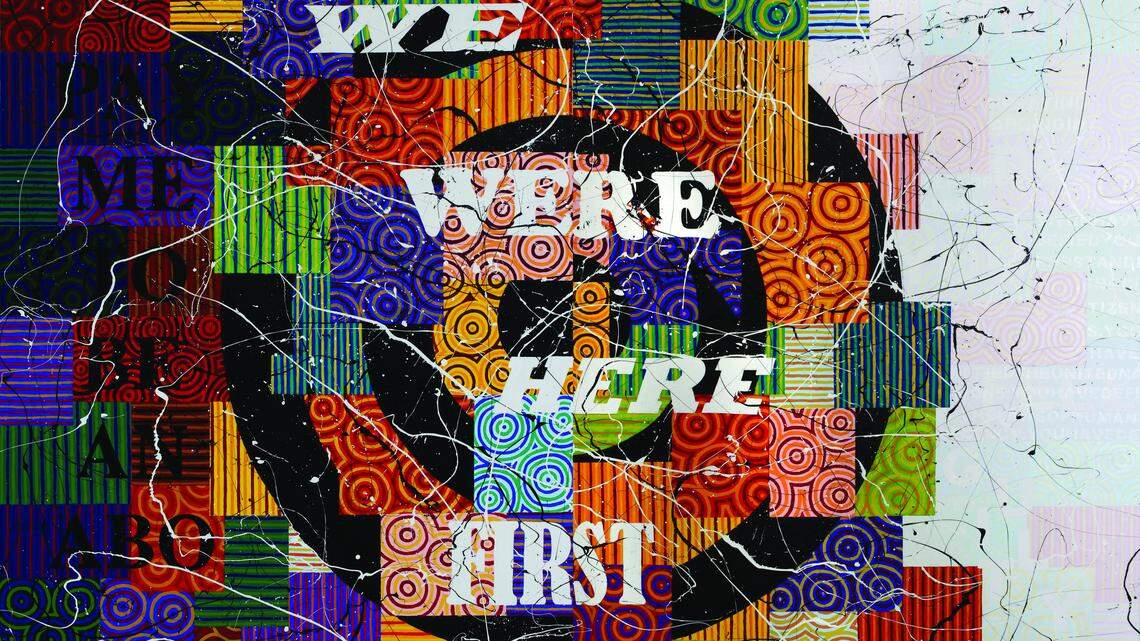
Through the windows, visitors can see the bright colors of Wewereherefirst, an 8-by-12-foot acrylic on canvas painting that declares "WE WERE HERE FIRST" in bright, white letters.
"We" are Aborigines, native Australians who were displaced by British colonists who had identified the country-continent as "uninhabited" when they arrived in the late 18th century. Bell is an Aborigine who protests racism and colonization through his art, which is obvious as you peruse the exhibit, particularly if you take a long, detailed look at it.
"He will say he is an activist before he is an artist," said Deborah Borrowdale-Cox, education director for the museum, inside the Singletary Center for the Arts.
Bell will be in Lexington for the next week for several public events, including a talk Saturday evening at the Carnegie Center for Literacy and Learning and an event Sunday afternoon at the museum.
Later in the week, he will visit Identities: There's Me and Them, an exhibition at the Lyric Theatre and Cultural Arts Center of work inspired by his show at UK, titled Uz vs. Them.
The inspiration is circular: Bell has previously drawn inspiration for his work from sources including the United States' black power movement in the 1960s and '70s, and oppressed people's many other causes around the world.
Borrowdale-Cox credits Janie Welker, the museum's curator of collections and exhibitions, with assembling the show to draw people in with its strong images and build the message, from the initial paintings out front to video installations in a back room.
"It's pretty hard to escape what he's talking about," Borrowdale-Cox says. "We don't really ask people their responses. But I think watching their faces and how they come in at one speed and leave at another, it does have a profound impact."
Welker said she had not heard of Bell until she saw materials from the American Federation of Arts promoting Uz vs. Them to museums. This is the first major exhibit of Bell's work in the United States, and UK is the second venue after Tufts University in Boston.
"They tend to do shows that are really interesting from a cultural and artistic standpoint," Welker says of the federation. "They were circulating this show about this Aboriginal artist, contemporary artist who I had never heard of, but I don't really know about the arts scene in Australia, so that's not surprising. But it sounded really interesting to us.
"It was a chance to bring in an artist from a totally different culture, but also, it was a chance to look at some issues that were common to our culture but also to look at them through the veil of another culture."
Slavery, racism and the displacement of Native Americans echo in many of Bell's pieces, notably the video Scratch and Aussie. In that piece, Bell, portraying a psychiatrist, interviews wealthy white Australians who have been the victims of robberies. They are traumatized by their plights but exhibit no sympathy when asked about the disruptions of the lives of Aborigines by colonists, and they laugh heartily at racist jokes that might sound uncomfortably familiar to Americans.
At several points, Bell says, "Give it back," meaning the land, and his white patients emphatically respond, "No!"
Much of Bell's work involves humor that sharpens the edge rather than softens the blow.
Prospectus.22 is a letter and draft treaty inviting China, not England, to colonize Australia. It's signed by Ian Di-Jinus of "The Lucky Country."
"There was never a treaty between the British, when they came into Australia and took over, and the Aboriginal people, so he decided that the Aboriginal people had a right on their own to decide who they wanted to be colonized by," Welker says. "It's an example of his wry sense of humor."
Words play a huge role in Bell's work, and many of the words are not visible to the eye. In Wewereherefirst, for example, if you stand at a certain angle, you can see extended writing, in white on white: "U have defied your upstanding citizens, You have defied the United Nations, you have defied the laws of humanity, you have defied your god."
In addition, there is a strong sense of art history, with variations on artists including Roy Lichtenstein, whose Shipboard Girl was the inspiration for The Peckin' Order, which depicts a blond woman with the thought cloud, "Thank Christ I'm not Aboriginal." The dots that make up her skin are black, not pink as they were in Lichtenstein's painting. Other works are marked by items such as paint drips that are reminiscent of Jackson Pollock, although Welker says they also echo native Australian art.
"He's really bringing things together," Welker says.
"Beyond all of that, the art is really exciting. It's bright, it's colorful, he's a wonderful painter. His work does have a political message, but he deals with it in a humorous fashion, sometimes sarcastic, sometimes wry, but in a way that always draws you in. That's what kind of drew us to this show."
This story was originally published April 13, 2012 at 8:12 AM with the headline "Aboriginal artist's message is unmistakable."