
State’s largest power company to bring energy storage system — and jobs — to EKY
Kentucky’s largest power company is joining a global energy developer on a project that could pave the way for the state’s first water-powered battery energy system, a form of stored electricity the region’s mountainous topography is uniquely positioned to provide.
Louisville Gas and Electric Co. and Kentucky Utilities are partnering with Rye Development on its Lewis Ridge pumped storage project in Bell County. It would move water between two reservoirs at different elevations to store, generating enough electricity to power nearly 70,000 homes annually.
Rye Development expects the facility to cost about $1.3 billion and estimate it would support as 2,300 jobs during an anticipated four-year construction period.
“Energy demand is on the rise,” Rye Development CEO Paul Jacob told the Herald-Leader. “Projects like this can help positively impact reliability and affordability issues stateside and regionally.
“These projects can last 100 years or longer. It’s a long-term asset that benefits the system for decades,” he said.
Energy costs are on the rise in Kentucky, especially as utilities make room in the grid for high-demand data center customers. Since 2021, average residential electric bills have increased 20%. In Eastern Kentucky, home to some of the commonwealth’s lowest-income counties, power bills have spiked the most because there are fewer residents carrying a greater share of utility costs.
What comes next for project
The Federal Energy Regulatory Commission gave the Lewis Ridge project its preliminary permit in 2022, and Rye Development is pursuing a final license company officials said they hope to secure in 2027. If evaluation of the project goes well, the utilities would then ask the Kentucky Public Service Commission for the authority to advance the project.
Lewis Ridge is expected to generate about $1.6 million in new local tax revenue through the creation of two 60-acre ponds about 1,000 feet in elevation apart to passively generate electricity in a closed loop system.
“We’re excited to partner with Rye Development to evaluate Kentucky’s first pumped storage hydro system, and we’re proud to be part of an effort that could introduce it in Eastern Kentucky,” said Liz Pratt, LG&E and KU’s senior director of communications and corporate responsibility.
Rye Development has positioned itself to reapply pumped storage hydropower to the domestic electricity grid amid a resurgence in renewable energy interest from utilities and localities scrambling to attract data center customers.
The company has already gotten federal approval for larger water batteries in Oregon and Washington, but Jacob said Lewis Ridge could serve as a case study for putting them on former coal mines in Appalachia.
There are more than 45,000 surface mine sites located throughout Eastern Kentucky, more than half of which are concentrated in a 15-county region extending from Bell to Greenup counties, according to data from the state Environment and Energy Cabinet.
“Part of what we’re looking for with this project was to prove that out,” he said. “When we studied that on paper, we realized there’s no reason it shouldn’t work, but the only way to really test it out is to do the geology, do the boreholes, do the calculations — really do that work and say, ‘This will work.’”
Jacob said that work has been done and it proves Appalachian mine sites are primed to host gravity-fed water batteries. Now, he said, it’s up to federal regulators to back the research his company and its contractors have produced.
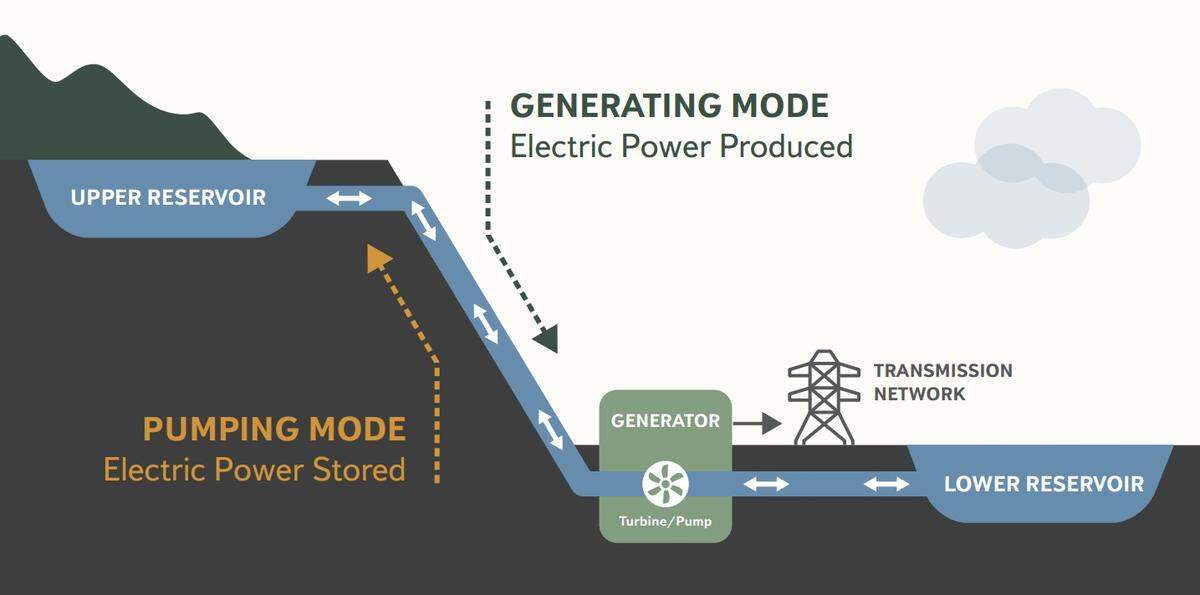
Water batteries, which account for 90% of the nation’s utility-scale energy storage capacity, don’t work everywhere. They need high- and low-elevation areas close to each other, along with access to transmission lines, water and a workforce.
“All of those things are what we found in Bell County, and all of those things exist throughout Appalachia and throughout Eastern Kentucky and that region,” Jacob said. “Part of what excites us about this project is the ability to repeat this at other sites.”
Stored hydro reemerges
The eight-hour Lewis Ridge pumped storage site could generate 266 megawatts of on-demand electricity daily, enough to power as many as 67,000 homes a year, officials said.
That would make it Kentucky’s second-largest hydropower generating station behind the Tennessee Valley Authority’s Wolf Creek Dam in Russell County. The dam has a capacity of 270 megawatts, according to the National Hydropower Association.
Kentucky has 12 hydro plants in total.
Large-scale water batteries use periods of excess electricity to pump water to an upper reservoir and allow gravity to feed turbines downstream when demand is high.
There are 43 pumped storage hydropower facilities in the U.S., most of which were developed in the 1970s to support nuclear and thermal plants that used coal. As those fuel sources waned, so did energy storage systems.
Rye Development said the Lewis Ridge project would be the first, new development of its kind in about 30 years.
U.S. electricity storage capacity is expected to double this year as utilities seek to stabilize the grid and new, high-demand tech customers enter the market. Those changes are leading grid operators back to renewable fuels that shave costs during peak demand.
Federal energy policy alters KY projects
The first-of-its-kind coal-to-pumped storage facility was approved for an $81 million federal grant from the U.S. Department of Energy’s Clean Energy Demonstration Program on Current and Former Mine Land grant in March 2024.
When the grant was awarded and announced, the developer said once the facility was operational, it would support 30 jobs.
That grant is funded through the Bipartisan Infrastructure Law, signed in late 2021 by former President Joe Biden. His administration championed efforts by the DOE to invest in clean energy projects, especially those on current and former mine land.
In May 2025, President Donald Trump’s DOE Secretary Chris Wright said the department had canceled two dozen grants awarded from the same office that gave the Lewis Ridge project money.
Reversal in federal energy policy positions has resulted in a number of Kentucky projects changing drastically. A company that planned to build a $1 billion electric vehicle battery recycling facility in Hopkinsville voluntarily filed for Chapter 11 bankruptcy April 9.
And late last year, the joint venture to make electric vehicle battery parts for Ford Motor Co. dissolved after just four months of operations outside Elizabethtown.
Regardless, the Bell County project aligns with Kentucky Gov. Andy Beshear’s energy strategy, KYE3. In a statement to the Herald-Leader, a spokesperson said the governor was proud to announce project plans in 2024 and “is excited to see progress being made through the LG&E and KU partnership.”
In 2024, the most recent year of data compiled in the federal Energy and Employment Report, there were 156,051 energy workers in Kentucky. The majority of those were employed in the motor vehicle manufacturing sector.
Since 2022, Rye Development has worked alongside one of Kentucky’s six regional innovation hubs, the nonpartisan nonprofit Shaping Our Appalachian Region, to craft a plan that prioritizes local hiring with several area unions and workforce training through the Southeast Kentucky Community & Technical College.

.JPG)