UK’s $7 million field hospital for coronavirus patients, never used, to be taken down
Roughly a month after the state’s largest hospital system scrambled to construct a 400-bed field hospital to treat an overflow of COVID-19 patients, university officials have announced the facility will close without ever having been used.
“Our decision was based on our continued evaluation of the trajectory of the virus,” UK spokesman Jay Blanton said Tuesday. “Initial modeling a few months ago projected a spike in the virus. Thanks to the social distancing and public health efforts at the state level, we have not experienced that spike,” he said, adding that most models now “continue to show a flattening of the curve.”
Though at least 6,677 Kentuckians have been infected with the new coronavirus, and 311 people have died, Gov. Andy Beshear has said the state’s infection rate has remained steadily plateaued over the last few weeks, meaning the infection curve upward has been successfully blunted. Hospitals across the state, as a result, never saw the projected surge in coronavirus patients.
But Beshear and Public Health Commissioner Steven Stack have continued to warn Kentuckians that the virus is still out there, and people’s chances of contracting it will only increase as the state, starting this week, gives gradual permission for more people to return to work, go back to church, eat out at restaurants, and visit with friends and family.
Back before the infection curve was flattened, UK hired Emergency Disaster Services on April 2 and spent almost $6.8 million to build the temporary turnkey facility, according to the contract. Emergency Disaster Services is a Kentucky company founded by Jerry Lundergan — father to the former Secretary of State Alison Lundergan Grimes and former Kentucky Democratic Party chairman — and still owned by three of his daughters. Lundergan last September was convicted of funneling illegal corporate campaign contributions to his daughter’s 2014 U.S. Senate bid.
In late April, UK furloughed 1,700 employees, including 1,500 in health care, to help compensate for its coronavirus-revenue shortfalls. At that time, UK had invested “some $20 million in COVID-related expenses,” UK President Eli Capilouto said, including ramped up testing and telehealth services. UK has since sent a request to the Federal Emergency Management Agency for some amount of reimbursement, but FEMA has not yet provided that relief, Blanton said.
Last week, under the terms of its field hospital contract, UK had to tell Emergency Disaster Services whether it wanted to keep the facility for another month, or take it down — a decision “we have been evaluating for some time,” Blanton said.
The field hospital will be deconstructed by May 20, around the same time Kentucky will reopen its retail stores, houses of worship and restaurants at partial capacity, and allow people to gather in groups of 10 or fewer. State officials are generally expecting and preparing for more cases to crop up as the economy continues its phased reopening. The challenge in reopening, Beshear has said, is to do so while avoiding a second spike in cases — the very thing the state’s field hospitals were built to absorb.
Though the overall curve is plateaued, since mid April, the rate of people with COVID-19 hospitalized, or worse, put in intensive care units in critical condition, is creeping upward — a development Beshear said his administration is closely monitoring. There were 383 people with COVID-19 hospitalized in Kentucky on Monday, including 220 in an intensive care unit.
That uptick is also evident at UK, where the number of hospitalized patients with coronavirus has doubled so far this month, jumping from 11 patients at the beginning of the month, to 24 on May 11, according to system data. On Monday, 12 patients were in the ICU, up from four on May 1.
The field hospital was set up in mid April on the south side of campus, near Kroger Field, in the Nutter Field House, the UK football team’s practice facility. At that time, the number of new coronavirus cases was still on the incline, and state and university leaders publicly projected that Kentucky’s peak would potentially overwhelm capacity at the state’s largest hospital system, necessitating an overflow medical facility.
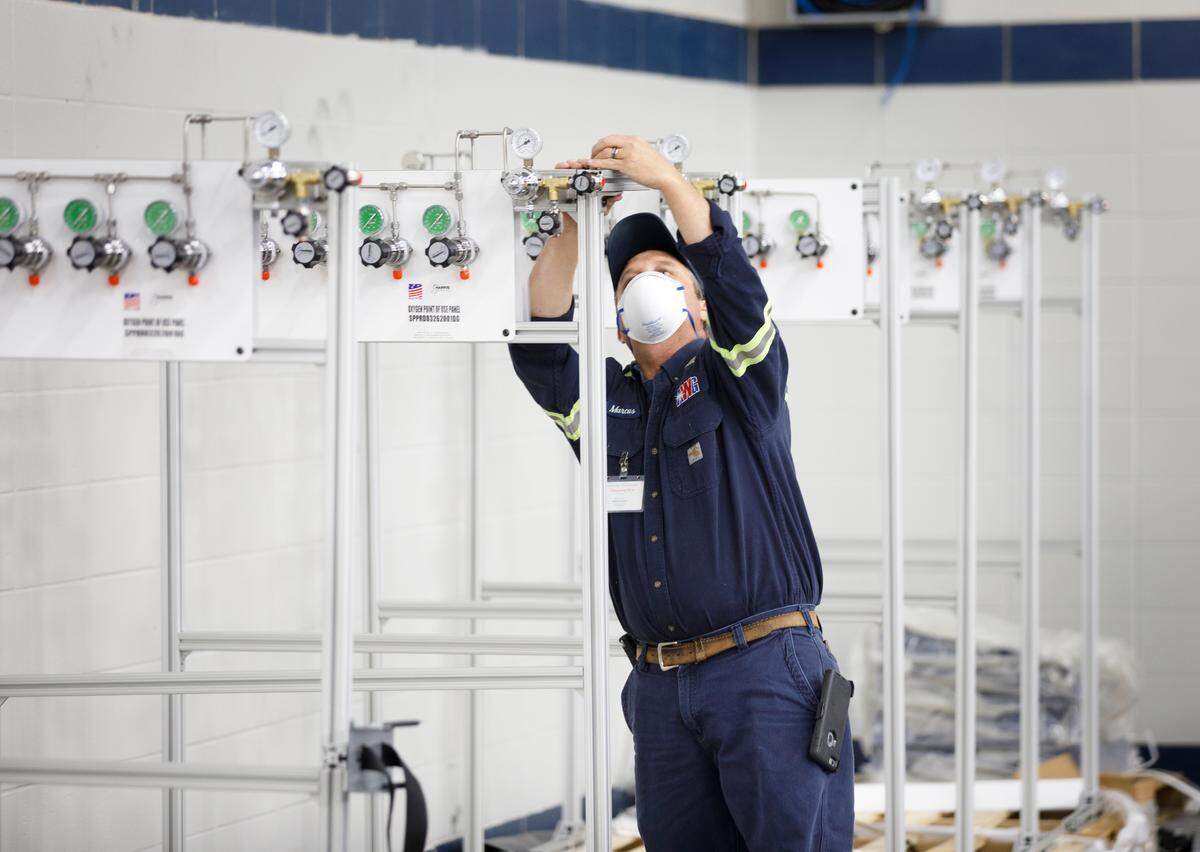
It has 400 partitioned rooms, heavy duty cots, break rooms, a nebulizing station for breathing assistance, shower and sanitation units, laundry services, and temporary generated power, ensuring potable water for food services, showers and bathrooms.
When UK announced in early April it would build the facility, Dr. Mark Newman, UK’s executive vice president for health affairs, said it was something “we hope we don’t need.” But, “should we need the beds,” he said, “we wanted scale [and] the ability to be able to respond to potentially worst case scenarios.”
It’s not the only Kentucky field hospital built to treat COVID-19 patients that’s gone unused. In Louisville, a field hospital with a 2,000-bed capacity was constructed last month with help from the Army National Guard at the Kentucky Exposition Center on the city’s fairgrounds that. So far, it has treated no patients.
Even though it hasn’t yet been needed, Beshear said earlier this month the facility would remain intact. “We are going to keep everything in place, while not staffed on a daily basis, [it’ll be] ready to go at any time we need it,” he said on May 1, adding that it may eventually serve as a COVID-19 wing for long-term care facilities with outbreaks.
At UK, Blanton said another factor in the university’s decision was the trajectory of the virus in Eastern Kentucky, where there is a shortage of critical care and intensive care unit beds. Unlike Western Kentucky, which boasts most of the highest virus infection rates per capita, Eastern Kentucky has kept the virus relatively contained. But any case spike in this part of the state would mean more of those patients seeking treatment at UK. It’s a “scenario we have been planning for in coordination with other hospitals in Lexington and the region,” he said.
The UK HealthCare system, which includes UK Chandler and Good Samaritan hospitals, has a total of 945 beds, but its surge capacity is nearly 1,300. Going forward, the plan is to reserve about 30 percent — 300 to 400 beds — for COVID-19 surge patients, Blanton said. That’s all the hospital projects it will need.
This story was originally published May 12, 2020 at 3:22 PM.