
Know Your Kentucky

Lexington’s first ‘skyscraper’ was 15 stories of dreams and downtown commerce
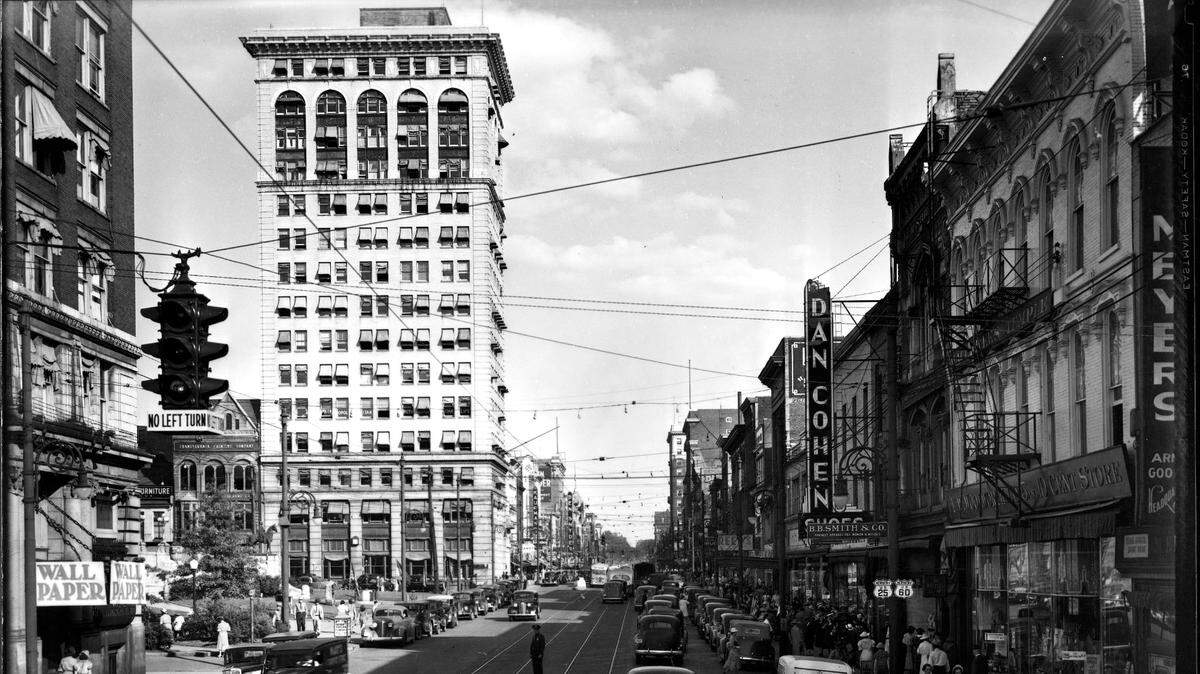
Main Street, downtown Lexington, circa summer 1938. Rails run down the street, but around this time streetcar service was discontinued in Lexington. Like most American cities, as roads were improved and more people bought automobiles, trolley tracks were pulled up or paved over. Motor buses took over the steadily declining demand for public transportation. In the lower left corner of the picture you can see two women and a child waiting for the bus that coming towards them. Along the left side is what is now Henry A. Tandy Centennial Park. Further down is Lexington’s first skyscraper, the First National Building. Built in 1913, it is now a 21c Museum Hotel. The buildings on the right include a Woolworth five-and-dime store and clothing store B.B. Smith & Co., whose sign said it was “Correct Appareral for Women & Misses”. This is now the site of the Lexington Financial Center, or more commonly known as the “Big Blue Building”.
Main Street, downtown Lexington, circa summer 1938. Rails run down the street, but around this time streetcar service was discontinued in Lexington. Like most American cities, as roads were improved and more people bought automobiles, trolley tracks were pulled up or paved over. Motor buses took over the steadily declining demand for public transportation. In the lower left corner of the picture you can see two women and a child waiting for the bus that coming towards them. Along the left side is what is now Henry A. Tandy Centennial Park. Further down is Lexington’s first skyscraper, the First National Building. Built in 1913, it is now a 21c Museum Hotel. The buildings on the right include a Woolworth five-and-dime store and clothing store B.B. Smith & Co., whose sign said it was “Correct Appareral for Women & Misses”. This is now the site of the Lexington Financial Center, or more commonly known as the “Big Blue Building”. Lafayette Studio Collection/UK Special Collection

Editor’s Note: As Lexington celebrates the 250th anniversary of its founding, the Herald-Leader and kentucky.com throughout 2025 will share interesting facts about our hometown. Compiled by Liz Carey, all are notable moments in the city’s history - some funny, some sad, others heartbreaking or celebratory, and some just downright strange.

Jan. 29, 1914: The First National Bank Building opens.

Originally the Fayette National Bank Building, it was the city’s first skyscraper. The historic 15-story high-rise on West Main Street was designed by a New York architectural firm McKim, Mead and White.

McKim, Mead and White are considered some of the most influential architects, along with Frank Lloyd Wright, in American history. Their other designs included Madison Square Garden, Penn Station in New York City and the Boston Public Library.

According to an article in the Herald-Leader at the time, the bank’s president, J. Edward Bassett, wanted the firm to create an architecturally significant building for downtown that “would serve as a catalyst for other commercial activities that would renew Lexington’s financial future.”

Fayette National Bank was founded in 1870, and the bank’s founders wanted a building that would mirror the bank’s prominence in the community. The building was built for about $400,000, records indicate, or about $12.6 million in 2024 funds. When the bank opened, the public was given the opportunity to ride elevators to the top of the building and look out at the panoramic view from the roof. It was the first time any such experience was provided in the city.

Later, the bank would become the First National Bank. In 1980, the building was placed on the National Register of Historic Places.
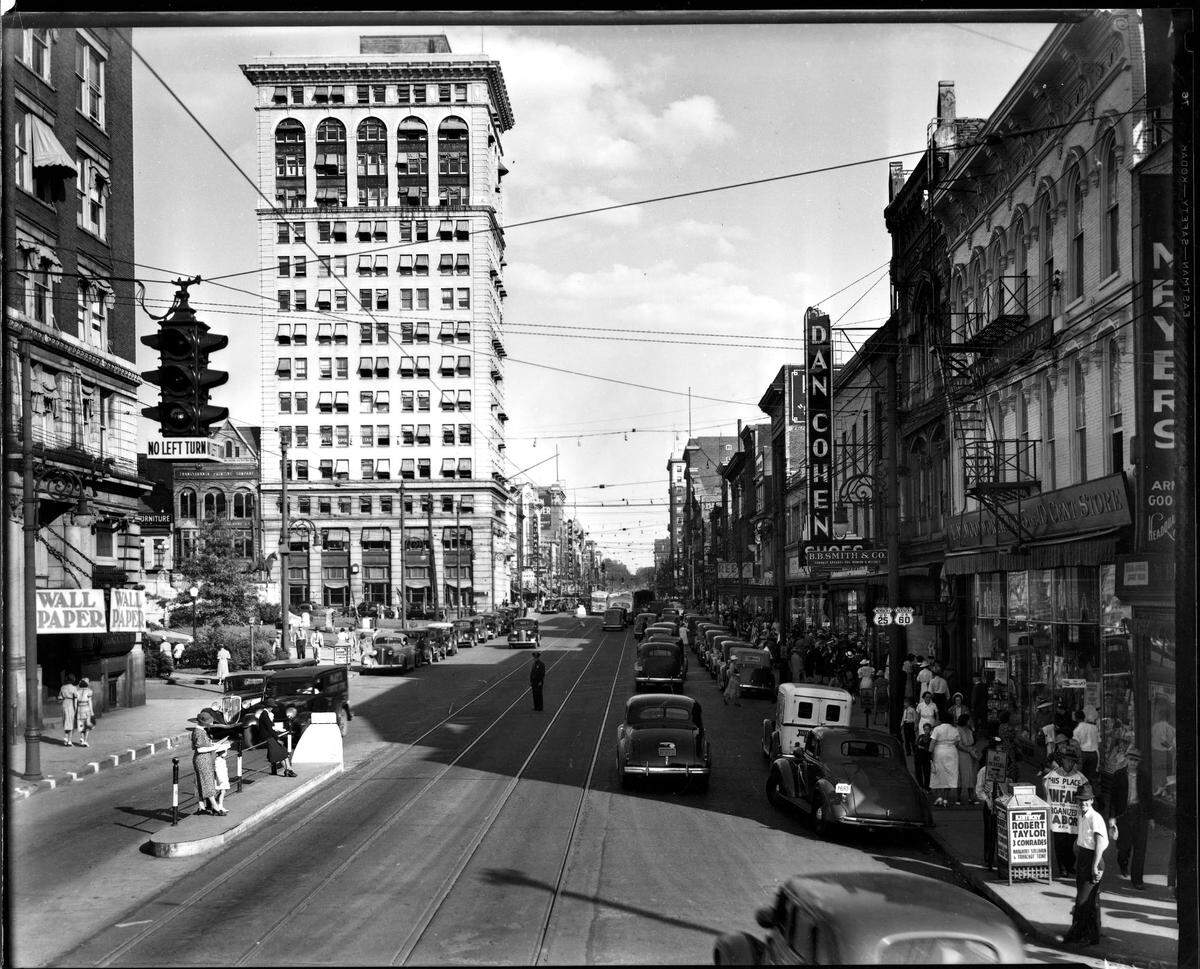
Main Street, downtown Lexington, circa summer 1938. Rails run down the street, but around this time streetcar service was discontinued in Lexington. Like most American cities, as roads were improved and more people bought automobiles, trolley tracks were pulled up or paved over. Motor buses took over the steadily declining demand for public transportation. In the lower left corner of the picture you can see two women and a child waiting for the bus that coming towards them. Along the left side is what is now Henry A. Tandy Centennial Park. Further down is Lexington’s first skyscraper, the First National Building. Built in 1913, it is now a 21c Museum Hotel. The buildings on the right include a Woolworth five-and-dime store and clothing store B.B. Smith & Co., whose sign said it was “Correct Appareral for Women & Misses”. This is now the site of the Lexington Financial Center, or more commonly known as the “Big Blue Building”.
Main Street, downtown Lexington, circa summer 1938. Rails run down the street, but around this time streetcar service was discontinued in Lexington. Like most American cities, as roads were improved and more people bought automobiles, trolley tracks were pulled up or paved over. Motor buses took over the steadily declining demand for public transportation. In the lower left corner of the picture you can see two women and a child waiting for the bus that coming towards them. Along the left side is what is now Henry A. Tandy Centennial Park. Further down is Lexington’s first skyscraper, the First National Building. Built in 1913, it is now a 21c Museum Hotel. The buildings on the right include a Woolworth five-and-dime store and clothing store B.B. Smith & Co., whose sign said it was “Correct Appareral for Women & Misses”. This is now the site of the Lexington Financial Center, or more commonly known as the “Big Blue Building”. Lafayette Studio Collection/UK Special Collection

Eventually, the bank closed. Without an appropriate tenant to fill the space, finding suitable use of the building was difficult.

However, in 2012, the 21c Museum Hotel company bought the building for $3.1 million and hired New York-based Deborah Berke Partners, and Pittsburgh-based Perfido Weiskopf Wagstaff + Goettel to convert the building into a hotel.

The reconfiguration includes 88 hotel rooms, a restaurant and a museum space.

Officials estimated the renovation cost more than $43 million. The hotel opened in December 2016, and was inducted into the Historic Hotels of America, a program of the National Trust for Historic Preservation, three years later.

250 Lex logo
250 Lex logo

This story was originally published January 29, 2025 at 2:16 PM.

Follow More of Our Reporting on 250 LEX

Richard Green
Lexington Herald-Leader
Richard A. Green was the executive editor of the Herald-Leader from August 2023 to November 2025. 
Get one year of unlimited digital access for $159.99
#ReadLocal

Only 44¢ per day

SUBSCRIBE NOW