
105 years later, efforts by Lexington women to earn voting rights still resonate
Editor’s note: Throughout 2025, the Herald-Leader will be spotlighting key moments and individuals in Lexington’s vibrant 250-year history. Today, we look at the role women in Lexington played in the passage of the 19th Amendment.
They came from local neighborhoods, urban and rural parts of Kentucky, even from nearby states.
Teachers, businesswomen and high school and college women.
Homemakers and social club members.
Veterans, laborers, professional men and elected officials.
On a sunny May morning in 1916, more than 1,000 marched along Main Street in downtown Lexington. Most were dressed in white and carrying homemade signs demanding equal voting rights for women.
Shop owners and community members lined the route, cheering the passersby who convened in Cheapside, originally the city’s Public Square. There, some 3,000 to 4,000 more Lexingtonians gathered to rally for the cause.
The next day’s Lexington Herald declared it the largest suffrage parade in the history of Kentucky.
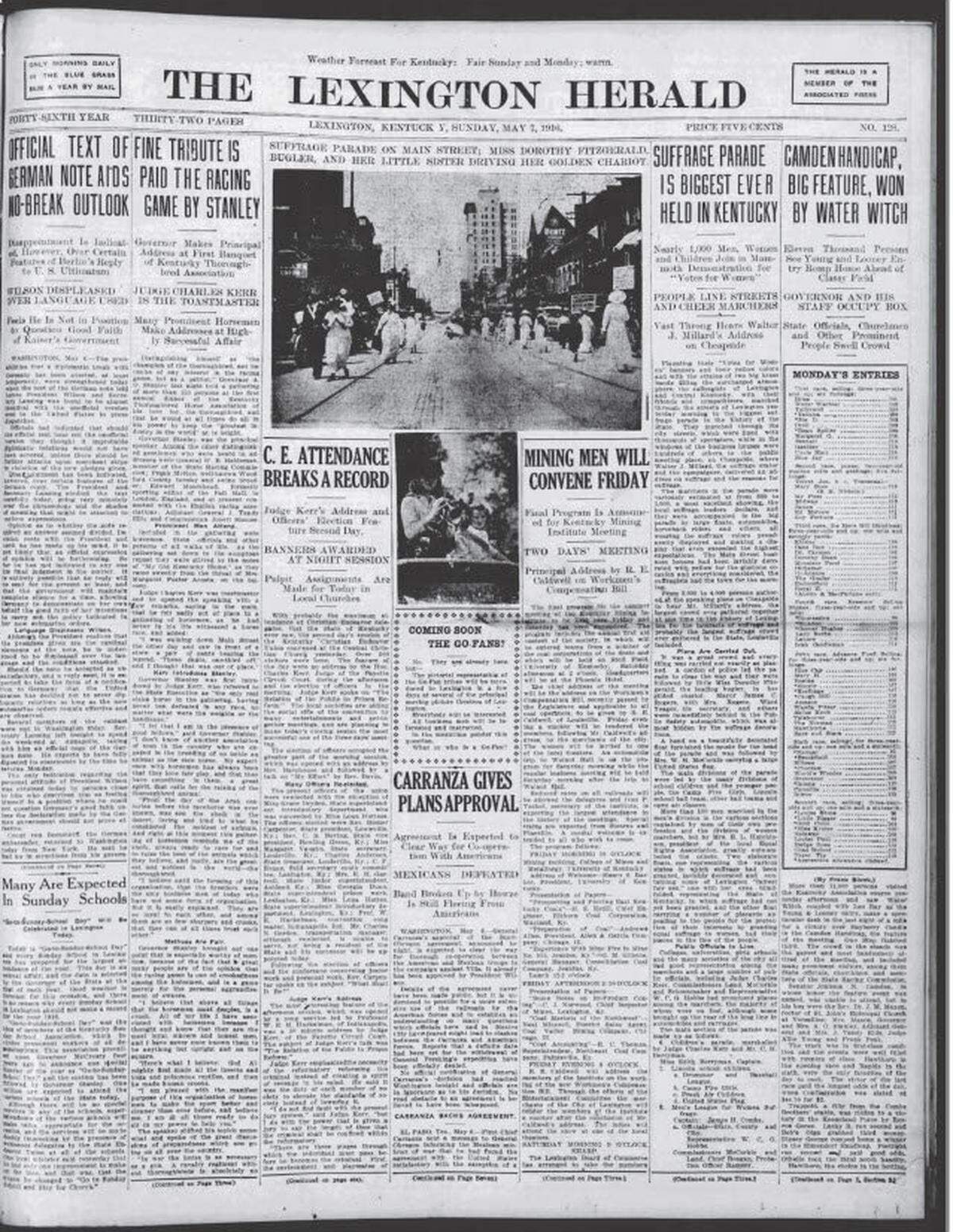
But the event that had been months in the making actually came years after other work.
First came efforts to pass laws against child labor. Then work to regulate housing and establish garbage collection and sanitation practices.
Next, attempts to publicize the often-dire conditions of laborers and working women.
All of it came before women in Lexington began organizing to earn voting rights.
“Let’s put ourselves back in that time. ‘Respectable’ women, ‘conventional’ women, didn’t want to talk about suffrage, it was much too radical,” said Ann Taylor Allen, a retired professor of history and women’s studies at the University of Louisville.
Societal issues, such as education, health and wellness, were considered natural interests of women, said Allen, 81.
So, driving large-scale community change in those areas was not only their right, but early organizers saw it as their duty.
“Increasingly, suffrage became a way of achieving these other ends,” Allen said. “In other words, (suffrage) gave them the ability of reforming society in the way that women believed it should be reformed.”
More than 100 years after the 19th Amendment was ratified, giving women nationwide the right to vote, historians and scholars recall the work done in Lexington that amplified female voices.
As the city celebrates its founding in 1775, honoring the work of revolutionary women is one part of those remembrances.
Don’t call them ‘suffragettes’
Rallying around educational issues was one of the first ways that women in Kentucky raised their collective voices for change.
Long before widespread voting rights, some Kentucky women had the chance to go to the polls on educational issues.
In 1838, state lawmakers granted limited voting rights for school board issues and school taxes to unmarried women or widows who owned property, were over 21 years old and lived in the school district in question.
“The 1838 law was a part of that revolutionary idea that everybody should be educated, even poor people,” said Randolph Hollingsworth, a Kentucky historian who taught for more than three decades, including at the University of Kentucky.
Kentucky lawmakers were second only to those in New Jersey when it came to including women in educational voting.
“Lexington was the center of that economic and educational reform effort, as well as the center of many different kinds of educational opportunities for women, including Black women,” said Hollingsworth, 68.
“The strength of that kind of human rights movement was consistent and continuing, rather than all of a sudden popping up out of the vacuum.”
The law was repealed in the early 1902, when lawmakers fretted over more Black than white women exercising their freedoms.
Still, the fact that the law had existed brought national attention to women in Kentucky and specifically in Lexington. That’s where Mary Ellen Britton, a Black doctor and educator, and Laura Clay, her sister Mary Barr Clay and their cousin, Madeline McDowell Breckinridge all were active in social reformation.
Like Britton, who wrote extensively in opposition to Jim Crow laws, Hollingsworth said the Clay sisters were vocal on human rights issues, challenging the common thinking of the day relative to women and children’s rights, and “challenging Plessy vs. Ferguson before it was handed down.”
The landmark 1896 “separate, but equal” ruling became the legal basis for racial segregation across the U.S. until the 1954 Brown v. Board of Education decision declaring separate facilities inherently unequal.
But Hollingsworth took care not to call those early voting rights pioneers ‘suffragettes.’
“To Lexington women, Black or white, the term was a slur. This was a term they wanted to avoid,” she said.
“That’s why they were late on parading, too. They wanted to show that they were actually very respectable.”
There remains a need to be vigilant
Women were coming together in their churches, social clubs and because of community projects, and it was in those spaces that the suffrage movement began to grow — albeit slowly.
“The simple fact that suffrage was associated with a lot of traditionally ‘radical’ causes, things like abolition, and very early on with temperance — here in Kentucky, people don’t like you messing with alcohol issues — so they see women as a threat,” said Melanie Beals Goan, a 20th-century history specialist at the University of Kentucky.
“They’re saying that suffrage is tied up with all these things.
She added: “When you think about suffrage taking 70-plus decades in the United States to achieve, when it seems like such a no-brainer. ‘Okay, we (women) should be able to vote.’ But because race and gender issues intersect in ways that there’s a real fear that if you extend a vote to women, it’s going to then mess with Southerners attempts to disenfranchise Black men after the Civil War.”
Because even though Kentucky was a Union state, Beals Goan said, “the state was always with the South.”
So, the movement struggled internally and externally, because voices that had been united for women’s rights were suddenly instead adopting an ‘us or them’ argument.
“I remember reading, and I can’t remember who wrote the piece, but someone talking suffrage and voting rights and rights in general, that it’s less a switch that gets flipped, and more of a dial that you can dial up or dial back.”
Beals Goans said women, specifically, and citizens in general must “be so vigilant and so mindful, because rights that are won in one moment — school suffrage is a great example — can be lost again.
“Some of the trade-offs and the sacrifices that sometimes we’re willing to make to protect rights for some, while eroding rights for others,” she said.
“And we certainly see that in the suffrage movement. Women who are scrambling to try and prevent losing their school vote, they’re saying, ‘Well, protect us who can read and write.”
This story was originally published March 27, 2025 at 1:30 PM.