
‘The house that Rupp built’: History of UK’s Memorial Coliseum
Editor’s Note: As Lexington celebrates the 250th anniversary of its founding, the Herald-Leader and kentucky.com each day throughout 2025 will share interesting facts about our hometown. Compiled by Liz Carey, all are notable moments in the city’s history — some funny, some sad, others heartbreaking or celebratory, and some just downright strange.
Seventy-five years ago, “the house that Rupp built,” Memorial Coliseum, was dedicated.
Crowds wanting to see the University of Kentucky’s 10,000-seat home of basketball started lining up outside of Memorial Coliseum on the morning of May 28, 1950.
The $4 million project — about $53 million in today’s dollars — started in 1941 when UK President H.L. Donovan recommended building the coliseum to “properly take care of our athletics, our health services, our physical education and our recreation.”
Four years later, the university had secured the propertyand approved drawings by architects John T. Gilling and his colleagues Ernest Johnson and Hugh Meriweather. The only thing standing in the way was approval from the federal government and materials.
Five years later, the UK basketball program was saying good-bye to the old in preparation to move into the new.
“After a quarter-century of ‘mothering’ University of Kentucky basketball teams from comparative obscurity to national and world-wide fame, old Alumni gymnasium retired from service as the home of Kentucky basketball,” an article in the Lexington Leader on Feb. 26, 1950, said.
Later that year, Memorial Coliseum opened.
Dedicated to the more than 10,000 Kentuckians who lost their lives in World War II and the Korean War, more than 12,000 people piled into its halls, eager to see the new building on opening day.
Some 6,000 of those attending were family members of the soldiers to whom the building was dedicated.
Attendees listened to Daniel Poling, editor and president of the Christian Herald, as he talked about the threat facing the country from communism and how it threatened the American way of life.
“Never before in all of recorded history has human liberty been so threatened,” he said. “Only strength, comprehensive strength — moral, spiritual and physical strength — is adequate for freedom’s highest hour.”
The coliseum’s first event was the University of Kentucky’s baccalaureate services for the graduating class. Later the coliseum would be the site for men’s and women’s basketball games, public performances and lectures (including actor Charles Laughton, the London Philharmonic and pianist Arthur Rubenstein).
In June, organizers announced that Eleanor Roosevelt would lecture at the coliseum. Then Roosevelt’s team threatened to not come if tickets were not sold to Black Lexingtonians the same as they were to white residents.
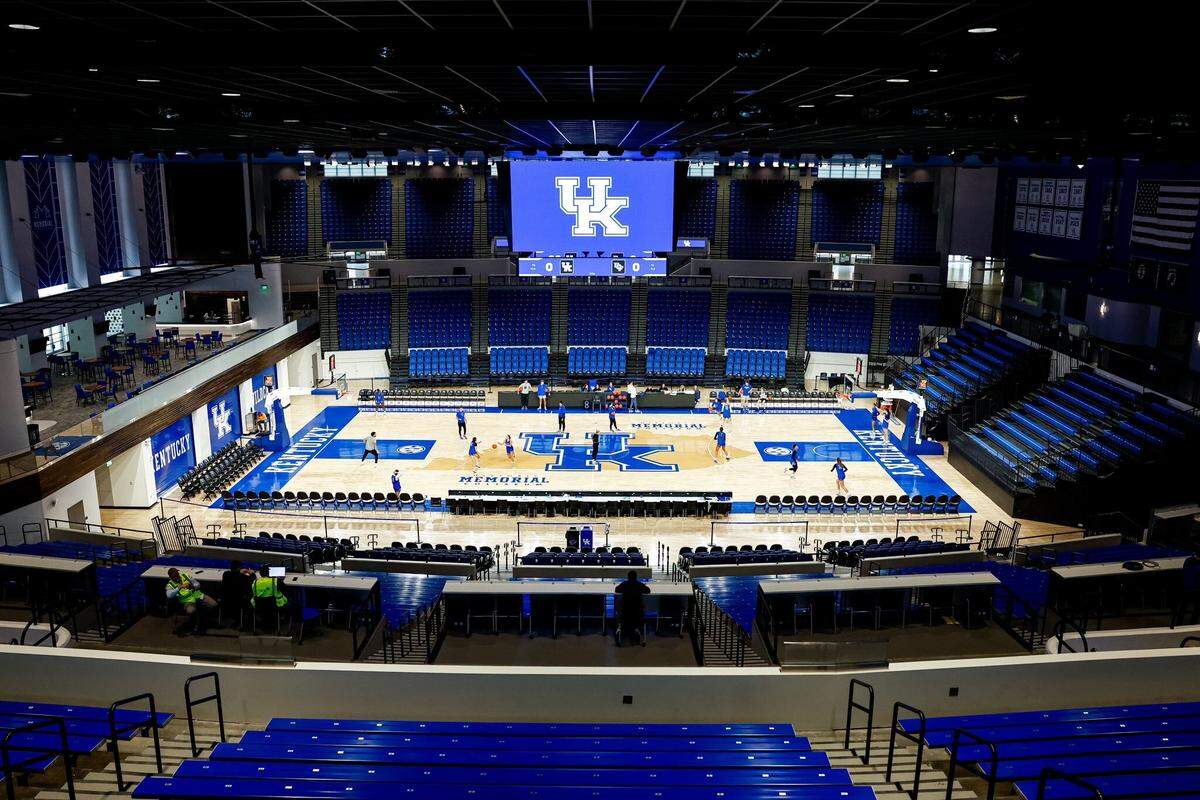
Although organizers and the university assured Roosevelt that tickets were sold to everyone in the same fashion, Roosevelt ultimately canceled due to commitments at the United Nations.
Memorial Coliseum covers an entire city block. In 1976, the UK men’s basketball team began playing at the newly opened 23,000-seat Rupp Arena. Memorial Coliseum became the exclusive home to the UK women’s basketball team.
In 1990, renovations to the facility included new weight training facilities, new basketball and athletics administration offices, a team meeting room and players’ lounges, the school said. But, the renovation meant the loss of some 3,000 seats.
Other renovations followed — a new state-of-the-art playing surface, a new sound system and speaker cluster and new offices.
UK is one of only four schools in the SEC whose volleyball team competes in its main athletics arena. The coliseum is also home to the school’s STUNT team – a competitive cheerleading sport – and gymnastics.
Last year, Memorial Coliseum underwent another major renovation, the largest investment into women’s sports in UK’s history. After the $82 million renovation, the new state-of-the-art facilities opened for the 2024-25 athletic season.
Have a question or story idea related to Lexington’s 250-year history? Let us know at 250LexKy@gmail.com.