
‘The end of time’: 1957 sonic boom over Lexington brought chaos
Editor’s Note: As Lexington celebrates the 250th anniversary of its founding, the Herald-Leader and kentucky.com each day throughout 2025 will share interesting facts about our hometown. Compiled by Liz Carey, all are notable moments in the city’s history — some funny, some sad, others heartbreaking or celebratory, and some just downright strange.
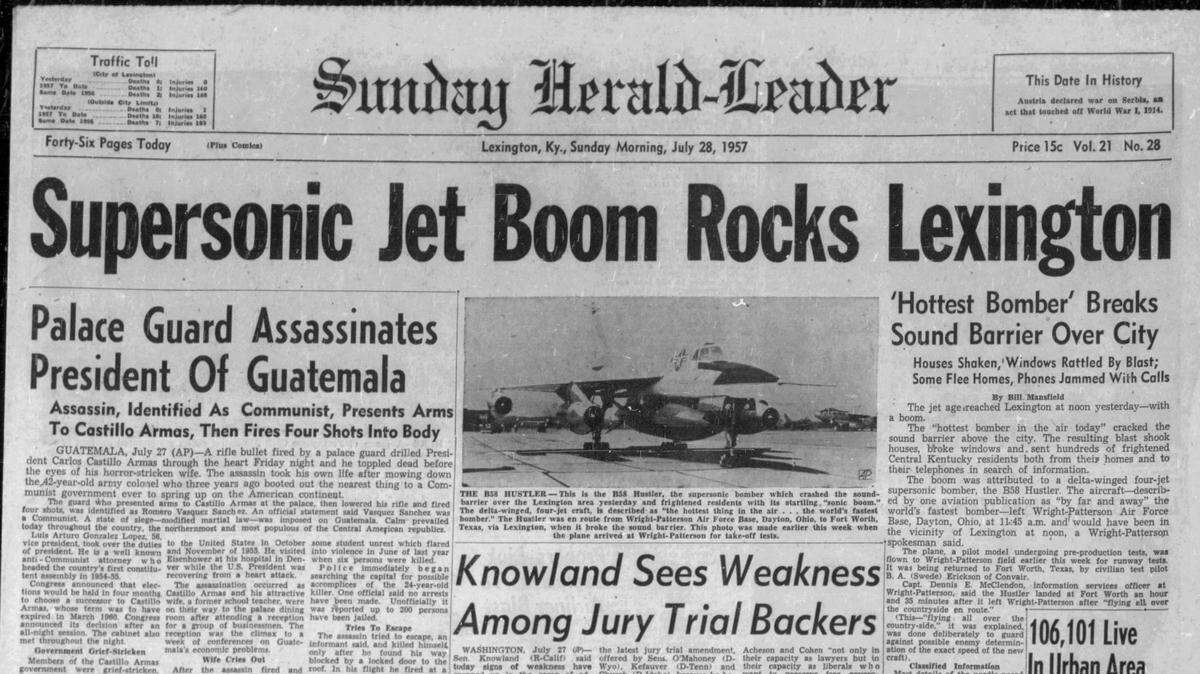
It was a boom that rattled houses and shook up the residents inside when a bomber broke the sound barrier over Lexington in 1957.
On July 27, 1957, a B58 Hustler bomber left Wright-Patterson Air Force Base in Dayton, Ohio around 11:45. By noon, it was over Lexington, traveling 145 miles in 15 minutes.
When it reached speeds over 767 miles per hour, it broke the sound barrier, causing a sonic boom. Residents flooded the phone lines with questions, according to a Lexington Herald news article.
As a plane moves faster than the sound waves its movement creates, the plane builds up an intense shock wave which creates sudden changes in air pressure, temperature and density, also known as Mach 1. When the waves reach the ground, it’s heard as one sudden, loud boom.
The pilot of the bomber told the Herald the flight was “routine,” but the average speed was “over the speed of sound.”
Chuck Yeager first broke the sound barrier 10 years earlier.
The West Virginia native was in the U.S. Army Air Forces, what would become the U.S. Air Force, at Muroc Army Air Field in California piloting the Bell Aircraft XS-1 over the Mojave desert. It wouldn’t be known to the public that he’d broken the sound barrier for another eight months.
By 1957, the Wright-Patterson Air Force Base was testing the B58 Hustler, the “hottest bomber in the air today,” U.S. Air Force Information Services Officer Capt. Dennis McClendon said at the time. The plane arrived at its destination — Fort Worth, Texas — an hour and 35 minutes after taking off.
In Lexington, the noise frightened many residents as their houses shook and windows rattled. Officials with the city said the phone lines were jammed as hundreds of people called to see what was happening.
“Lord, I just knowed it was the end of time,” Ruth Young told Herald reporter Bill Mansfield. Some called the paper to find out what was going on. Callers guessed a gas station had exploded, that dynamite had been used nearby or that a car had run into their house.
Police said for approximately 40 minutes, all of the phone lines to the police department were in continuous use. One caller even asked police if the boom signified a Russian attack.
“If there had been an emergency, we probably wouldn’t have been able to find out what it was,” one officer told the paper.
In downtown Lexington, businesses emptied as people ran into the street to find out what had happened.
“Everybody started running out of the stores to see what happened. In a matter of seconds, the streets were crammed full of people,” Patrolman Gene Haynes said. “Everybody was running every which way.”
Have a question or story idea related to Lexington’s 250-year history? Let us know at 250LexKy@gmail.com.
This story was originally published August 4, 2025 at 12:29 PM.