
History of Town Branch: Water was key to the early years of Lexington
Editor’s Note: As Lexington celebrates the 250th anniversary of its founding, the Herald-Leader and kentucky.com each day throughout 2025 will share interesting facts about our hometown. Compiled by Liz Carey, all are notable moments in the city’s history — some funny, some sad, others heartbreaking or celebratory, and some just downright strange.
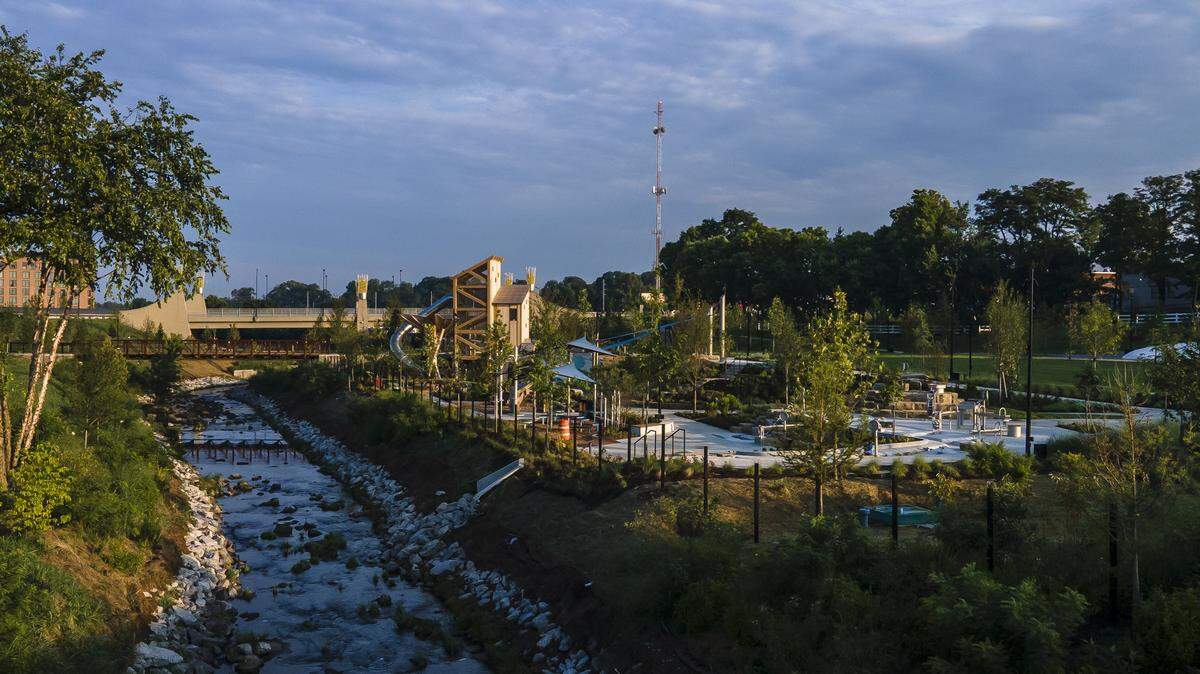
While the new Gatton Park opened this weekend on the banks of Town Branch, the area has been part of the city’s history since the beginning.
As settlers came to Kentucky looking for a place to call home, they set up camp in what is now McConnell Springs Park, according to a history of Town Branch written by former Lexington Herald-Leader Editor Tom Eblen.
The area near what is now High Street had a stream running through it, making it a natural choice for a place to start farming, raising livestock and the beginnings of a town.
For about four years, the settlers fought with Native Americans over the land, which had previously been their hunting grounds. By 1779, a group set out to establish a fort north of the Kentucky River.
There, along the banks of the Town Branch, they built a blockhouse on what is now the corner of Main and Mill Streets. Before long, a stockade went up to protect the blockhouse and some cabins, and Lexington became a settlement.
By 1782, the town had grown, and leaders petitioned the Virginia General Assembly (Kentucky wasn’t yet a state yet, and Lexington was part of the Virginia colony) to recognize the town.
Ten years later, when Kentucky became a state, the town served as the first state capital. It didn’t take long for the city to become an important part of the country’s expansion west, the last big town before the Mississippi River and home to education, trade, culture and industry.
The city leaders had laid out the street grid oriented along the banks of Town Branch. It is the reason, Eblen wrote, Lexington sits at “about a 45-degree angle, southeast to northwest.”
Town Branch led to a cholera outbreak
By 1806, the town had grown into a city, and a directory listed 301 houses, a college, several civic buildings and a public library, as well as plenty of businesses.
But houses bordered the creek and many emptied their bathrooms into it. The waterway flowed along what is now Midland Avenue, across Main Street and between Main and Vine to what is now Gatton Park.
Town leaders had forbidden people from fishing off the bridges spanning Town Branch, or from washing in any of the city’s waterways.
The banks of Town Branch were littered with leather tanneries, slaughterhouses, mills, brick and lumber yards, distilleries and factories, as well as homes and hotels.
The water quality declined. During heavy rains, privies overflowed into the water, and sometimes the water overflowed its banks.
In 1833, a cholera epidemic hit Lexington, blamed mostly on the wet days in the weeks before the first outbreak, leading to the water from Town Branch flooding into businesses and basements. That first epidemic killed some 500 of the city’s 7,000 residents, and another outbreak in 1849 killed another 345.
The epidemic caused city leaders to create a reservoir system to protect the water supply.
In 1885, the city dammed West Hickman Creek and implemented a piping system and a water purification system. But it didn’t really do much to tame Town Branch. For many years, the town’s trustees voted on plans to built canals around the water and keep it from flooding into the streets.
But the waterway wasn’t much more than a creek, and it was far too small for anything like a steamboat to come down. As the industrial age took over, the town moved away from using the steam and turned more to railroads and stagecoaches.
City leaders chartered the Lexington & Ohio Railroad, and laid tracks along Town Branch. Eventually a depot was built over the waterway, and passenger service on the railroad began. Then more railroads came with more lines along Town Branch.
For more than 100 years, until 1957, passenger trains ran in and out of Lexington.
In the late 1880s, Town Branch was where the city’s sewers emptied. Lexington newspapers called the waterway “a stream of almost living filth.”
Eventually, the creek was covered, but not much more was done. The sanitation issues remained and the neighborhoods that had grown up around the waterway disappeared to make way for more railroad tracks.
From the beginning of the 20th century, town officials knew Town Branch was a problem that needed to be dealt with. It continued to flood, and it continued to be a sanitation problem.
In 1934, federal money was used to address sewer lines and flooding. The widening of the Town Branch culvert kept the water from overflowing its banks, but didn’t do enough to address the water’s quality.
In 2007, the U.S. Environmental Protection Agency sued the city because of pollution in Town Branch and other streams, resulting in a $590 million upgrade to sewers and stormwater systems.
Now clean and uncovered near Rupp Arena, Town Branch continues to flow through the city, trickling water through Lexington’s next 250 years.
Have a question or story idea related to Lexington’s 250-year history? Let us know at 250LexKy@gmail.com.
This story was originally published August 25, 2025 at 1:32 PM.