
The legend of Cocaine Bear begins with a Lexington cop turned drug smuggler
Editor’s Note: As Lexington celebrates the 250th anniversary of its founding, the Herald-Leader and kentucky.com each day throughout 2025 will share interesting facts about our hometown. Compiled by Liz Carey, all are notable moments in the city’s history — some funny, some sad, others heartbreaking or celebratory, and some just downright strange.
The legend of the cocaine bear — the black bear who died after eating pounds of cocaine in Georgia — began with an infamous Lexington police officer who operated outside the law.
On the morning of Sept. 11, 1985, retired engineer Fred Myers woke up to find a body in his Knoxville, Tennessee, driveway. He also found a duffel bag filled with guns, knives, night vision goggles, $4,800 cash, gold and about 77 pounds of cocaine.
The man in the driveway was Andrew Thornton. Thornton had been a lawyer and police officer in Lexington. But at the end of his life, he was a drug smuggler who had tried to evade the police one last time.
Thornton’s parents owned Threave Main Stud in Bourbon County, and Thornton grew up in the horse racing industry. After attending Sayer School in Lexington, he went to St. Andrew Sewanee Military Academy when he was 14.
It was at Sewanee that he met Bradley Bryant, another connected Kentucky boy. The two became fast friends and after graduating, joined the Army together. Thornton trained to become a paratrooper but was injured in battle and returned home.
When Bryant’s tour was finished, he also returned to Lexington and the friends reconnected.
Thornton worked in his family’s horse business but was also parachuting and getting his pilot’s license. In 1968, he joined the Lexington Police Department.
At that time, President Lyndon Johnson was beginning America’s War on Drugs. In Lexington, police launched a special narcotics unit and Thornton joined.
There, he met Henry Vance, another charming Southern boy with a good family and better connections. Vance was the unit’s spokesperson, while Thornton went undercover to set up drug buys and gather intel.
The unit was given directions to get rid of drugs in Lexington at any cost, and worked with scant supervision.
It was during this time that Thornton and Vance began operating outside the law. Thornton turned to dealing drugs, stealing from the police evidence locker and keeping the profits.
Vance turned to illegal weapons sales, and Bryant began making connections with drug and weapons traffickers to grow their operation outside of Lexington.
Thornton and Bryant formed Executive Protection, a personal bodyguard service, in 1975 as a front to their illegal activities. They used their connections and reputations as law enforcement officers to cover up their illegal activities that they called “The Company.”
Bryant ran the business side of the operation, while Thornton ran logistics, renting airplanes to pick up and distribute drugs. Vance, now working in state government as an aide to legislators, was able to look out for any investigations.
For years, the dual purpose for the business worked. It wasn’t until Bryant tried to take things to the next level that it fall apart.
‘The Company’ began to fall apart
In 1978, Thornton and Bryant flew to Colombia to pick up 20,000 pounds of marijuana. Once the drugs were unloaded, Thornton had the plane flown to Louisville and abandoned.
The plan got the drugs into the country undetected, but airport personnel discovered the plane and called the police. Authorities found marijuana residue inside and a look into the plane’s records linked it back to Bryant.
Investigations into Bryant seemed to lead nowhere until January 1980, when a hotel maid in Philadelphia noticed the smell of marijuana coming from a room. When police investigated, they found Bryant gone but a ledger, a telephone scrambling device, $25,000 in cash and a lease to a warehouse in Lexington left behind.
Police tracked Bryant down and arrested him at the Philadelphia airport. The Philly police turned the lease over to Lexington officials, who raided the warehouse.
Inside, they found enough weapons to supply a small army, 25,000 rounds of ammunition, an anti-aircraft gun and military-grade night vision goggles.
After standing trial, Bryant was acquitted. He turned around and tried to sell 800 pounds of marijuana to a DEA agent in Illinois. He pleaded guilty in that case and was sentenced to 15 years in prison.
Meanwhile, another associate of “The Company,” Mike Kelly, was facing charges in Florida for importing marijuana.
Vance, who by now was an administration assistant to Kentucky Gov. John Y. Brown Jr., feared he’d be associated with the drug smuggling ring during Kelly’s trial. He convinced Kelly’s wife, Bonnie, to travel to Florida and kill the prosecutor in the case, Assistant State Attorney Gene Berry.
Bonnie Kelly did as she was told. With a gun and alibi supplied by Vance, she went for a run in Berry’s neighborhood, rang his doorbell and shot him three times when he answered the door. She was convicted and sentenced to life in prison.
Vance and Thornton were breathing easier, thinking they’d gotten away with everything. But Kentucky law enforcement officers wanted to hear what Bonnie Kelly had to say. She told them everything — from Vance’s role in the murder to Thornton’s role in the drug smuggling operation.
Vance was arrested, tried, convicted and sentenced to 15 years in prison.
Thornton evaded police for more than six months
Thornton he evaded police by flying around the country for more than six months. He was eventually arrested during a fueling stop in North Carolina, and was found guilty on drug charges and spent five months in prison.
Jail time didn’t stop him. By 1985, he’d formulated plans to fly to Colombia and pick up 400 kilograms of cocaine.
He and an associate loaded nine duffel bags of cocaine — about 75 pounds in each — onto the plane and began the flight home. In an effort to outsmart authorities, he decided to dump the cocaine over the Chattahoochee National Forest.
Thornton strapped one duffel bag full of drugs and another full of survival gear onto his body. With the plane on autopilot, he jumped.
It’s not clear what happened next, but ultimately, Thornton fell to his death and landed in Myers’ driveway. The plane crashed about 50 miles away in North Carolina. Officials said they found three duffle bags filled with cocaine dangling from a tree in North Georgia a few days later.
Thornton’s death made headlines across the country. His funeral in Paris was attended by some of the most influential people at the time in Lexington.
The legend of cocaine bear
What happened after got roughly three sentences of coverage in the New York Times:
“BLUE RIDGE, Ga. — A 175-pound black bear apparently died of an overdose of cocaine after discovering a batch of the drug, the Georgia Bureau of Investigation said today. The cocaine was apparently dropped from a plane piloted by Andrew Thornton, a convicted drug smuggler who died Sept. 11 in Knoxville, Tenn., because he was carrying too heavy a load while parachuting. The bureau said the bear was found Friday in northern Georgia among 40 opened plastic containers with traces of cocaine.”
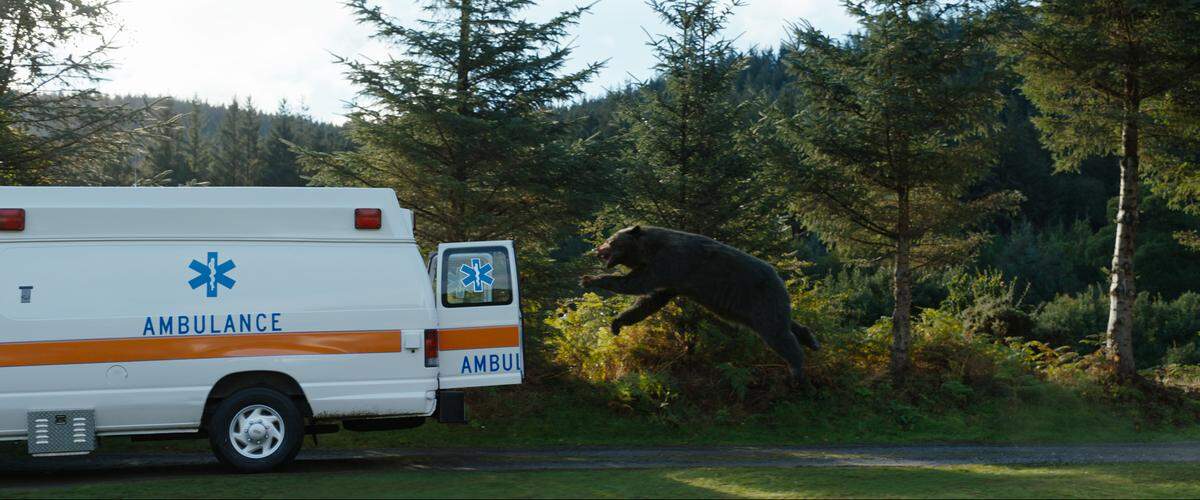
The bear’s death would go on to give rise to the legend of Cocaine Bear, made famous by the movie of the same name.
Kentucky for Kentucky claims to have the remains of the bear that ate the cocaine on display in their shop on Winchester Road. But Fran Wiley, who worked the case for the Georgia Bureau of Investigation, said the carcass was in such poor condition, there would not have been much to preserve with taxidermy.
In 2023, A Herald-Leader reporter was unable to verify Kentucky for Kentucky’s story about obtaining the bear.
Have a question or story idea related to Lexington’s 250-year history? Let us know at 250LexKy@gmail.com.
This story was originally published October 6, 2025 at 11:27 AM.