
Remembering how far we’ve come, how far we have to go. Honoring MLK’s legacy
Despite frigid temperatures and snow, hundreds gathered at the Central Bank Center Monday to honor the legacy of the Rev. Dr. Martin Luther King Jr.
One of the many events that also celebrate Lexington’s 250th anniversary, the 31st-annual Unity Celebration Breakfast and the annual Freedom March and MLK Celebration program reflected on some of the city’s and state’s strides in Black history.
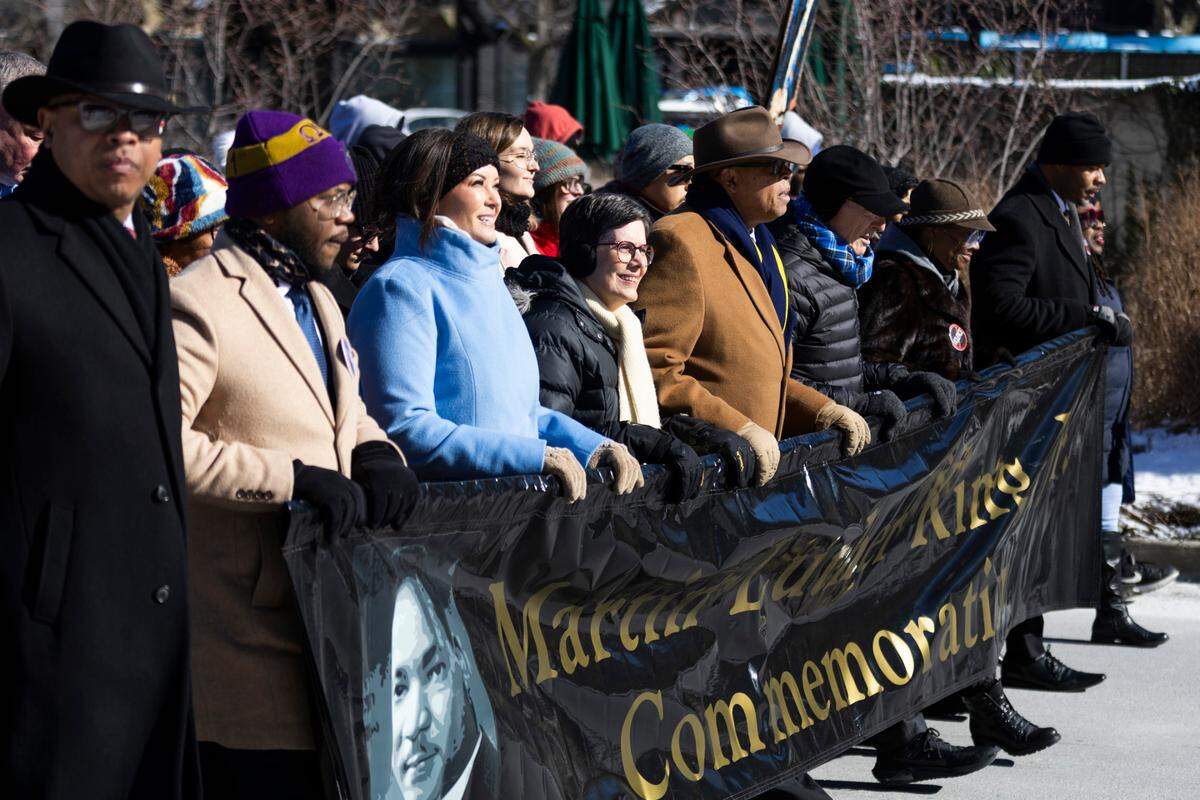
“Each year we come together for this program to celebrate Dr. King – his life, his work, his commitment to equality, freedom and justice. This year is our city’s 250th birthday and all year long we are looking at our past, we are celebrating our present and we are looking boldly into our future for our great city,” Mayor Linda Gorton said.
“Once again, we want to remember how far we’ve come and how far we have to go to ensure everyone feels welcome here. We’ve made progress in working toward Dr. King’s dream and will continue to focus on people, lifting people up to be the best version of themselves that they can be.”

Dr. Eli Caputo, president of the University of Kentucky, recalled how different life is now compared to his childhood growing up in Montgomery, Alabama. He also noted the work of one man, Lyman Johnson, and how his attendance at UK in 1949 effectively integrated UK and ended the day law in Kentucky.
That legislation was introduced on Jan. 12, 1094, by Rep. Carl Day of Breathitt County to “prohibit white and colored persons from attending the same school.”
The bill passed 73-5 in the Kentucky House and 28-5 in the Senate. Aimed at only one school – Berea College, which had integrated in 1855 – the bill also prohibited individual schools from operating separate Black and white branches within 25 miles of each other.
After it passed, Berea was criminally convicted and fined $1,000 – the equivalent of more than $35,000 in 2025 dollars. The court of appeals in Kentucky denied the school’s appeal, saying it agreed with the general assembly’s purpose in passing the law - preventing racial violence and interracial marriage.
In the 1940s, a group of educators, including Johnson, was working to integrate UK. Failing to find any high school students willing to take the risk, in 1948, Johnson applied to UK as a graduate student.
His application was rejected, and he sued the university for admittance.
The next year, a judge ruled in his favor, effectively overturning the Day Law.
That summer, according to the university, he and 29 other Black students enrolled at UK. While Johnson did not graduate from UK, he later stood in front of the board of trustees at the University of Louisville and advocated for real change.
“We are fresh from victory at Lexington. You can read the handwriting on the wall and open these doors now, or you can be made to do it, with humiliation,” he reportedly told them.
Louisville would go on to integrate in 1950. And in 1954, the U.S. Supreme Court would ultimately overturn Kentucky’s Day Law with its decision in the Brown v. Board of Education of Topeka, Kansas, case.
Gorton said Lexington must continue working for King’s legacy.
“I want to thank each and every one of you for your commitment to remembering and celebrating the life of Dr Martin Luther King, Jr, his dream of justice, his dream of community and opportunity, and certainly, his dream of fairness for all people,” she said.
“As we move forward, let us remember the works and the words of Dr King and keep them alive in our hearts and in our city,” she said.
“The time is always right to do what is right.”
During the afternoon program, emcee Christian Motley said it is still time for Lexingtonians to honor Dr. King’s legacy through their work and actions.
“In Washington right now, a great many of our fellow Americans are witnessing the peaceful transfer of power. That’s a good thing,” he said.
“I’m here to tell you that if you voted, whether your candidate won or lost on election day, your work is not done. Contrary to popular belief, all power does not live in Washington, DC. In fact, it’s on days like this where we evoke the power that lives in every individual in this room.”
Motley added: “It’s on days like this, we throw off a politics that divides us and too often pits neighbor against neighbor, sometimes parent against child, and all too often, Democrats against Republicans. Today, we can aspire to a more compassionate, a more humane, a more just, a more perfect union.”
This story was originally published January 21, 2025 at 7:30 AM.