Botched Lexington police no-knock raid cost city thousands, altered rules. Now what?
David Rice was sitting on his couch in his living room in a neighborhood off Harrodsburg Road shortly after 9:45 p.m. when his front door burst open.
Two men carrying shields entered his home and yelled: “Police, search warrant” and “Get on the ground.”
Stunned, Rice said he initially didn’t comply and approached the officers. He thought he was being robbed. One Lexington officer knocked him to the ground using his shield while a second officer handcuffed him.
Other officers ran upstairs, where two members of Rice’s family were in bed. One family member called 911. They too thought the Rice home was being robbed, according to documents and recordings obtained by the Lexington Herald-Leader.
“Someone was at the house,” the caller told the dispatcher. “They are crying, no longer speaking,” the dispatcher said, according to an audio recording.
But shortly afterward, dispatch received another call. Disregard the previous 911 call. Police were already on the scene.
Police weren’t supposed to be at the Rice home that December night in 2015. It was a costly mistake.
Detective Chris Pope, who used a ram to break down the Rice family’s front door, was the first to realize police had served a no-knock warrant at the wrong house.
The home police intended to raid for suspected narcotics was nearly identical in layout and design. The homes were in the same neighborhood.
In his memo after the incident, Pope said no children lived in the intended target home. In the Rices’ front room was a small child’s chair.
There were other clues that police had busted the door of an innocent family’s home.
“The house also appeared to be well kept,” Pope wrote in the memo. “I went back to the front door, which was now open and illuminated by their interior lights and noticed ... the color of the front door.”
Pope went outside, looked at the street sign and realized police had made an error.
Rice was released from the handcuffs. The two family members upstairs were never restrained by officers. One was a minor, according to the reports.
There was another problem. The door to the home would not shut. Police had damaged the frame.
Police officers went to Meijer and bought a security bar so the Rice family could secure the home for the night, according to memos from officers there that night.
Clark Batten, a lawyer for the Rice family, said the family did not want to comment. It has been five years since the incident, and they were trying to put that night behind them.
Lexington police: No-knocks should still be used
Lexington police insist that no-knock warrants — that allow police to enter a residence without knocking or announcing — are used sparingly and are thoroughly vetted before they are carried out. Police Chief Lawrence Weathers said in a June presentation before the Lexington-Fayette Urban County Council that no-knock warrants had been used four times in the last five years.
But Weathers, the city and other police officers have not publicly acknowledged the botched no-knock raid at the Rice home. And it was that 2015 wrong-door no-knock raid that changed how Lexington police conduct those warrants, police officials confirmed. Weathers was not police chief at the time.
According to settlement documents, the city of Lexington paid the Rice family $100,000 for damages. The case was settled out of court in 2017 and was not publicly disclosed. No body camera video of the incident is available. Lexington police did not get body cameras until late 2016, more than six months after the wrong-door raid at the Rice home.
The settlement was listed in documents provided to a subcommittee of Mayor Linda Gorton’s Commission on Racial Justice and Equality. The Herald-Leader obtained the documents through an Open Records Act request.
One of the commission’s recommendations to address inequality in Lexington and increase police transparency is a ban no-knock warrants.
Gorton issued a moratorium on no-knocks in June, but Lexington has not prohibited the practice. The police can use one — with Gorton’s permission— if it’s a matter of life or death.
The council will hear more details about the commission’s recommendations. at a meeting next week. Gorton has said her staff is looking at the group’s more than 54 recommendations to determine what needs to be addressed by the council. Separately, a council committee is also considering no-knock warrants, said Councilman James Brown.
“I am not familiar with the out-of-court settlement,” Brown said of the Rice case. The council may have been made aware of it when the case was settled in 2017, said Brown, who has been one of the more vocal council members on police-related transparency issues.
“I don’t think there is a collective opinion on council on no-knocks yet,” Brown said. “I’m leaning more towards banning no-knocks. I know the police have argued that it’s a tool they need in their tool belt. If it’s a life or death situation, I believe an officer has discretion to act (without a no-knock warrant).”
Rev. Clark Williams, one of several Black faith leaders pushing the city to ban no-knock warrants, said he was not aware of the botched 2015 no-knock raid. His group wants the city to end the practice because the risk of injury or loss of life outweighs the usefulness of no-knocks, Williams said.
“If someone busts into my home unannounced as a homeowner, I’m always going to feel the need to protect myself and the other inhabitants in my home,” Williams said.
Other cities have already moved to ban the practice.
Louisville banned no-knock warrants earlier this summer after the death of Breonna Taylor during the execution of a no-knock warrant in March. Virginia recently became the third state to ban no-knock warrants. Florida and Oregon already have statewide prohibitions. More cities and states are weighing similar bans after Taylor’s high-profile death.
Rep. Attica Scott, D-Louisville, has pre-filed legislation banning no-knock warrants statewide. But the Kentucky Fraternal Order of Police has spoken out against the bill calling it “an attack and slap in the face” to all cops in Kentucky in a Facebook post.
Because of the incident at the Rice home, Lexington policies were changed to require no-knock warrant sign-offs from multiple supervisors, said Brenna Angel, a police department spokeswoman. In addition, the department’s Emergency Response Unit, a trained tactical unit, is now the only unit authorized to serve no-knock warrants.
In June, the department added another step — the police chief must also approve all applications for no-knock warrants before officers take the warrant to a judge who must sign off on all warrants, including no-knock warrants.
Officers must also have continuous pre-search surveillance of the property and have visual and verbal confirmation of the street and address, Angel said.
How a raid went wrong
Officers who requested the no-knock warrant — that resulted in the wrongful raid on the Rices’ home — did not surveilthe raid’s target house during the day, according to written memos of officers involved.
Detective Mark Evans, who was the lead detective, surveyed the intended home the previous night but not during the day. The target address was redacted or blacked out in all documents released to the Herald-Leader.
Evans used a Fayette County Property Value Administration photo of the home officers wanted. Evans said in documents that a more senior detective had told him the photo was acceptable. Detective Danny Page, in a memo, said he thought Evans had already completed surveillance on the home and was using the photo to make sure that the team serving the warrant knew where the numbers on the home were located.
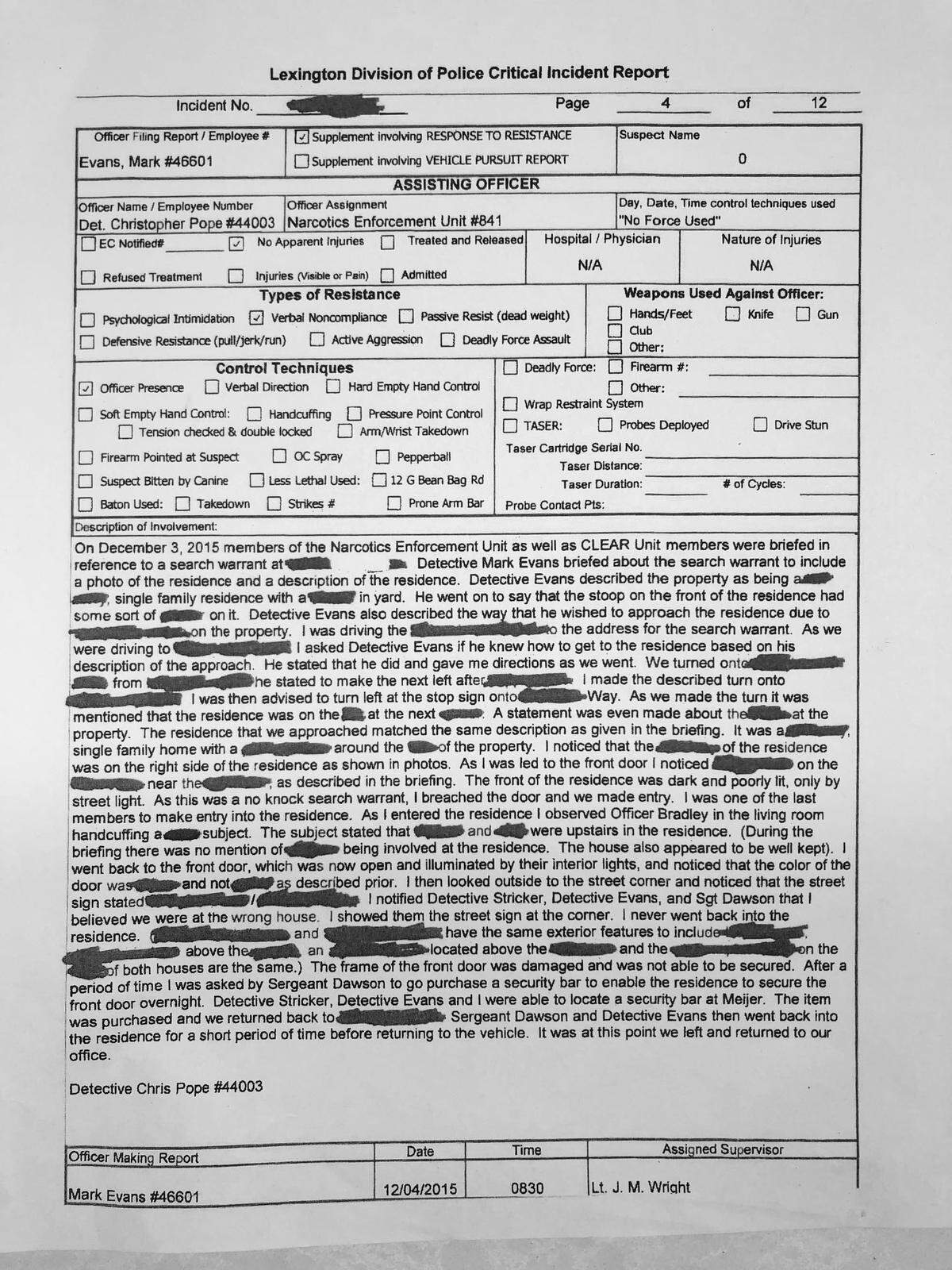
Complicating matters that night was that the door to the Rice home was not well lit. That meant officers could not see the door’s color, which was a different color than the door of the raid’s intended target.
Officers also approached the Rice house from the rear. But it’s still not clear how officers ended up two blocks away from the right location, according to documents.
Evans received an 80-hour unpaid suspension and retraining after the incident, according to documents obtained by the Herald-Leader.
Louisville sued over botched no-knock raids
A common factor when Kentucky raids go wrong: Inaccurate or inadequate information.
There are lingering questions about whether police knew who was in the apartment with Breonna Taylor when officers served that no-knock warrant at her Louisville apartment in March.
Sgt. Jonathan Mattingly, one of three officers involved in serving the search warrant, said in a statement to the police’s public integrity unit that Taylor was a “soft target.” Mattingly said he was not told before the raid that inside there was another
person — Kenneth Walker, Taylor’s boyfriend and a registered gun owner. Walker has said he shot at the officers, striking Mattingly in the leg, because he believed it was a home invasion. Officers returned fire, killing Taylor.
Louisville detective Joshua Jaynes wrote in the affidavit seeking the warrant that he had verified through a U.S. Postal Inspector that suspected drug dealer Jamarcus Glover, Taylor’s ex-boyfriend, has been receiving packages at Taylor’s home. A postal inspector disputed Jaynes’ claim, according to WDRB in Louisville.
In early October, Louisville agreed to pay Taylor’s family $12 million and enact several reforms as part of a settlement of a civil lawsuit brought by Taylor’s family. Meanwhile, Mattingly has filed a lawsuit against Walker for emotional distress, battery and assault.
The Taylor case was not the first time Louisville police were accused of botching a no-knock warrant.
Louisville police also did not do their due diligence when executing a no-knock search warrant at the home of Mario Daugherty and Ashlea Burr in 2018, according to a 2019 lawsuit filed against police and the Louisville Metro Government.
In October 2018, 18 members of a Louisville SWAT team smashed through the rental home’s front door, used exploding materials, and drew assault rifles on Daugherty, Burr and their three minor children. One of their daughters, believing the home was being robbed, ran and tried to climb the fence to get to her grandmother’s home next door. Police chased her, drew assault rifles on her, and told her to get down, the lawsuit alleges.
The lawsuit alleges police did not have probable cause for the search. In an affidavit supporting the search warrant, a Louisville officer said a black man, whose name was not Daugherty, was known to be growing marijuana in the house. The man had a white girlfriend named Holly, who owned the home.
A search of the Jefferson County Property Value Administration records would have shown a man owned the house, the lawsuit alleges. The lawsuit alleges the other information the police used as probable cause for the search warrant was the smell of marijuana coming from the home on two occasions. No one was charged after the raid.
“It was the correct address, but the police had no idea who lived there and lacked probable cause to obtain a warrant, much less a warrant for the use of 18 SWAT team members with assault rifles,” said Joshua Rose, a lawyer who represents the Daugherty and Burr family.
The lawsuit, which has been moved to federal court, is pending. Louisville Metro Police and the officers named in the lawsuit have asked the judge to dismiss the case.
Wrong-door raids across the country
How often do police raid the wrong house? Those numbers are difficult to come by.
But it’s happened in cities across the country. And some of those wrong-door no-knocks have resulted in death.
Acting on a bad tip from an informant, New York City police mistakenly raided the home of Alberta Spruill, a 57‐year‐old city worker, who died of a heart attack in the middle of the raid. Spruill’s 2003 death spurred cries for reform in how no-knock warrants were served in America’s largest city.
In February 2018, officers from a Georgia sheriff’s department raided the home of an elderly Henry County man, using a battering ram to knock down his door and a “flash-bang” grenade. They had the wrong man and the wrong house. The intended target was the house next door, according to court documents.
In 2014, the American Civil Liberties Union analyzed 800 SWAT raids from 2011-2012. Of those raids, they found the vast majority — 62 percent — were search warrants for suspected drug use. And the vast majority of the targets of those drug raids were Black and Latino residents, the ACLU study found.
.
And many times, police departments deny requests for warrant information.
The ACLU’s data was collected from 20 law enforcement agencies. The ACLU filed public records requests with more than 255 law enforcement agencies; 114 agencies denied the request, either in full or in part, according to the report.
How other Lexington no-knock warrants were used
Through multiple Open Records Act requests, the Herald-Leader requested all no-knock search warrants served by Lexington police from 2016 to the present. The police at first denied the request, saying that it did not file those warrants in a way that made it easy for no-knock warrants to be located. After receiving a letter from the Herald-Leader’s lawyer, the police reconsidered and provided three highly redacted no-knock search warrants.
All three were for narcotics cases — or people suspected of dealing drugs. In all three of those raids, police found contraband of some kind — either weapons, drugs or both. None was for a hostage situation, kidnapping or immediate danger to someone’s life, all examples police have used in the past to justify continued use of no-knock warrants.
Lexington police say those no-knock warrants were life or death situations — someone inside the home either was a registered gun owner, was known to have guns or was a known gang member.
“All of the affidavits speak of armed individuals being observed inside of the houses,” said Angel. “The utilization of a no-knock warrant allowed for greater safety of both the officers executing the warrant and any individuals located inside.”
The department wants no-knock search warrants available for use in limited situations, Angel said.
” The proper application and execution of a no-knock search warrant, as opposed to a knock and announce search warrant, provides an additional level of safety for both individuals inside the location and the officers performing the execution.”
This story was originally published November 13, 2020 at 11:50 AM.