
Mom sues Lexington hospital, specialist alleging he used his sperm to impregnate her
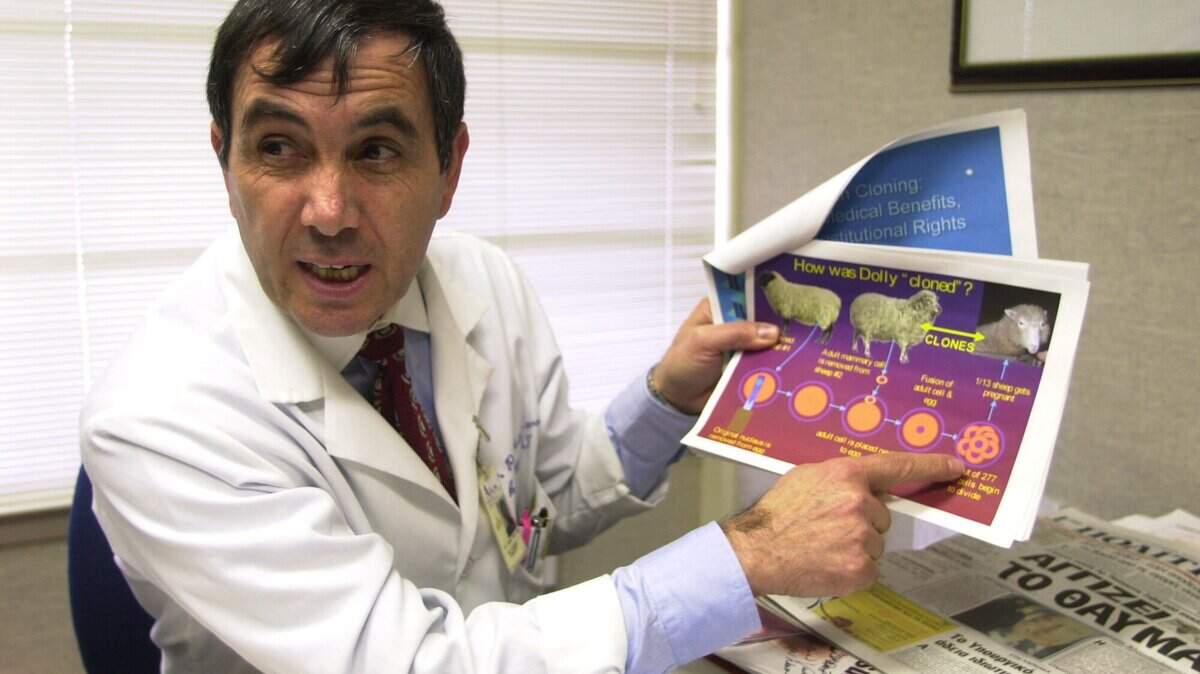
A mother is suing a Lexington hospital and a fertility specialist after recent ancestry DNA and follow-up tests, she says, revealed he was the biological father of her daughter and used his sperm without consent.
In the lawsuit against Panayiotis Michael Zavos and Baptist Health Lexington, Diane White of Paris said she was referred to Zavos for help with in vitro fertilization in the 1980s while he had an office at the hospital. White acknowledged in her suit, filed in late June, that she has to overcome a significant legal problem: the statute of limitations that imposes a deadline of sorts for filing a lawsuit.
Zavos, who became notorious for claiming in the early 2000s that he cloned a human embryo and implanted it into someone outside the United States, could not be reached for comment, and he hasn’t yet filed a response to the accusations in court.
Baptist Health spokeswoman Ruth Ann Childers said in a statement Tuesday that for about 10 years, Zavos and Central Baptist Hospital had a contract under which Zavos provided andrology services to hospital patients. Andrology addresses male reproductive issues.
On Feb. 8, 1994, “the hospital terminated the contract based on Zavos’ failure to abide by the terms of the contract in addition to the policies, procedures and rules of the hospital,” Childers wrote.
She said that “if the allegations in this complaint are determined to be true,” the hospital was not aware of Zavos’ conduct and would not have sanctioned it.
In the late 1980s, Zavos allegedly told White the sperm was donated by a 24-year-old University of Kentucky medical student after promising to match the mother’s eye, skin and hair color, according to the court records.
Zavos allegedly told White the medical student was “blue eyed and blonde haired with Nordic features” similar to White’s, the lawsuit said. She never met the donor.
White said she was given a vial of sperm in early November 1988 to take to her gynecologist Dr. Preston Nunnelley for the in vitro procedure, but a pregnancy wasn’t produced, according to the court record. A repeat of the same process occurred on Jan. 9 and Jan. 11, 1989, and White became pregnant.
When the baby girl was born in October 1989, she had “dark hair and olive skin and had no Nordic features,” according to the suit. Because of some medical concerns, White telephoned Zavos to ask about the donor’s medical history. “Zavos sounded very nervous and stated that none of his donors had any medical issues.”
Nearly 30 years later, White’s daughter had a standard ancestry DNA test, which confirmed she had no Nordic, Scandinavian or other light-skinned ancestry, the lawsuit maintains.
A DNA test showed “beyond any reasonable doubt that ... Zavos is the father of Mrs. White’s child,” according to the lawsuit.
White’s attorney argued the statute of limitations doesn’t apply because the lawsuit was filed within a year of the confirmation DNA test allegedly showing Zavos to be the biological father.
Furthermore, the paternity was concealed, White argued in the lawsuit. She contended she believed Zavos was a practicing physician when he wasn’t licensed, the lawsuit said.
White said she would never have allowed Zavos to fertilize her eggs.
Zavos committed fraud, White alleged in the suit. “Baptist Health either knew or should have known that ... Zavos used his own sperm.” If it didn’t know, the hospital is still liable because it did “not have in place a proper protocol or procedure for the identification of sperm collected on its premises and to regulate the use of that sperm.”
White is seeking an unspecified amount of money for damages.
Others in Kentucky and U.S. medical services have faced similar accusations.
A former University of Louisville Obstetrics and Gynecology department chairman, Dr. Marvin Yussman, was accused of fathering a woman now in her 40s, the Courier-Journal reported in June. Erin Crowder said she learned Yussman was her father when she used an Ancestry.com genetic test and she complained to the Kentucky board that licenses doctors, the Courier-Journal reported.
Yussman said he used his sperm only on “rare occasions when the donor didn’t show up,” the Courier-Journal reported. The University of Louisville said Yussman retired when confronted with the allegation.
According to Medscape, about two dozen U.S. physicians have been identified as “having used their own sperm without telling their patients.” It’s an ethical violation, said Sigal Klipstein, the chair of the ethics committee of the American Society for Reproductive Medicine. “I think what happened is a crime,” Klipstein told Medscape.
This story was originally published July 14, 2021 at 7:40 AM.